



Customer retention is not a single campaign, discount, or loyalty perk.
For multi-location service brands, retention is an operating system. It is the way a brand remembers clients, prompts the next visit, rewards repeat behavior, follows up after appointments, measures satisfaction, and gives every location the tools to keep clients engaged.
That matters because service businesses do not grow only by filling more first-time appointments. They grow when more clients come back, book the next service, join a membership, redeem a package, refer a friend, leave feedback, and build a habit with the brand.
At one location, a strong manager may be able to spot those patterns manually. Across 10, 50, or 100 locations, retention has to be designed into the system.
Why customer retention matters
Retention is one of the most powerful growth levers because the relationship already exists.
Harvard Business Review notes that acquiring a new customer can be five to 25 times more expensive than retaining an existing one. It also cites Frederick Reichheld of Bain & Company on research showing that increasing customer retention rates by 5% can increase profits by 25% to 95% (Harvard Business Review).
The exact impact will vary by brand, service category, margin, and visit frequency. But the principle is consistent: when more of the right customers come back, the business has more chances to grow lifetime value without rebuilding demand from scratch.
For appointment-based service brands, that value shows up in practical ways. A returning salon client may book color maintenance every few weeks. A spa client may buy a package and return for a planned series. A pet care customer may need routine services on a predictable cadence. A barbershop member may visit every month because the benefit is already built into their routine.
Retention also makes planning easier. More repeat visits can support steadier staff schedules, better inventory decisions, smarter marketing spend, and more predictable local performance.
Why retention gets harder as brands scale
Most service brands know retention matters. The challenge is making it consistent across locations.
Harvard Business School Online explains that customer experience management can improve satisfaction, trust, loyalty, and retention. Poor customer experience management can reduce retention, referrals, and sales (Harvard Business School Online).
That is especially important for multi-location brands because the experience is delivered locally. The brand can set the promise, but clients experience that promise through each appointment, front desk interaction, reminder, checkout flow, follow-up message, and service recovery moment.
As the business grows, retention can break down in several ways:
- Client records live in separate systems or are not used consistently.
- Rebooking depends on each staff member remembering to ask.
- Memberships, packages, loyalty rewards, and referrals are hard to track across locations.
- Follow-up messages are inconsistent or too generic.
- Leaders cannot easily see which locations are losing repeat clients.
- Local teams do not have the same playbook for bringing clients back.
The fix is not more manual effort. The fix is a retention system that connects operations, marketing, and reporting.
Build one client view across the brand
Retention starts with remembering the client.
A strong retention system should help the brand understand the full client relationship. That includes what the client booked, which location they visit, what they usually buy, and whether they are a member. It also includes unused package value, visit frequency, feedback, and when they may be due for another visit.
That shared view matters because personalization gets harder at scale. A client may book at one location, redeem a benefit at another, and expect the brand to recognize them in both places. If each location sees only part of the relationship, the experience can feel fragmented.
The goal is not to make every location identical in a robotic way. The goal is to give every location the same foundation, so teams can deliver a consistent brand experience while still responding to individual client needs.
Harvard Business School Online describes this balance as standardization and customization: standardization supports consistent quality, while customization helps service teams meet individual customer needs (Harvard Business School Online).
For service brands, that balance is the heart of retention. The brand standard keeps the experience dependable. The client history makes the experience feel personal.
Make rebooking the default
Many retention problems begin with a gap between visits.
A client has a great appointment, leaves happy, and intends to return. But no one prompts the next booking. The client gets busy. The usual cadence slips. By the time the brand reaches out, the client may have drifted.
Rebooking should not depend on memory. It should be part of the appointment flow.
For a salon, that might mean prompting a color client to book the next maintenance visit before leaving. For a spa or wellness brand, it might mean recommending the next visit in a package or series. For pet care, it might mean reminding clients when routine services are due again. For barbershops, it might mean making the monthly visit simple enough to become automatic.
The strongest rebooking systems are helpful, not pushy. They answer a client’s natural next question: “When should I come back?”
That means the message should match the service cadence. A haircut, facial, grooming visit, package service, and membership benefit may all need different timing. The more the brand understands the client’s service history, the easier it is to prompt the next visit at the right moment.
Use memberships and packages to create a reason to return
Memberships and packages can turn retention from a hope into a structure.
Instead of waiting for clients to remember the brand, a membership gives them a built-in reason to return. A package does something similar by giving clients prepaid value, a planned series, or a bundled experience that encourages follow-through.
MyTime supports configurable memberships for franchise and multichain requirements. It also supports package tracking and redemptions, plus gift card selling, reloading, and tracking across in-store, online, and guest app channels (MyTime memberships, packages, and gift cards).
Memberships can enhance client loyalty, increase average order value, create predictable revenue streams, and encourage repeat visits (MyTime memberships, packages, and gift cards).
The key is designing memberships around real client behavior. A program should not exist only because recurring revenue sounds attractive. It should match the services clients already need, the cadence at which they return, the benefits they value, and the way locations can deliver the experience consistently.
For example:
- A salon brand may design a membership around blowouts, color maintenance, or recurring retail perks.
- A spa brand may package services into a series that encourages clients to complete the full experience.
- A pet care brand may build routine care reminders around the services clients need throughout the year.
→ Retention improves when the client has a clear reason to come back and the brand has a clear system for tracking the value.
Reward behavior with loyalty, not blanket discounts
Loyalty should not be a race to give away margin.
For multi-location service brands, a strong loyalty program rewards the behaviors the brand wants to grow: repeat visits, higher-value services, product purchases, package engagement, referrals, or cross-location activity.
MyTime’s loyalty program allows brands to create custom rewards, track client points, automate client communication, and support in-store and online point redemption (MyTime client loyalty program).
MyTime also supports loyalty capabilities that work across locations. These include franchise-wide loyalty tracking, flexible earning rules for services and products, and client visibility into balances and activity. Staff can apply points at checkout, and leaders can track loyalty-driven revenue (MyTime loyalty article).
That matters because clients should not have to understand the brand’s internal structure. If they earn rewards at one location, the experience should still feel clear and trustworthy when they return, redeem, or book elsewhere in the network.
The best loyalty programs are easy to explain:
- What earns points or credit?
- What can clients redeem?
- Where can they see their balance?
- How does staff apply rewards?
- How does leadership measure whether the program is working?
If those answers are unclear, loyalty can become another operational burden. If they are clear, loyalty becomes a reason to keep choosing the brand.
Turn happy clients into advocates
Retention and referrals work together.
A retained client has more experience with the brand, more trust, and more reasons to recommend it. But referral growth still needs structure. Clients need to know the program exists, understand the incentive, and have an easy way to share.
The British Franchise Association recommends proactive communication and meaningful loyalty rewards as part of franchise customer retention. It also recommends referral programs that reward word-of-mouth recommendations (British Franchise Association).
MyTime supports configurable referral rewards, automated thank-you messages, referral link sharing, email invitations, social sharing, and referral credit tracking in client profiles. Referral reporting includes Referral History and Top Referrers (MyTime client referral program).
For franchise and multi-location brands, tracking is critical. Without it, referrals can become a front-desk favor, a spreadsheet, or a local-only promotion that leadership cannot measure. With the right structure, referrals become a repeatable growth loop.
→ Retention creates the trust. A referral system gives that trust a path to travel.
To go deeper, read How Franchise Brands Build Predictable Revenue with Memberships, Loyalty, and Referrals.
Automate lifecycle outreach and win-back
Clients rarely announce that they are drifting away.
They simply stop booking as often. They skip the next visit. They stop redeeming package value. They do not renew the membership. They ignore a reminder. They move from “regular” to “inactive” without a clear moment of churn.
That is why lifecycle outreach matters. A brand needs timely, relevant prompts before the relationship goes cold.
Useful lifecycle messages can include:
- Appointment confirmations and reminders
- Post-visit thank-you messages
- Rebooking prompts based on service cadence
- Package or membership benefit reminders
- Review requests and satisfaction follow-up
- Win-back messages for clients who have not returned
- Referral invitations for satisfied clients
MyTime includes retention-related capabilities such as automated reminders and confirmations, NPS collection, automated review requests, SMS and email campaigns, and campaign reporting with revenue attribution. Premier also includes AI-powered retention and win-back campaigns (MyTime pricing packages).
The best automated outreach still feels human because it is tied to the client’s actual relationship with the brand. A reminder about an unused package benefit is useful. A rebooking prompt after a service interval is useful. A win-back message after a long gap can be useful if it gives the client a simple path back.
Automation should not replace service. It should make the service relationship easier to maintain.
Measure retention across the network
Retention cannot improve if leaders cannot see where it is breaking.
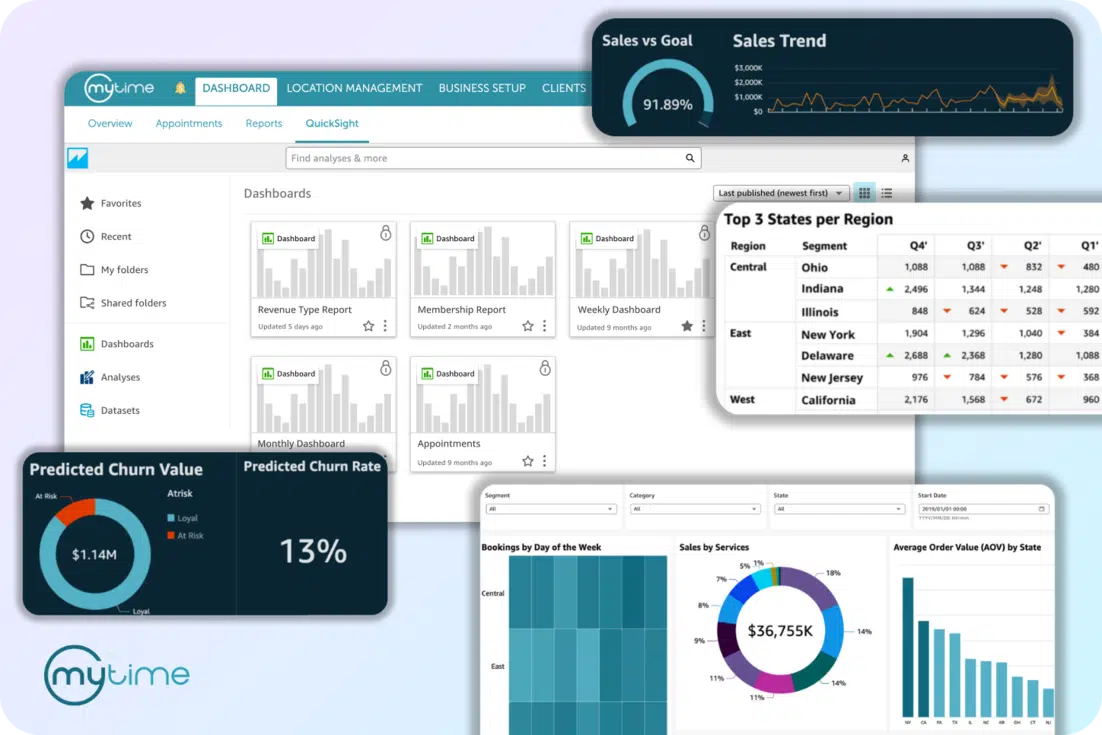
At the brand level, leaders need a clear view of customer behavior across the network. At the location level, operators need to know which actions are helping clients return.
Useful retention metrics include:
- Customer retention rate
- Repeat visit rate
- First-to-second visit conversion
- Average visit frequency
- Membership attach rate
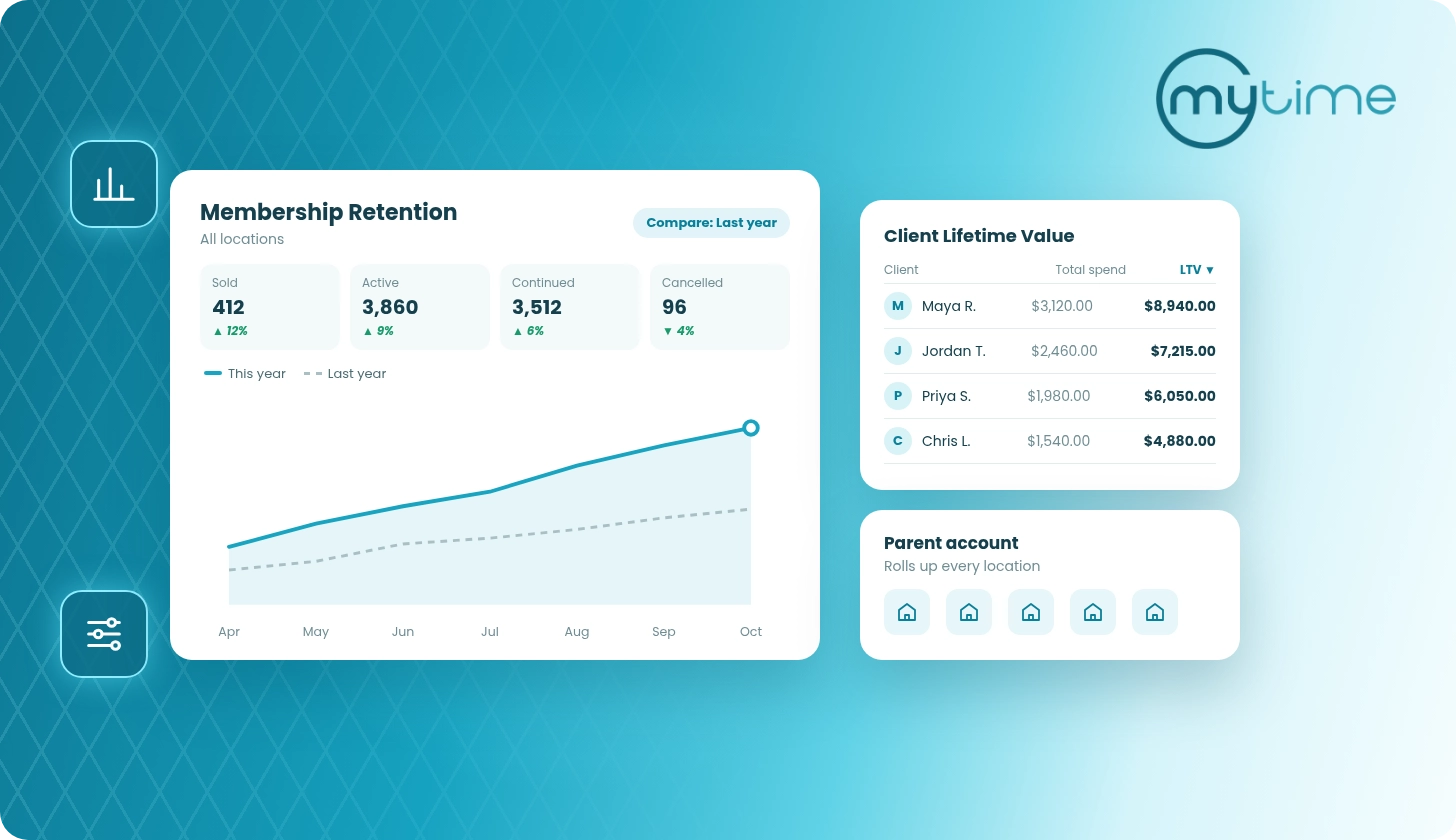
- Membership retention
- Package redemption
- Loyalty participation
- Referral conversion
- Win-back revenue
- NPS and review trends
- Location-level cohort performance
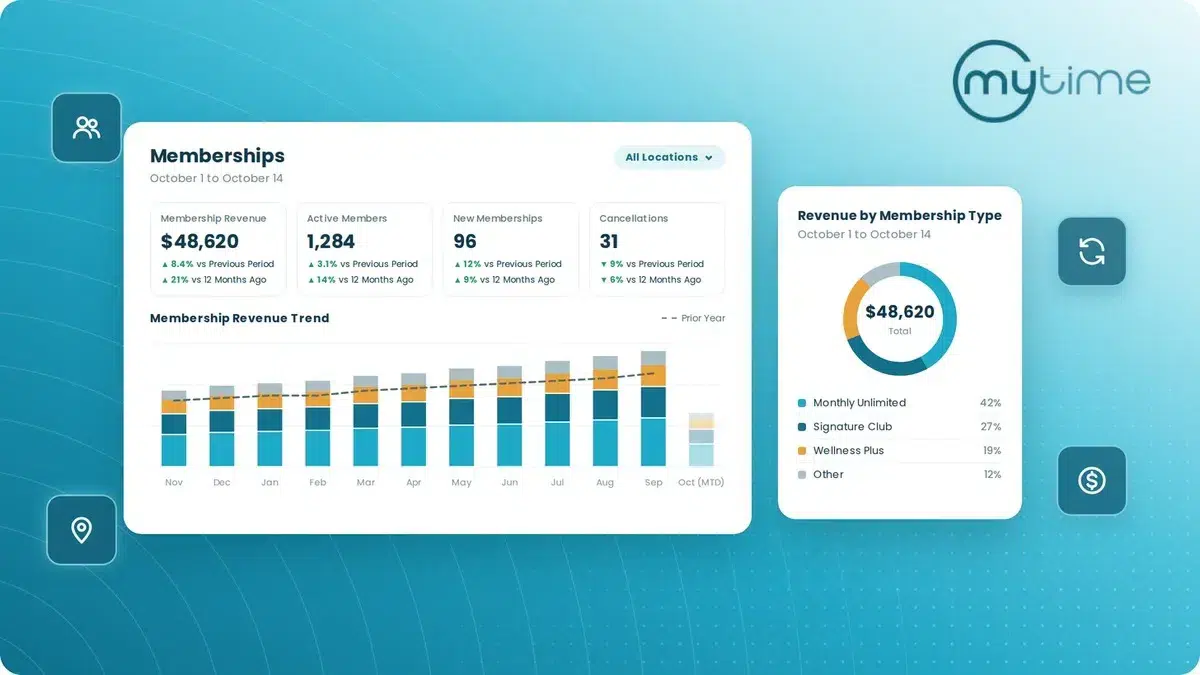
MyTime reporting includes 70+ reports, real-time data across all locations, client reporting, revenue reporting, campaign reporting with revenue attribution, and report exports (MyTime pricing packages).
Those measurements help leaders separate activity from impact. A location may send many campaigns but generate few repeat visits. Another may have high membership sales but low membership retention. Another may have strong referrals but weak first-to-second visit conversion.
The goal is not to overwhelm teams with dashboards. The goal is to help leaders ask better questions:
- Which locations retain first-time clients best?
- Which services lead to repeat visits?
- Which memberships are actually used?
- Which loyalty rewards drive return behavior?
- Which win-back campaigns create booked appointments?
- Which locations need coaching, playbooks, or better follow-up?
Once retention is visible, it becomes manageable.
What this looks like in practice
A salon franchise notices that color clients often wait too long between visits. The brand builds a rebooking prompt into checkout and adds loyalty rewards tied to repeat visits and product purchases. → Retention improves when timing is tied to service cadence.
A spa brand sells packages but sees uneven redemption across locations. The team standardizes package tracking, benefit reminders, and local reporting so staff can help clients complete the series. → Predictable demand is easier to plan when packages and redemptions are visible.
A pet care brand wants more routine repeat visits without relying on constant promotions. The brand uses reminders, referral incentives, and client history to prompt clients before they drift. → Retention improves when outreach happens before the relationship goes quiet.
A barbershop concept has a strong membership base but wants more consistency as it scales. The team tracks membership activity, visit frequency, and referral performance across locations. → A membership program becomes more valuable when leaders can see how it performs across the network.
Customer proof points
Customer stories show how retention and recurring-revenue systems can support service-brand growth.
Hydrate IV Bar generated more than $2M from automated client engagement, with 40% of total revenue driven by memberships (MyTime customer stories).
WeWhiten attributes 50% of revenue to recurring memberships and reports 0.75 referrals per new client generated (MyTime customer stories).
Scissors & Scotch has 20,000 members in its membership program. Co-founder Tanner Wiles says predictable revenue matters both to the business and to stylists who know clients are committed to coming in every month (MyTime customer stories).
These examples point to the same lesson: retention gets stronger when memberships, client engagement, referrals, and reporting are part of one system.
How MyTime helps multi-location brands improve retention
MyTime helps multi-location service brands connect the systems that keep clients coming back.
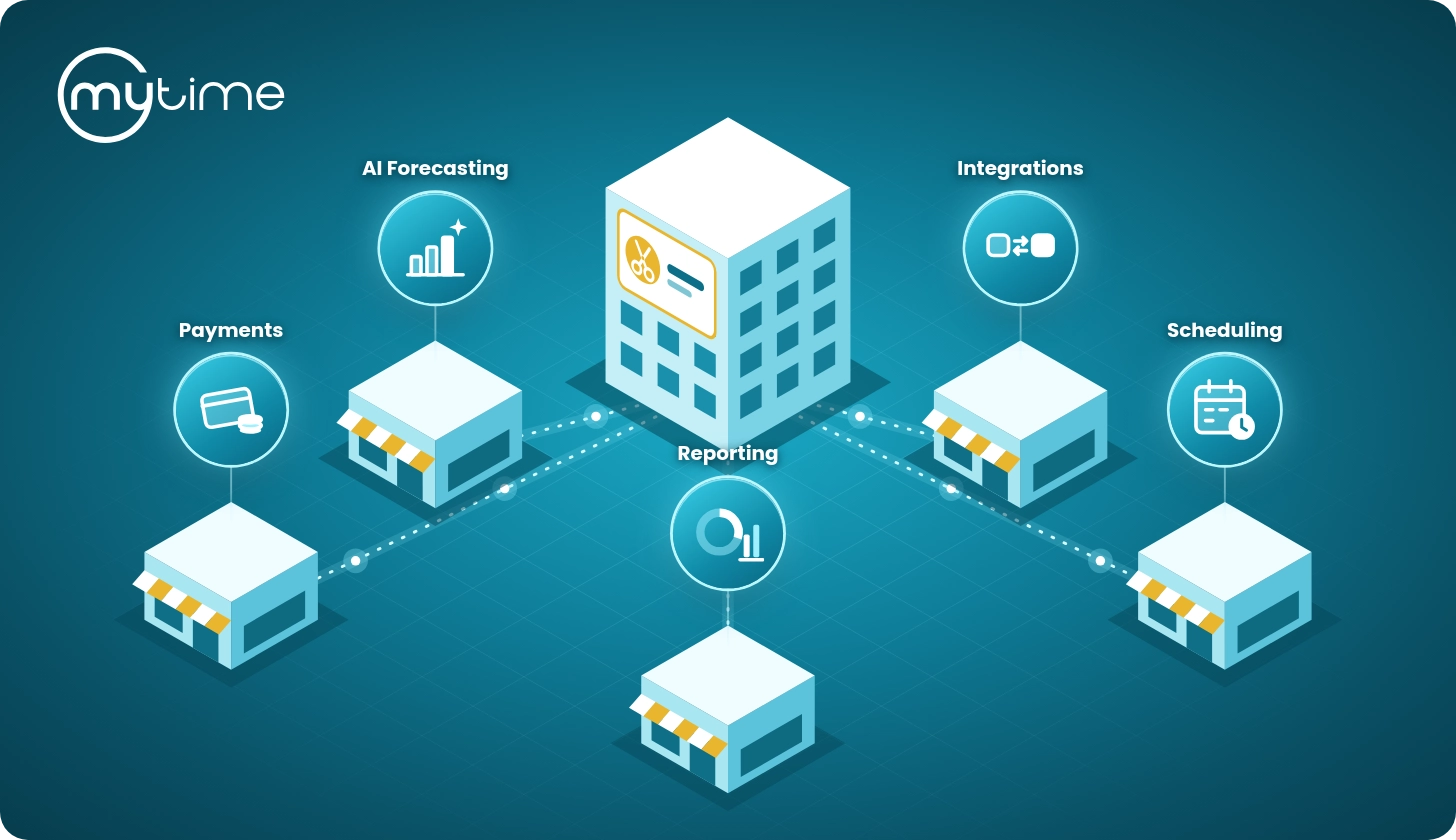
Instead of treating retention as separate tools, MyTime brings together appointment workflows, client engagement, memberships, packages, gift cards, loyalty, referrals, automated reminders, NPS collection, review requests, campaign reporting, revenue attribution, and cross-location reporting.
That connected approach matters because retention is not owned by one team. Marketing may run the campaign. Operations may own the playbook. Staff may deliver the experience. Finance may care about predictable revenue. Franchise leaders may need visibility across the whole network.
When those systems work together, the brand can move from reactive retention to proactive retention. Leaders can see which clients are returning, which programs are working, which locations need support, and which messages are bringing clients back.
Customer retention FAQ
What are customer retention strategies for service brands?
Customer retention strategies for service brands are the systems that keep clients returning after their first visit. They include rebooking prompts, reminders, memberships, packages, loyalty rewards, referral programs, customer feedback, win-back campaigns, and reporting across locations.
How can multi-location service businesses improve customer retention?
Multi-location service businesses can improve retention by standardizing the client experience while personalizing outreach based on client history, preferences, visit cadence, membership status, loyalty activity, and feedback.
What customer retention metrics should franchise brands track?
Franchise brands should track retention rate, repeat visit rate, first-to-second visit conversion, visit frequency, membership attach rate, membership retention, package redemption, loyalty participation, referral conversion, win-back revenue, NPS, reviews, and location-level cohort performance.
How do memberships improve customer retention?
Memberships improve retention by giving clients a reason to return on a predictable cadence. They can also help brands create recurring revenue, increase visit frequency, and make future demand easier to forecast.
How do loyalty programs support repeat visits?
Loyalty programs support repeat visits by rewarding the behaviors a brand wants to encourage, such as booking again, purchasing products, redeeming services, or engaging across locations. The strongest programs are easy for clients to understand and easy for staff to apply.
How can automated messages help bring clients back?
Automated messages can bring clients back by sending the right prompt at the right time. Examples include appointment reminders, post-visit follow-up, rebooking prompts, membership reminders, package redemption reminders, review requests, referral invitations, and win-back campaigns.
What is the difference between retention, loyalty, and referrals?
Retention is the outcome: clients keep coming back. Loyalty is one system that rewards repeat behavior. Referrals are a growth loop that turns happy clients into advocates. For multi-location service brands, the strongest strategy connects all three.
Build retention into the way your brand operates
Customer retention is not just a marketing goal. It is the result of every experience, reminder, membership, reward, referral, follow-up, and report working together.
For multi-location service brands, the opportunity is to make retention consistent without making the client experience feel generic. That means giving every location the same tools, the same visibility, and the same ability to keep clients engaged.
MyTime helps service brands turn retention, loyalty, referrals, and predictable revenue into one connected operating model. Book a demo to see how MyTime can help your locations keep clients coming back.