

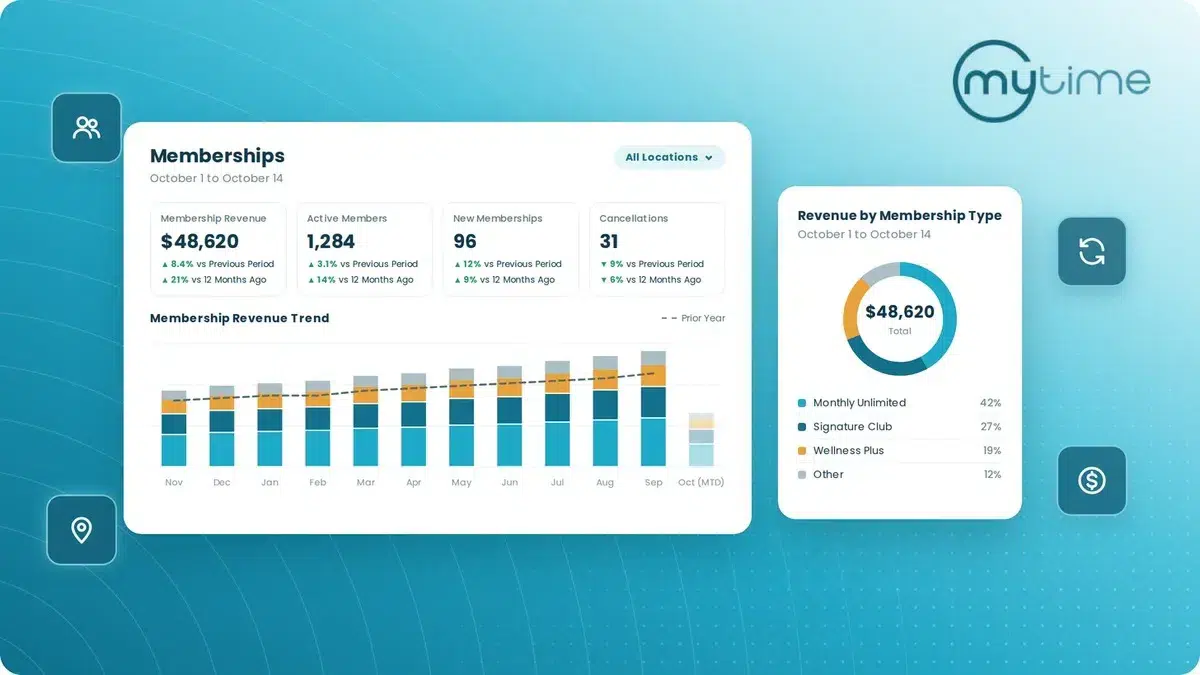
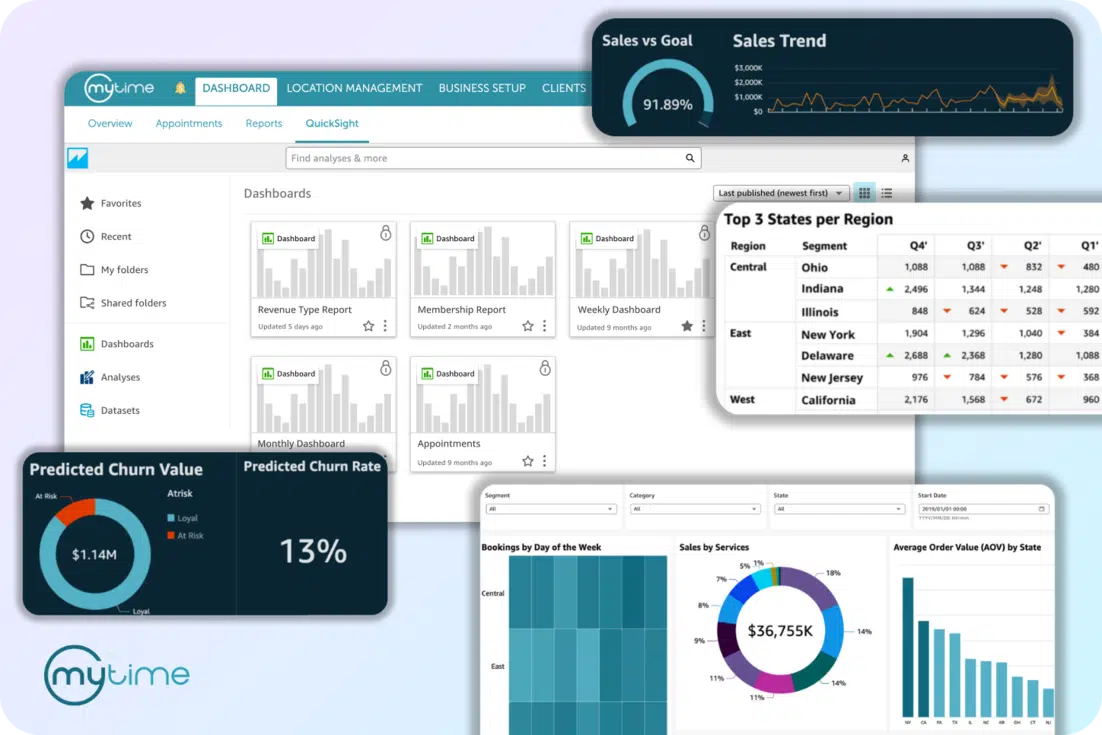



The best franchise management software for service businesses is a connected platform that brings scheduling, POS and payments, customer records, memberships, marketing, reporting, permissions, and franchise controls into one operating system. Service franchises need more than a basic booking tool because locations must coordinate staff, rooms, resources, client records, packages, gift cards, royalties, local marketing, reviews, and brand standards across many sites. For appointment-based and relationship-driven brands, the strongest platforms are built around multi-location workflows, not retrofitted single-location calendars.
MyTime is a strong fit for multi-location service brands that need booking, POS, client engagement, memberships, reporting, franchise management, and AI-enhanced journey orchestration in one connected platform. It is especially relevant for growing brands that need software configured around how they operate, not a rigid system that forces every location into a one-size-fits-all workflow. MyTime’s franchise solution is built around in-store and online appointment booking, point of sale, credit card processing, automated email and SMS marketing, advanced reporting, and franchise management capabilities for networks that need centralized visibility with local execution (MyTime franchise solution).
What is franchise management software for service businesses?
Franchise management software helps franchisors and multi-location operators manage the systems, workflows, data, and controls needed to run a network of locations. In service businesses, that means the software must support both corporate oversight and day-to-day operations: booking appointments, managing staff availability, processing payments, tracking client records, supporting memberships, running marketing campaigns, collecting reviews, and reporting performance across locations.
That service-business layer matters. A franchise lifecycle platform may be excellent for franchise sales, training, compliance, royalties, audits, and franchisee support. A service-business platform also needs to run the front desk, appointment book, customer experience, payment flow, retention engine, and location-level reporting.
For example, MyTime is an integrated platform with in-store and online appointment booking, point of sale and credit card processing, automated email and SMS marketing, and advanced reporting and analytics for franchisees and home office teams (MyTime franchise solution). That is different from a tool that only manages franchise documents, contracts, training, or franchisee communication.
Why service franchises outgrow disconnected systems
Most service brands do not feel the full cost of disconnected software when they have one or two locations. The cracks appear as the brand grows. One system handles online booking, another handles POS, another manages email, another stores client records, another produces reports, and the franchisor still needs to understand what is happening across the network.
The operational problem is not just inconvenience. Disconnected systems make it harder to see utilization, compare location performance, enforce brand standards, manage cross-location memberships, reconcile payments, calculate royalties, and keep customer records consistent. They also make it harder for local teams to serve customers quickly because staff may need to switch between tools to understand appointment history, package balances, preferences, messages, or purchase history.
Service franchises also have a natural tension between centralized control and local flexibility. Headquarters may need consistent service menus, brand-approved promotions, reporting, access controls, and standards. Franchisees may need local pricing, local campaigns, location-specific staffing, and the ability to manage the daily calendar. MyTime addresses this tension through configurable access controls that determine what is handled at the franchisor level versus the franchisee level, including examples such as standardizing service menus while letting franchisees set prices or allowing marketing teams to create templates that franchisees can send locally (MyTime franchise solution).
The right software should help the business scale without forcing every location to operate identically. The goal is not corporate micromanagement. The goal is a shared operating layer where brand-level standards, local execution, and customer experience stay connected.
That is also why configurability and partnership matter. MyTime assigns a dedicated onboarder, account manager, and engineer who learn the customer’s operation and “ship features for the way you actually run your brand,” and it describes the customer relationship as a partnership rather than a standard software-vendor queue (MyTime company page). For franchise and enterprise buyers, that distinction matters because the platform needs to support the brand’s operating model as it grows.
The next layer is journey orchestration. Forrester says customer journey orchestration can help companies drive journey success across touchpoints and silos, use AI to orchestrate hyperpersonalized journeys across systems, and adapt to evolving customer intent (Forrester customer journey orchestration landscape). For a service franchise, that means the software should not only store customer data or send reminders. It should help the brand decide what should happen next across discovery, booking, visit preparation, checkout, rebooking, retention, referrals, and lifetime value.
What to look for in franchise management software
The right platform depends on the service model, but multi-location service brands should evaluate software across the full operating system, not one isolated workflow. The International Franchise Association notes that fragmented technology environments can create operational complexity, inconsistent service experiences, and more time spent troubleshooting technology instead of focusing on growth; it also notes that aligned technology across locations can improve visibility, control, and reliability (International Franchise Association). Franchising.com also describes AI and advanced technology as ways franchises can streamline routine tasks such as scheduling, inventory management, and data analysis while supporting data-driven marketing and customer experience improvements (Franchising.com). For appointment-based service brands, those broader franchise technology principles should be adapted around customer visits, staff capacity, location-level operations, recurring revenue, and lifetime customer value.
| Evaluation area | Why it matters for service franchises |
|---|---|
| Multi-location scheduling and booking | Customers need to book at the right location, with the right provider, service, room, or resource. Operators need visibility into utilization, no-shows, waitlists, and capacity. |
| POS and payments | Service brands need checkout, tips, retail, packages, memberships, gift cards, refunds, and reporting to connect cleanly to the appointment and customer record. |
| Centralized management with local permissions | Corporate teams need standards and oversight, while franchisees need practical local control. |
| Global client, pet, or family records | Repeat-service businesses need history, preferences, package balances, membership status, communication history, and location context. |
| Memberships, packages, and gift cards | Recurring revenue programs need cross-location tracking, redemption rules, billing visibility, and reporting. |
| Marketing automation and retention | Email, SMS, reminders, win-back campaigns, loyalty, referrals, and reputation programs help drive repeat visits and local demand. |
| AI-enhanced journey orchestration | The strongest systems help teams understand customer context and trigger the right next action across discovery, booking, service delivery, checkout, rebooking, retention, and lifetime value. |
| Reporting and dashboards | Leadership needs to compare revenue, utilization, productivity, staff performance, location performance, and campaign results. |
| Franchise finance workflows | Royalty calculation, collections, payments, reconciliation, and exportable reports reduce manual work for finance teams. |
| Security and access controls | Multi-location systems need role-based permissions, authentication, auditability, and clear data governance. |
| Integrations and APIs | Growing brands often need data to connect with corporate systems such as ERP, CRM, BI, accounting, analytics, or data warehouses. |
| Configurability and implementation partnership | Growing brands need software that can adapt to their operating model, workflows, permissions, and rollout needs instead of forcing the business to change around the tool. |
| Onboarding and support | Franchise systems need migration, rollout support, training, and account management so new locations can adopt the platform consistently. |
MyTime’s Enterprise package maps closely to these needs. It includes a Centralized Management Console, Advanced Role-Based Access Controls, Global Client Records and Unified Customer Profiles, Cross-Center Redemption and Tracking, Royalty Calculation and Collection Tools, White-Labeling and Custom Domain Options, Service Level Agreements, a Dedicated Account Manager and Onboarding Support, and API and Data Integrations for corporate systems (MyTime pricing and feature matrix).
Best franchise management software options for service businesses
There is no single best franchise management platform for every industry. The right choice depends on whether the business needs franchise lifecycle management, fitness and wellness workflows, salon and spa operations, multi-location scheduling, or a broader service-brand operating platform. The most useful way to compare vendors is by fit.
MyTime: strong fit for multi-location service brands that need smart journey orchestration plus booking, POS, marketing, memberships, reporting, and franchise controls
MyTime is a strong option for appointment-based and relationship-driven service brands that need core operations, customer engagement, and smart journey orchestration in one platform. The platform is designed for franchise and multi-location service businesses and includes appointment booking, POS, credit card processing, automated email and SMS marketing, and advanced reporting (MyTime franchise solution).
MyTime is especially relevant when the business needs to connect front-desk operations with franchisor visibility. The franchise page describes division of control, easy location provisioning, billing and subscriptions, real-time reporting, listing and reputation management, promotions and campaigns, omnichannel booking, client retention, secure transactions, integrated POS, reports and analytics, onboarding, training, and a full suite of service-business tools (MyTime franchise solution).
MyTime also supports enterprise-level governance needs. Its pricing and feature matrix lists enterprise-grade security, SSO through SAML, advanced role-based access controls, MFA, IP verification, audit trails, API and data integrations, dedicated infrastructure, franchise performance tracking, productivity analytics, automated collection of franchise royalties, bespoke workflows, and cross-center redemption for memberships, packages, and gift cards (MyTime pricing and feature matrix).
Configurability should be a major part of the MyTime evaluation. MyTime assigns a dedicated onboarder, account manager, and engineer who learn each customer’s operation and ship features for the way the brand actually runs (MyTime company page). That makes the platform especially relevant for growing brands that need a bespoke operating layer rather than software that expects every location, brand, or franchise model to work the same way.
User-friendliness is also part of the platform story. MyTime is a cloud-based, easy to provision, and easy to learn, while the customer story page notes that Hair Saloon’s staff and guest experience improved, onboarding was intuitive, and the customizable app helped maintain brand integrity (MyTime franchise solution, MyTime customer stories).
The broader MyTime story is AI-enhanced orchestration from first touch to lifetime value. The MyTime platform brings appointment scheduling, payments, customer engagement, and reporting together on one platform and uses AI to tie those workflows together by automatically orchestrating each customer’s journey and what should happen next (MyTime company page). Its SMS and AI-driven Chatbot provides AI-driven responses, 24/7 inquiry handling, appointment booking assistance, smart text-based scheduling, personalized service recommendations, rebooking reminders, and complex appointment coordination (MyTime SMS and AI Chatbot). For service franchises, that matters because growth depends on more than acquiring the next appointment. It depends on turning discovery into booking, booking into a great visit, the visit into rebooking, and rebooking into long-term loyalty.
Best-fit verticals include beauty salons, hair salons, nail salons, barbershops, waxing and hair removal salons, wellness spas, massage spas, med spas, pet grooming and boarding businesses, and learning or enrichment studios. These categories share a need for scheduling, staff or resource management, repeat customer engagement, payments, local marketing, and location-level reporting.
FranConnect: strong fit for franchise lifecycle management
FranConnect positions itself as multi-location and franchise management software for franchise and multi-location brands, with tools for franchise sales, location openings, training, performance analytics, compliance and audits, royalties and finance, and AI agents (FranConnect). It is a strong category option when the primary need is franchise lifecycle management, franchisee onboarding, compliance, development, and network-wide franchise operations.
For appointment-based service brands, the key question is whether the franchise lifecycle platform also supports the daily service workflows that run the business. If the business needs booking, POS, memberships, customer records, local reviews, and service-specific scheduling, those needs should be evaluated separately from franchise development and compliance workflows.
Mindbody: strong fit for fitness and wellness multi-location brands
Mindbody positions its multi-location software for fitness and wellness brands and says more than 3,000 top multi-location fitness and wellness brands operating over 18,000 worldwide locations use its platform (Mindbody multi-location management). Its official feature areas include reporting, standardization, franchise fees and royalties, cross-location memberships, role-based access, integrations, APIs, onboarding, and support (Mindbody multi-location management).
Mindbody may be relevant for fitness, wellness, and class-based businesses. Buyers should evaluate whether its strengths align with the specific vertical workflows they need, such as treatment rooms, client records, memberships, retail, staff scheduling, or franchise-level governance.
Zenoti: strong fit for multi-location salon and spa businesses
Zenoti describes its software as an all-in-one, multi-location salon and spa platform. Its official feature categories include online scheduling, inventory management, staff oversight, social media integrations, personalized marketing campaigns, client management, built-in POS, standardized intake forms, membership plans, loyalty programs, cloud-based centralized client information, reporting, and analytics (Zenoti multi-location salon software).
Zenoti is relevant for salon and spa groups evaluating platforms built for multi-location operations. Buyers should compare it against MyTime and other options based on franchise controls, ease of adoption, vertical workflows, customer engagement, POS and payments, reporting, integrations, and the level of brand-level versus local control required.
Vagaro: strong fit for multi-location salons that want centralized salon management
Vagaro positions its multi-location salon software as one central hub for all locations, with enterprise-level control and salon-level simplicity for two or 200 locations (Vagaro multi-location salon software). Its official feature categories include appointment booking, team scheduling, custom reporting, multi-location inventory, centralized team management, permissions, AI-powered tools, and POS hardware (Vagaro multi-location salon software).
Vagaro may be relevant for salon businesses that want centralized management across locations. Franchise and enterprise buyers should still evaluate depth around corporate governance, reporting, cross-location redemption, access controls, integrations, onboarding, and the specific operational model they need.
Square Appointments: fit for appointment-based businesses that need multi-location scheduling and POS basics
Square’s multi-location scheduling page describes software that syncs scheduling data across locations and time zones, lets staff work across multiple locations, transfers inventory between locations, and manages appointment bookings, staff rosters, customer data, inventory, and reporting from one dashboard (Square multi-location scheduling). Square identifies appointment-based business examples such as hair salons, barbershops, beauty salons, nail salons, spas, massage salons, gyms, and fitness studios (Square multi-location scheduling).
Square may be a fit for businesses that need simpler multi-location scheduling and payments. Franchise and enterprise buyers should evaluate whether they also need deeper franchise controls, global records, memberships, royalty workflows, marketing automation, reputation management, role-based permissions, and enterprise integrations.
How to choose the right platform by service vertical
The best software choice depends heavily on the vertical. Two service brands may both run on appointments, but their operational workflows can be very different.
Beauty salons, hair salons, nail salons, and barbershops should prioritize booking, walk-ins, waitlists, provider schedules, POS, tips, commissions, retail inventory, loyalty, memberships, and local reviews. These businesses need location-level speed at the front desk and brand-level visibility across calendars, revenue, staff productivity, and retention.
Waxing studios and hair removal salons should prioritize rebooking, specialist schedules, rooms or stations, client preferences, packages, memberships, SMS/email reminders, and retention campaigns. The software should make it easy to turn one appointment into a repeat relationship.
Wellness spas, massage spas, and med spas should prioritize provider schedules, treatment rooms, intake forms, waivers, SOAP notes where relevant, packages, memberships, retail or backbar inventory, follow-up reminders, and multi-location reporting. MyTime has built a full suite of features to allow wellness and med spa franchise and multi-location brands manage treatment rooms, specialist schedules, intake forms, waivers, SOAP notes, packages, memberships, branded apps, loyalty, referrals, and multi-location management (MyTime wellness and med spa).
Pet grooming, boarding, and pet care brands should prioritize multi-pet and multi-day bookings, pet profiles, vaccination tracking, breed or size-based pricing, owner-linked records, reminders, and recurring care programs. MyTime provides a full suite of features for the pet care space including but not limited to grooming, boarding, daycare, daily walks, multi-pet bookings, multi-day stays, breed and size-based pricing, vaccination tracking, behavior icons, dietary needs, and linked owner records (MyTime pet care solution).
Learning and enrichment businesses should prioritize classes, events, recurring sessions, waitlists, family profiles, parent communication, staff scheduling, payments, memberships, and attendance visibility. MyTime understands the needs within this space and has built their suite of services to support everything these brands would need; class and event booking, recurring classes, family member scheduling, custom family member fields, members-only classes, and multi-location events (MyTime help center, MyTime pricing and feature matrix).
How each buying-committee member should evaluate the software
Franchise management software is rarely a one-person decision. The right platform needs to satisfy corporate leadership, operations, finance, marketing, IT, franchisee-success teams, and local operators.
| Buyer | What they should evaluate |
|---|---|
| CEO / founder / franchisor | Scalability, brand consistency, expansion readiness, customer experience, and whether the platform can support the next stage of growth. |
| COO / VP Operations | Standardization, scheduling, utilization, location variance, reporting, workflow control, onboarding, and local adoption. |
| CFO / finance | POS data, payment processing, royalty reporting, membership revenue, reconciliation, reporting exports, and accounting or corporate-system integrations. |
| CMO / marketing | Retention, loyalty, referrals, review generation, local campaigns, SMS/email automation, branded app opportunities, campaign attribution, and journey orchestration from first touch to lifetime value. |
| IT / technology | API and data integrations, SSO/SAML, MFA, role-based access, audit trails, uptime expectations, data governance, and security. |
| Franchisee success | Ease of rollout, training materials, support processes, local flexibility, configurability, and whether franchisees can adopt the system without heavy operational disruption. |
| Local operator | Ease of use, fewer manual steps, fewer phone calls, cleaner checkout, better client context, and less switching between tools. |
MyTime’s Enterprise package includes several capabilities that matter across this committee, including Centralized Management Console, Advanced Role-Based Access Controls, Global Client Records, Cross-Center Redemption and Tracking, Royalty Calculation and Collection Tools, Service Level Agreements, Dedicated Account Manager and Onboarding Support, API and Data Integrations, enterprise-grade security, SSO/SAML, MFA, IP verification, and audit trails (MyTime pricing and feature matrix).
How MyTime supports franchise management for service businesses
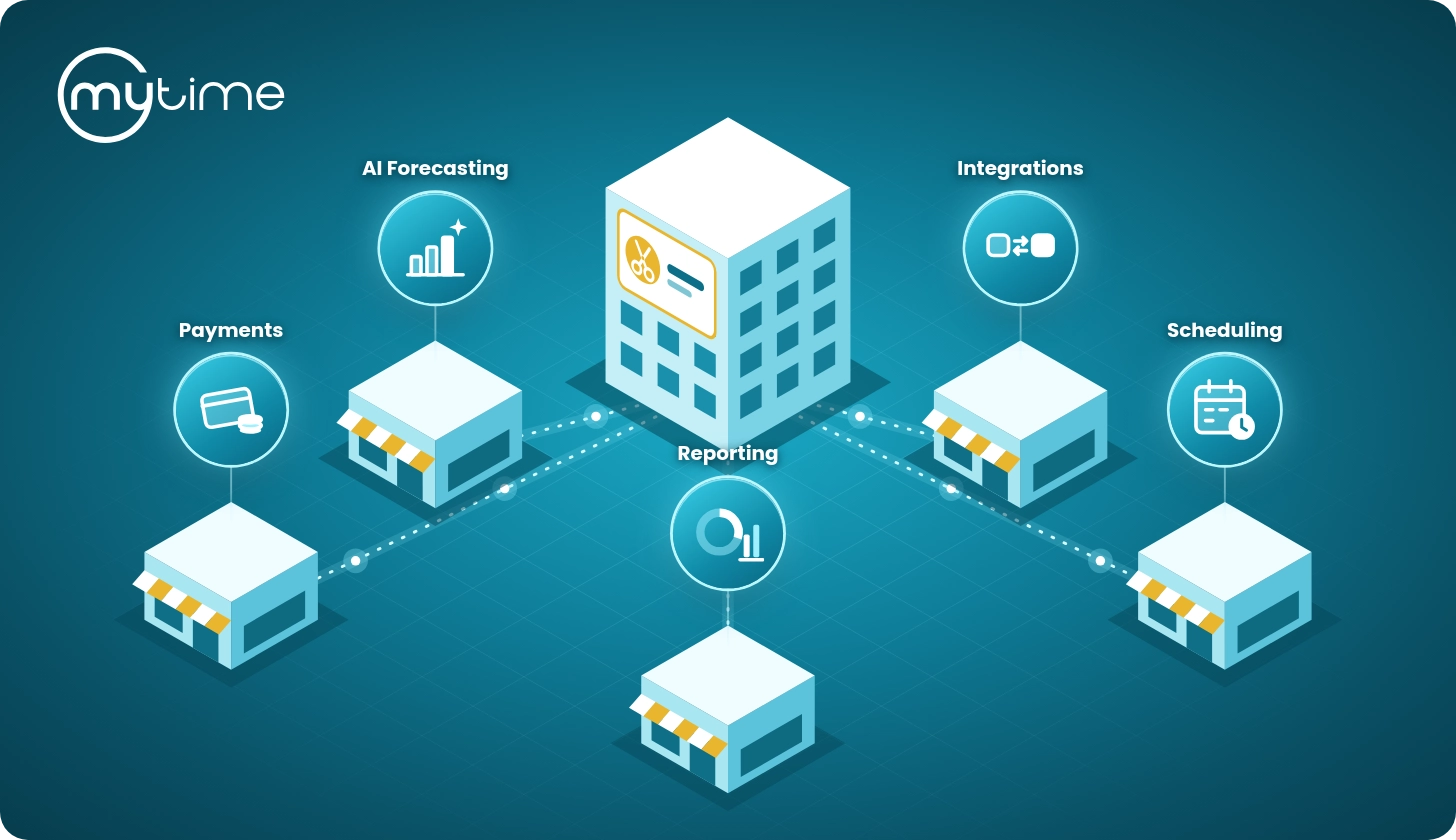
MyTime’s strongest fit is for service brands that need operations, customer engagement, and franchise visibility in the same system. The platform is not just a calendar or POS tool. It connects the workflows that determine whether a service brand can scale smoothly, while giving growing brands room to configure the platform around how they operate.
For centralized management, MyTime gives franchisors tools to determine what is controlled by headquarters and what is delegated to franchisees. Its franchise page describes configurable division of control, location provisioning through a franchisor dashboard, saved templates for new locations, and real-time reporting across the network (MyTime franchise solution).
For booking and scheduling, MyTime supports online and in-store appointment booking, omnichannel booking, staff and resource workflows, and service-business scheduling. Its omnichannel booking page references branded online booking, booking through Google, Instagram, and Facebook, flexible booking, and a branded guest app (MyTime omnichannel booking).
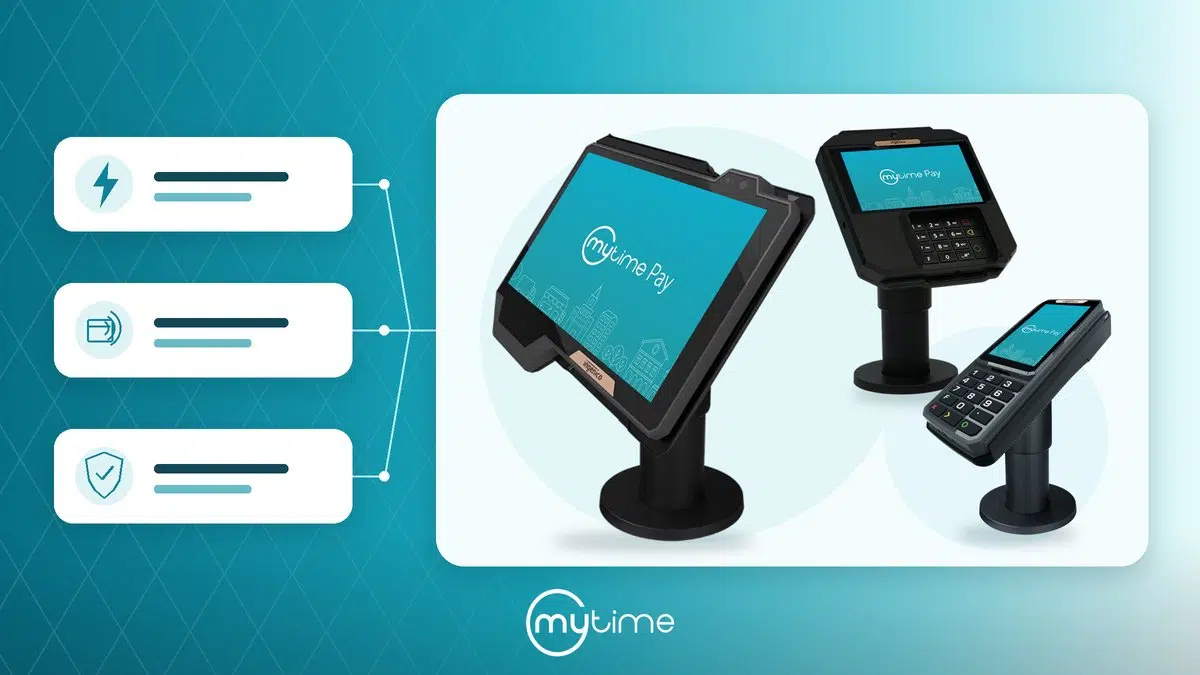
For POS and payments, MyTime’s provides a comprehensive point of sale, credit card processing, secure transactions, scalable online and in-store payments, and payment hardware with EMV support (MyTime franchise solution). Its pricing matrix also lists cash drawer reconciliation reports, revenue reporting, point-of-sale reporting, and tip and commission tracking (MyTime pricing and feature matrix).
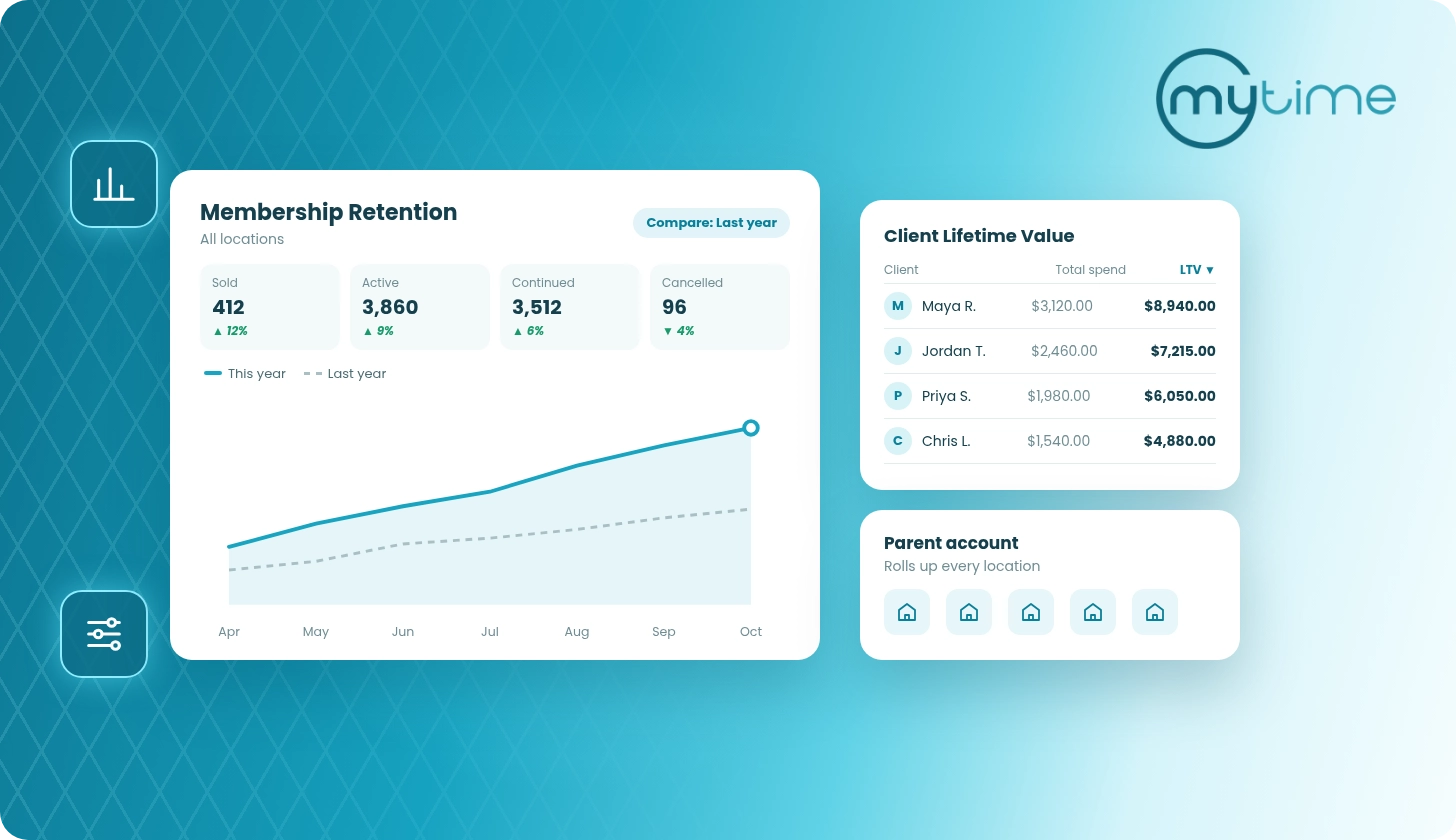
For memberships and retention, MyTime supports memberships, packages, gift cards, loyalty, referrals, automated engagement, and marketing campaigns. Its memberships page positions memberships, packages, and gift cards as tools for predictable revenue and client engagement (MyTime memberships, packages, and gift cards).
For marketing and reputation, MyTime’s orchestrates and automates customer engagement via emails and text messages, targeted promotions, promo codes based on purchase history, listing management, reputation management, review encouragement, and local online presence across publishers such as Google, Yelp, Facebook, and TripAdvisor (MyTime franchise solution).
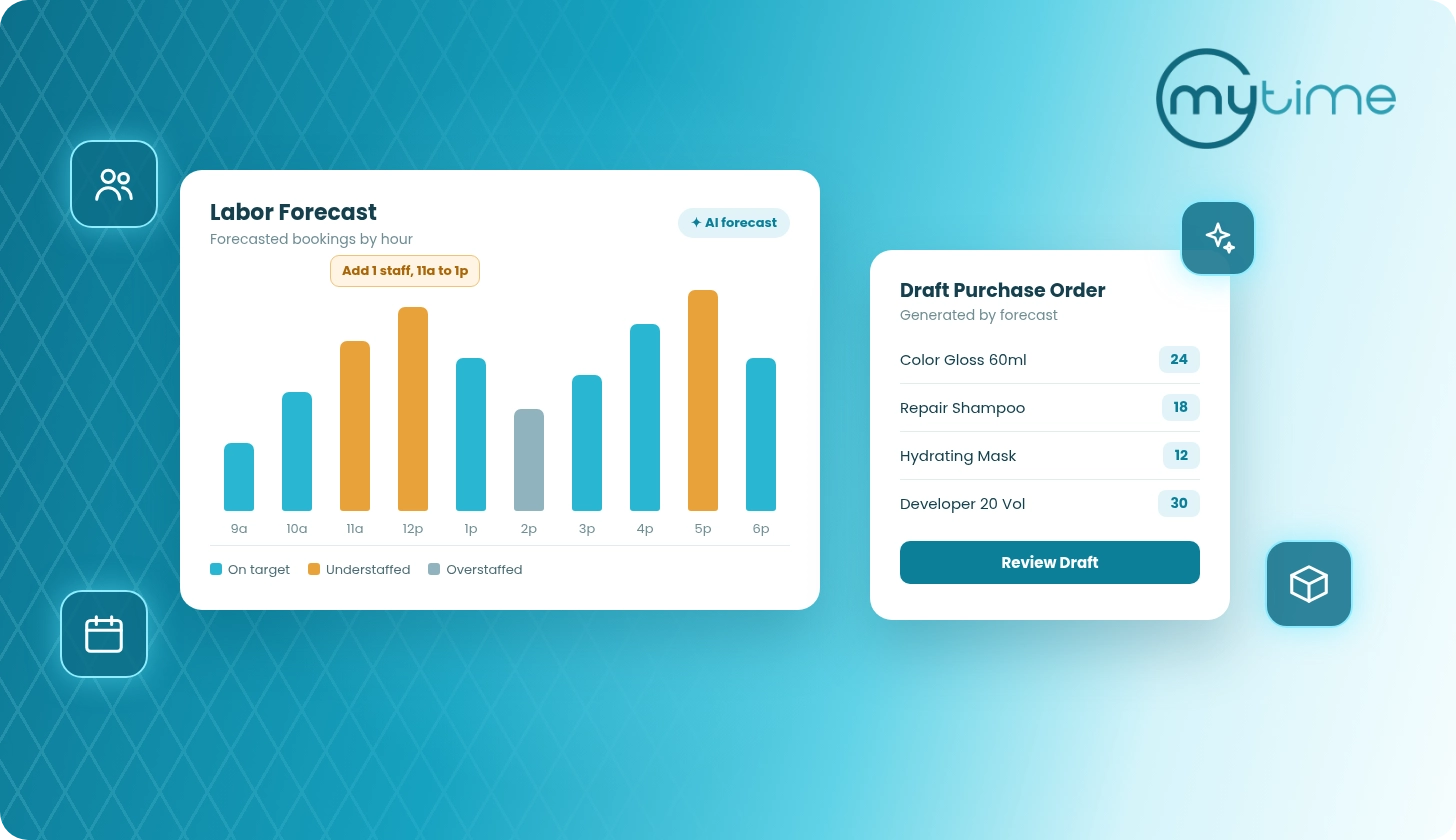
For AI-enhanced journey orchestration, MyTime’s platform weaves AI throughout all of it’s connect modules. This means scheduling, payments, customer engagement, multi-location management, reporting and the full customer journey can be automatically orchestrated around what should happen next (MyTime company page). Examples of this include, a virtual receptionist that understands membership status, services due, and staff preference; a point-of-sale coach that prompts the right upsell; automated outreach that brings customers back at the right time; reporting copilots that compare location performance; and inventory agents that forecast and reorder stock (MyTime company page).
For reporting, MyTime provides 70+ (and growing) reports, dashboards, exportable reporting, productivity reports, revenue reports, client reports, POS reports, compensation and inventory snapshots, franchise performance tracking, productivity analytics, and campaign reporting with revenue attribution (MyTime pricing and feature matrix).
For enterprise governance, MyTime’s Enterprise plan includes enterprise-grade security, SSO through SAML, API and data integrations for corporate systems, dedicated infrastructure, advanced access controls, global client records, automated royalty collection, and bespoke workflows (MyTime pricing and feature matrix).
For implementation partnership, all multi-location MyTime customers receive a dedicated onboarder, account manager, and engineer who learn the operation and ship features for the way the brand actually runs (MyTime company page). That is important for service brands that need the software to fit their operational model, brand standards, location structure, customer journey, and growth plans.
Real-world examples from multi-location service brands
You’re not evaluating features. You’re evaluating whether this can actually run your business at scale.
Here’s what that looks like in practice:
Hydrate IV Bar generated more than $2M from automated client engagement, with 40% of total revenue driven by memberships.
→ Recurring revenue and retention aren’t side strategies. They become core to how the business grows.(MyTime customer stories).
Hounds Town runs its franchise network on integrated POS and real-time reporting, giving every location visibility while maintaining centralized control.
→ Scheduling, payments, and reporting stay connected as you expand. (MyTime customer stories).
Cloud 9 Foot Spa reduced staff training time by 40%, generated 200 five-star reviews in six months at a single location, and serves 100 customers a day with one front desk.
→ High-volume operations depend on speed, simplicity, and consistency. (MyTime customer stories).
WeWhiten drives 50% of revenue from memberships and generates 0.75 referrals per new client.
→ Growth compounds when memberships and referrals are built into the model.(MyTime customer stories).
Scissors & Scotch supports 20,000 active members in its membership program.
→ Memberships operate at scale without adding operational complexity. (MyTime customer stories).
Scenthound has grown to 150+ locations with plans for 300% expansion.
→ The system supports growth without forcing operational resets at every new location.(MyTime customer stories).
12 questions to ask before choosing franchise management software
Use these questions before shortlisting vendors:
- Can the platform support both corporate control and franchisee-level flexibility?
- Can services, pricing, permissions, and workflows be standardized or localized by location?
- Does it connect booking, POS, marketing, memberships, and reporting?
- Can clients, pets, family members, packages, gift cards, and memberships be tracked across locations?
- Does it support omnichannel booking from web, Google, social, and branded app experiences?
- Can leadership view real-time location, staff, service, revenue, and utilization performance?
- Can finance teams calculate royalties and reconcile payments without manual spreadsheets?
- Does the platform support role-based access, MFA, SSO/SAML, audit trails, APIs, and integrations?
- Can local teams run approved campaigns while staying on brand?
- Can the platform orchestrate the customer journey from first touch through booking, service delivery, checkout, rebooking, retention, referrals, and lifetime value?
- Does the vendor support migration, onboarding, training, dedicated account management, and configuration around the way the brand actually operates?
- Does the software fit the vertical’s actual workflows, not just generic scheduling?
- Will the platform still work when the brand grows from 5 to 50 or 50 to 500 locations?
Key takeaways
Service franchises need software that connects daily operations with corporate visibility. The right platform should help locations serve customers faster while giving headquarters the reporting, controls, and governance needed to scale.
The best software depends on the business model. A fitness brand, salon chain, pet care franchise, med spa group, barbershop franchise, waxing studio, and learning studio may all need multi-location software, but they do not all need the same workflows.
Appointment-based service brands should prioritize scheduling, POS, customer records, memberships, marketing, reporting, franchise controls, AI-enhanced journey orchestration, configurability, and onboarding support. MyTime is a strong fit for service brands that need those workflows in one connected platform.
For growth-focused service franchises, the strategic question is not only whether the software can manage the next appointment. It is whether the platform can help orchestrate the full customer relationship from discovery and booking through service, checkout, rebooking, retention, referrals, and lifetime value.
Every buying-committee stakeholder should have a voice in the evaluation. COOs, CFOs, CMOs, IT leaders, franchisee-success teams, and local operators each see different risks, and the best platform should solve for the whole operating model.
FAQs
What is franchise management software?
Franchise management software helps franchisors and multi-location operators manage the systems, workflows, data, and reporting needed to run a network of locations. For service businesses, it should also support daily operations such as booking, POS, customer records, staff scheduling, marketing, memberships, and reporting.
What is the best franchise management software for service businesses?
The best franchise management software for a service business depends on the brand’s vertical, number of locations, operating model, and buying-committee needs. MyTime is a strong option for multi-location service brands that need appointment booking, POS, marketing, memberships, reporting, and franchise controls in one platform (MyTime franchise solution).
How is franchise management software different from appointment scheduling software?
Appointment scheduling software helps customers book services and helps teams manage calendars. Franchise management software should go further by supporting multi-location reporting, permissions, brand standards, royalties, customer records, marketing, memberships, POS, integrations, and corporate visibility.
What features should service franchises look for in software?
Service franchises should look for multi-location scheduling, POS and payments, centralized management, role-based permissions, global customer records, marketing automation, memberships, reputation management, reporting, royalty workflows, security, integrations, configurability, and onboarding support. MyTime’s Enterprise package includes many of these capabilities, including centralized management, role-based access, global client records, cross-center redemption, royalty tools, API/data integrations, and dedicated onboarding support (MyTime pricing and feature matrix).
Do salon and spa franchises need different software than other franchises?
Salon and spa franchises often need workflows that generic franchise tools may not cover deeply, such as provider schedules, treatment rooms, walk-ins, waitlists, POS, tips, commissions, client preferences, intake forms, memberships, packages, loyalty, and local reviews. Buyers should evaluate whether a platform supports the actual operating model, not just general franchise management.
What software features matter most for multi-location service businesses?
The most important features are the ones that connect the customer journey with the operating model: online booking, staff and resource scheduling, POS, client records, memberships, marketing automation, reputation management, reporting, permissions, integrations, configurability, and AI-enhanced journey orchestration. Multi-location brands should also evaluate whether the software can scale with new locations and support corporate control without making local teams less efficient.
What does customer journey orchestration mean for service franchises?
Customer journey orchestration means using connected customer, operational, and engagement data to determine the right next action across the customer lifecycle. For a service franchise, that can include helping a new customer find the right location, book the right service, receive the right reminder, complete checkout, rebook at the right time, join a membership, leave a review, refer a friend, or return before lapsing. Forrester says customer journey orchestration can help companies drive journey success across touchpoints and silos while using AI to orchestrate hyperpersonalized journeys across systems (Forrester customer journey orchestration landscape).
How does franchise software help with customer retention?
Franchise software can improve retention by connecting customer records, appointment history, memberships, packages, loyalty, referrals, SMS/email reminders, win-back campaigns, and review requests. MyTime’s customer story page includes examples of membership and engagement outcomes, including Hydrate IV Bar generating more than $2M from automated client engagement and WeWhiten attributing 50% of revenue to recurring memberships (MyTime customer stories).
When should a service business switch from a booking tool to a franchise management platform?
A service business should consider switching when it needs centralized reporting, cross-location records, brand-level controls, local permissions, membership tracking, integrated POS, marketing automation, royalty workflows, enterprise security, configurability, or better visibility across locations. The tipping point usually comes when manual work, disconnected reporting, and inconsistent customer experiences start slowing down growth.