



Med spa growth can make the schedule feel like the center of the business. Every appointment touches staff availability, provider skill, room capacity, equipment access, service timing, intake details, and follow-up. As brands add locations, those moving parts get harder to manage with static templates and manual edits.
That matters because the category keeps expanding. Grand View Research estimated the medical spa market at USD 21.21 billion in 2024 (Grand View Research). It projected the market to reach USD 78.23 billion by 2033 (Grand View Research). The same report said U.S. medical spas increased from 8,899 in 2022 to about 10,488 in 2023 (Grand View Research). Grand View Research also reported that multi-location medical spa operators averaged nine locations per group, up from six in 2022 (Grand View Research).
Growth raises the bar for med spa staff scheduling. Leaders need more than open time slots. They need a scheduling system that helps match every service with the right injector, aesthetician, room, device, buffer, and location rule.
Why med spa staff scheduling gets harder as brands scale
A single-location med spa can often solve schedule gaps with manager judgment. A multi-location brand needs a repeatable system. The moment a brand adds providers, rooms, locations, devices, and service bundles, each schedule decision affects revenue, labor cost, and client experience.
Understaffing creates pressure fast. Clients wait longer, appointments run behind, and staff members feel stretched. High-value services can also lose available capacity. Overstaffing creates a different problem because labor dollars sit idle when demand falls.
MyTime’s labor forecasting article explains this tradeoff clearly. It notes that overstaffing increases labor costs. It also says understaffing can create inconsistent experiences that weaken retention and loyalty (MyTime Labor Forecasting).
Med spas also face more scheduling constraints than many appointment-based businesses. A consultation may need one provider. The treatment may need another. A service may require a specific room, device, supply, waiver, intake form, SOAP note, or recovery window.
Basic calendar tools do not manage those dependencies well. They show open time. They rarely answer the bigger question: should this provider, room, and time block handle this exact service at this exact location?
What makes injector and aesthetician schedules different
Injectors, aestheticians, and wellness providers do not all support the same services. Each schedule must account for service eligibility, duration, room setup, provider availability, and client flow.
For example, a client may book a consultation before an injectable service. Another client may add a peel after a facial. A third may schedule IV therapy with a wellness service. Each appointment looks simple to the client, but the schedule must coordinate multiple operational rules behind the scenes.
MyTime’s Appointment Scheduling page says brands can configure service bundles, set precise timeframes, and assign staff (MyTime Appointment Scheduling). It also says MyTime can match appointments with staff availability and certification levels (MyTime Appointment Scheduling). Operators can configure services, classes, and consultations with durations, availability, staff, and pricing (MyTime Appointment Scheduling).
Those controls help med spa teams prevent the most common scheduling mistakes. Providers should only receive services they can perform. Treatments need rooms with the right setup. Schedules also need to account for prep, consultation, room turnover, and follow-up.
MyTime also supports buffer times for transitions, preparation, and unexpected delays (MyTime Appointment Scheduling). That matters in high-scale med spas because tight schedules can create a chain reaction. One delayed appointment can affect the next provider, the next room, and the next client.
Match every appointment to the right provider, room, and resource
Med spa scheduling works best when the platform connects staff, rooms, equipment, and service rules in one workflow. Staff assignment alone cannot solve the whole problem.
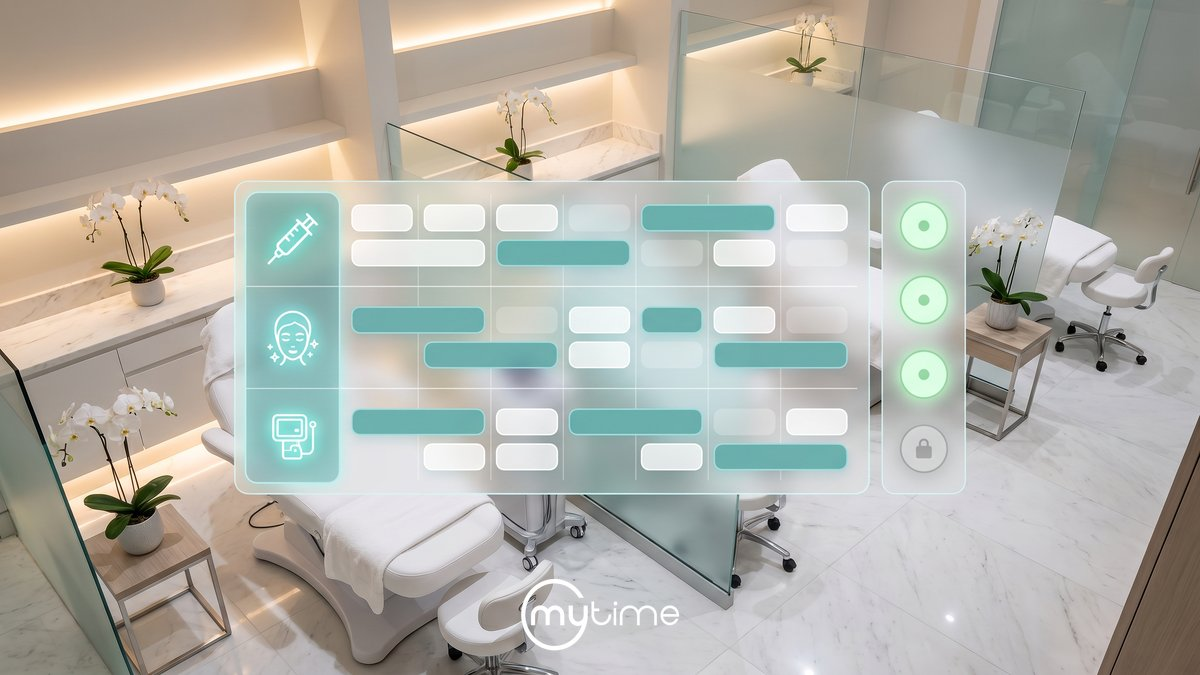
MyTime’s Wellness & Med Spa page describes the complexity directly. It says med spa operations involve staff and resource scheduling across advanced equipment, treatment rooms, and specialist schedules (MyTime Wellness & Med Spa). The page also says MyTime coordinates room bookings and specialist assignments (MyTime Wellness & Med Spa). It says MyTime automates schedules, aligns staff with needed resources, and helps eliminate double-bookings and scheduling conflicts (MyTime Wellness & Med Spa).
That connected approach helps corporate and location teams manage the real workflow. A manager can think beyond “Who is free?” and ask better questions:
- Provider fit: Does this person perform the service?
- Room fit: Does the appointment need a specific room or device?
- Buffer fit: Does the service need extra time before or after?
- Bundle fit: Does the booking include multiple services?
- Demand fit: Will the location have enough coverage during peak demand?
Service bundles add another layer. MyTime says wellness and med spa brands can use service bundles for complex treatments (MyTime Wellness & Med Spa). The page gives examples like a peel followed by IV therapy or a full rejuvenation day (MyTime Wellness & Med Spa). Bundles can increase the value of a visit, but they also require stronger scheduling logic.
When a platform connects the bundle, provider, room, and timeframe, the team can deliver a smoother experience. Staff know what they will perform. Clients see a more organized visit. Leaders get a clearer view of capacity.
Use demand-based labor forecasting instead of static templates
Static schedules create hidden risk for high-scale med spas. They often rely on last year’s numbers, manager memory, or the same weekly staffing pattern. Demand rarely behaves that neatly.
Demand changes by location, day, hour, season, provider, and service mix. A location may need more injectors on certain afternoons. Another may need more aestheticians on weekends. A new membership push, event, promotion, or seasonal trend can shift the pattern again.
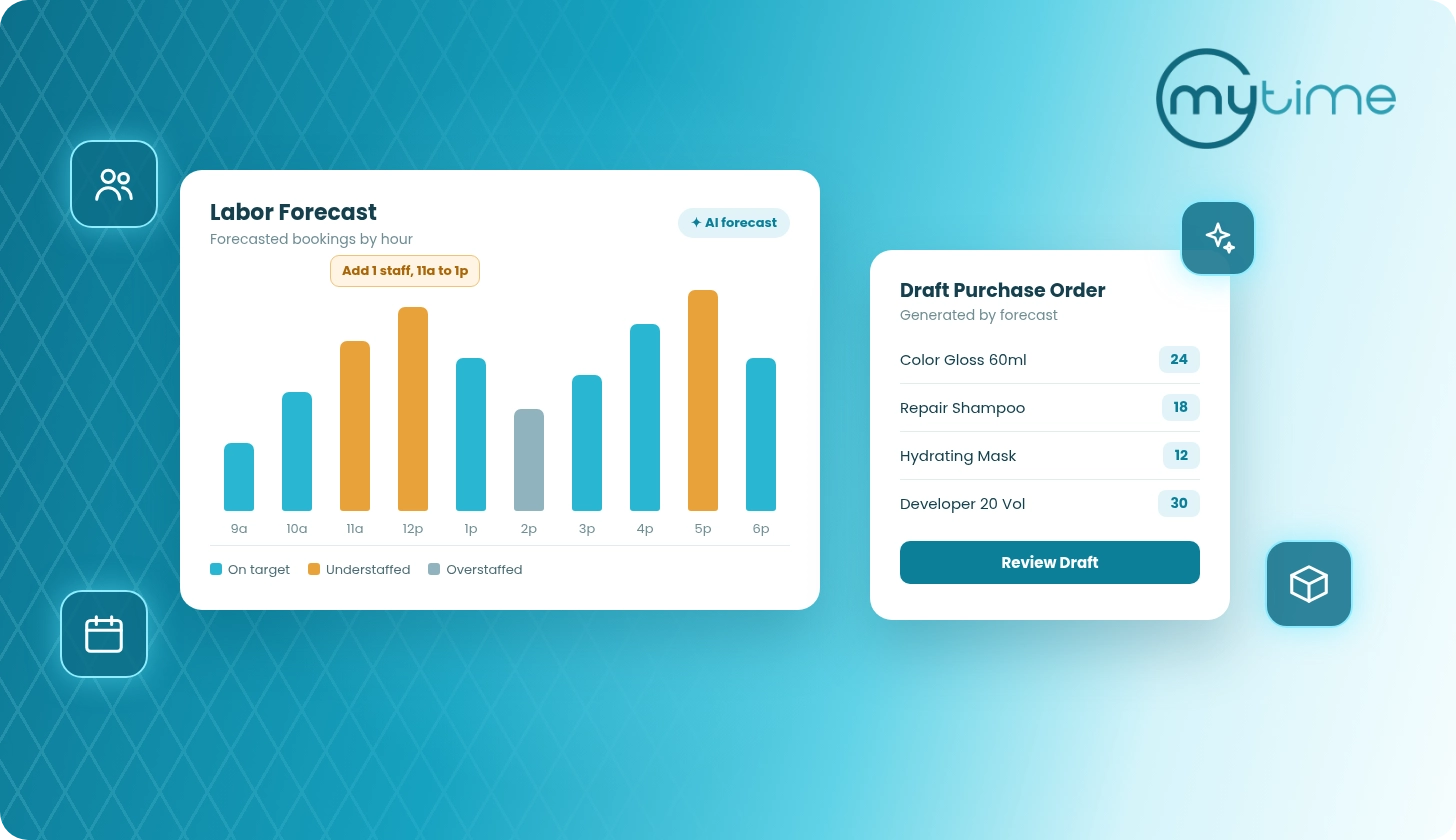
MyTime’s Labor Forecasting uses an AI-driven model grounded in actual booking behavior (MyTime Labor Forecasting). It predicts how many staff members a business needs at a given hour (MyTime Labor Forecasting). The model uses historical booking patterns, recent demand trends, and provider productivity (MyTime Labor Forecasting). MyTime says the model layers yearly seasonality, monthly trends, weekly patterns, daily and hourly patterns, and a recent 90-day demand layer (MyTime Labor Forecasting). That recent demand layer helps override stale seasonal trends when behavior changes (MyTime Labor Forecasting).
That approach gives operators a better planning signal. It does not replace manager judgment. It gives managers better data before they build the schedule.
For med spa brands, that distinction matters. The goal is not to staff every location the same way. The goal is to plan coverage around real demand, provider productivity, and appointment patterns.
MyTime positions Labor Forecasting as a way to align hour-by-hour staffing to real demand and avoid overstaffing or understaffing (MyTime Labor Forecasting). It also supports peak-time coverage planning and centralized forecasting across a network (MyTime Labor Forecasting).
Support multi-staff and multi-service appointments
High-scale med spas often need more than one provider in a single client journey. A consultation, treatment, add-on, follow-up, or device-based service may involve different team members.
MyTime’s multi-staff appointment documentation says multi-staff appointments allow multiple staff members to work in the same appointment (MyTime Help: Scheduling Multi-Staff Appointment on Scheduler App). Each staff member can handle different services within that appointment (MyTime Help: Scheduling Multi-Staff Appointment on Scheduler App). The appointment modal lets operators assign specific staff members to each service or add-on (MyTime Help: Scheduling Multi-Staff Appointment on Scheduler App). Clients booking online can also choose different staff for each service (MyTime Help: Scheduling Multi-Staff Appointment on Scheduler App).
That capability matters when med spa teams coordinate injectors, aestheticians, device specialists, and wellness providers. The schedule can support the actual care flow instead of forcing every service into one provider’s column.
MyTime’s online booking documentation also states that clients can book multi-staff appointments online when the feature is enabled (MyTime Help: Booking Multi-Staff Appointments Online). Assigned staff members receive notifications when their profiles allow appointment booking notifications by email, text, or both (MyTime Help: Booking Multi-Staff Appointments Online).
Online booking intervals add more control. MyTime’s online booking documentation says custom intervals can follow each staff member’s configured profile settings when the relevant setting is enabled (MyTime Help: Booking Multi-Staff Appointments Online).
Multi-client workflows can also support wellness and spa use cases. MyTime’s multi-client documentation says operators can schedule and manage appointments involving multiple clients at the same time (MyTime Help: Scheduling Multi-Client Appointment on Scheduler App). The documentation gives couples massage as an example (MyTime Help: Scheduling Multi-Client Appointment on Scheduler App). For med spa groups that also offer wellness or spa services, this helps support shared appointment experiences without losing individual client visibility.
The same MyTime documentation says staff notifications show the names of all clients when a multi-client service is scheduled (MyTime Help: Scheduling Multi-Client Appointment on Scheduler App). That keeps teams aligned before the visit starts.
Track productivity, utilization, and schedule quality
Staff scheduling improves when leaders can see what the schedule produces. A calendar shows appointments. A stronger platform shows utilization, productivity, sales, cancellations, and repeat behavior.
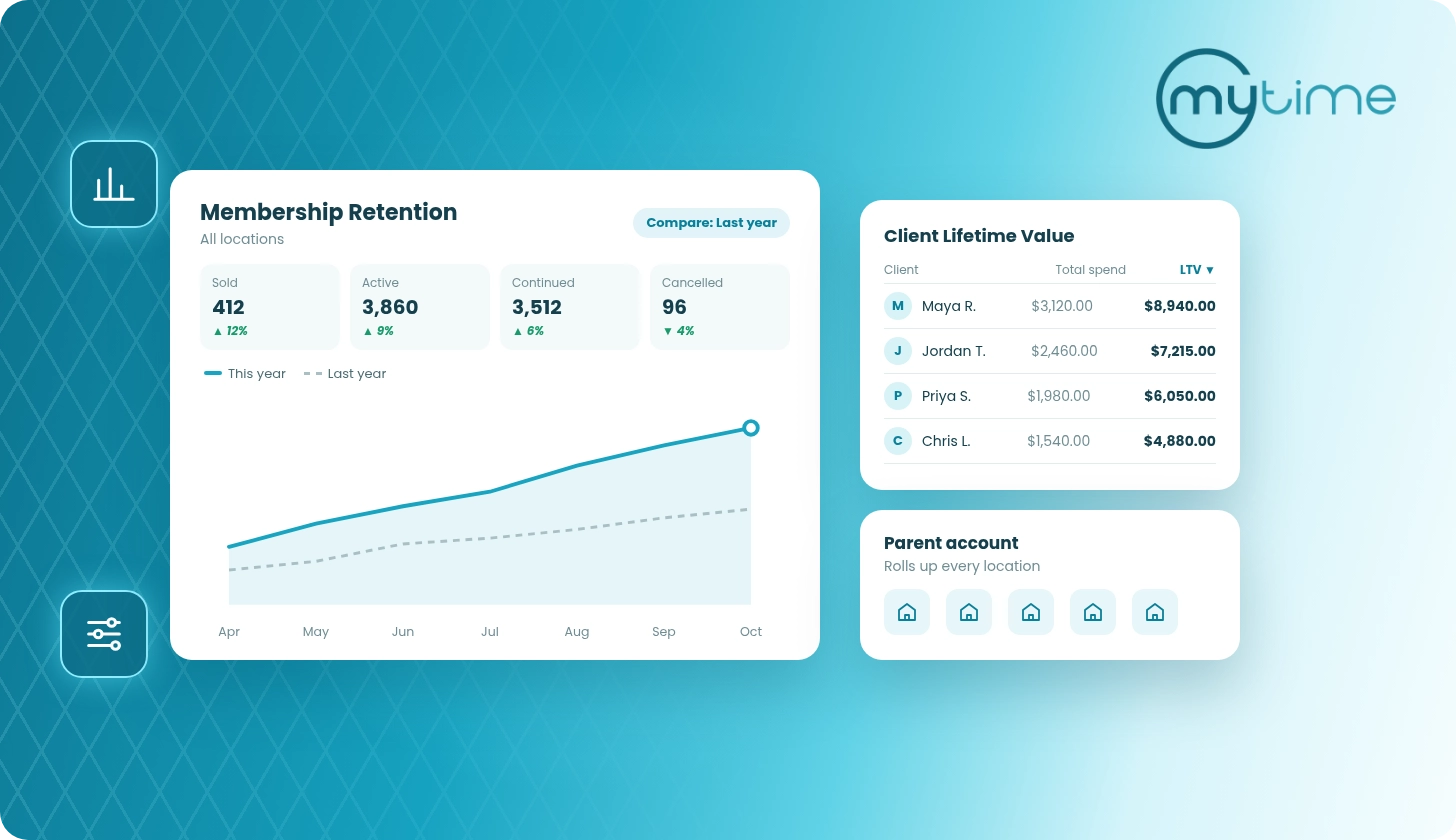
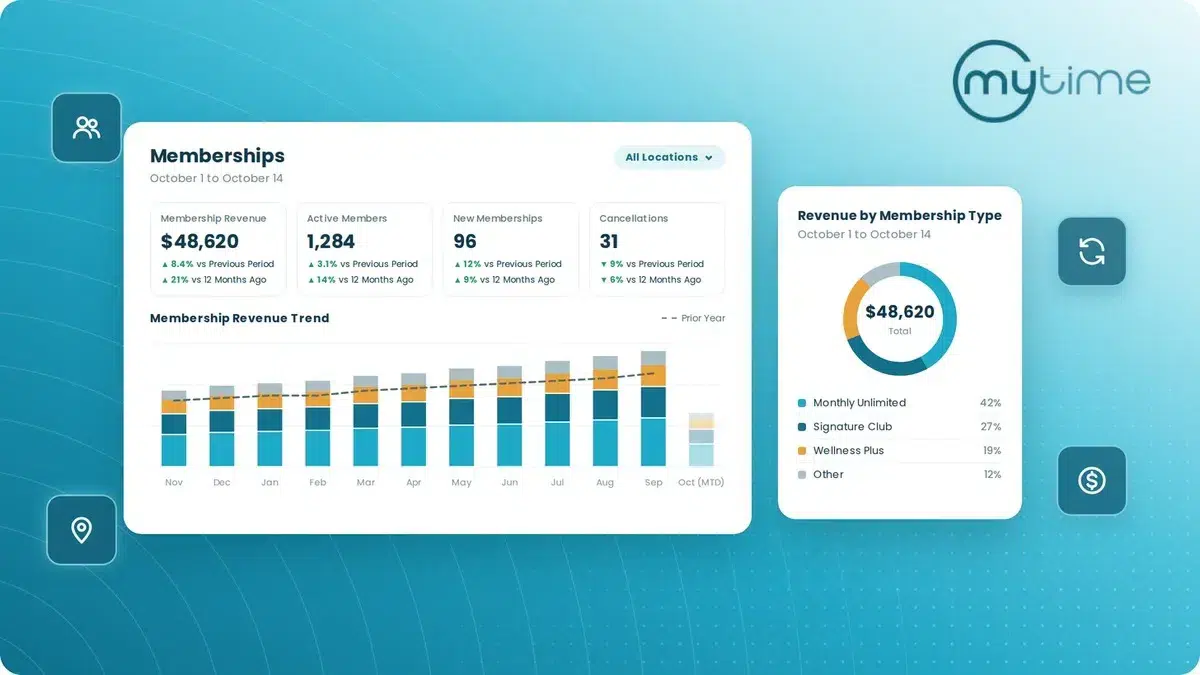
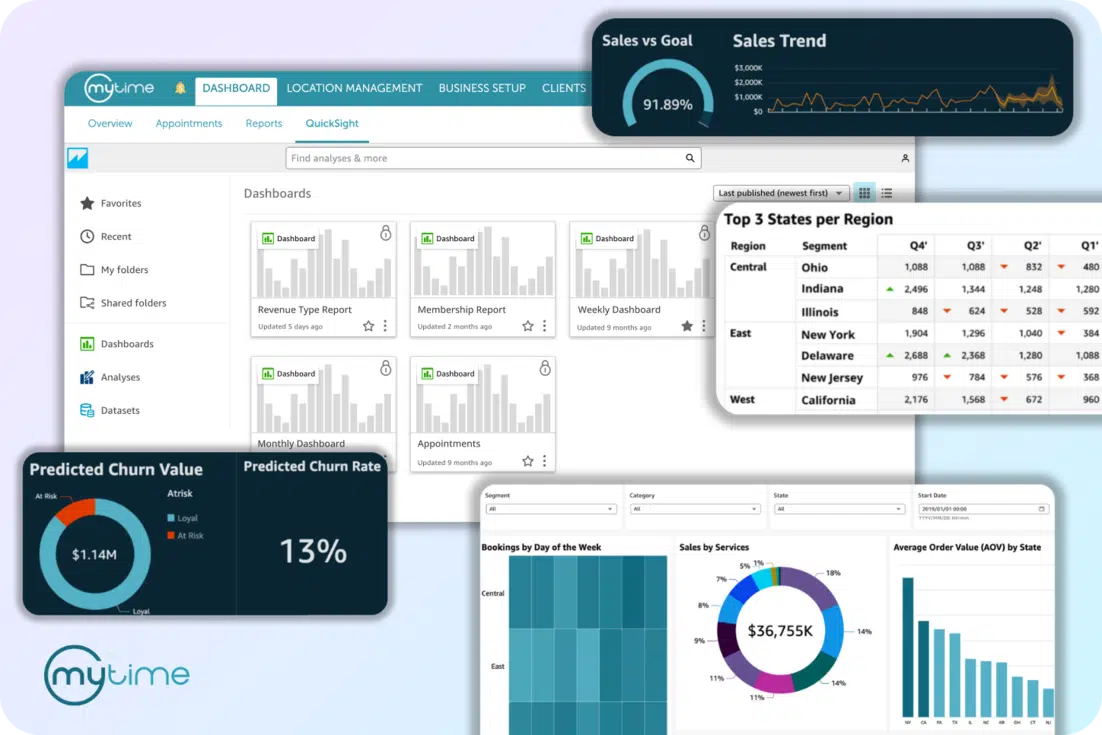
MyTime’s Staff Productivity Report displays staff productivity metrics such as sales per hour, number of tickets, and utilization (MyTime Help: Staff Productivity Report). The report includes scheduled hours, clocked hours, booked hours, total sales, service sales per clocked hour, average ticket, and appointment revenue (MyTime Help: Staff Productivity Report). It also includes cancellations, refunds, utilization, appointments, book-again activity, pre-booked appointments, requested appointments, walk-ins, and new versus repeat client percentages (MyTime Help: Staff Productivity Report).
Those metrics help leaders ask better scheduling questions:
- Which providers carry the strongest utilization?
- Which locations need more coverage during peak periods?
- Where do cancellations hurt schedule quality?
- Which providers drive more pre-booked appointments?
- Which services need different durations or buffers?
The report can also filter by primary or secondary staff in multi-staff service appointments, which helps leaders review individual revenue and appointments when more than one staff member contributes to a service workflow (MyTime Help: Staff Productivity Report).
This matters in med spa operations because multi-staff services can hide performance details if the platform only shows one provider. Leaders need to understand how each staff member contributes to utilization, revenue, and client flow.
MyTime also ties multi-staff work into the POS experience. Its tip-splitting documentation says a single tip gets divided among the staff members who performed the services (MyTime Help: Automatically Split Tips for Multi-Staff Appointments). The system allocates tips based on each staff member’s share of total appointment revenue (MyTime Help: Automatically Split Tips for Multi-Staff Appointments). Operators can manually adjust tip distribution on the ticket if needed (MyTime Help: Automatically Split Tips for Multi-Staff Appointments).
That connection helps the business treat scheduling, service delivery, checkout, and staff attribution as one operational flow.
Centralize standards while preserving local control
Multi-location med spa brands need consistent standards. They also need enough location-level flexibility to reflect demand, staffing, room layouts, and service mix.
Corporate teams may want shared service menus, provider permissions, intake requirements, reporting structures, and scheduling rules. Local teams still need practical control over day-to-day coverage, provider availability, and room use.
MyTime’s Wellness & Med Spa page says multi-location brands can clone menus, permissions, and configurations (MyTime Wellness & Med Spa). It also says brands can sync data, manage operations centrally, and use real-time analytics (MyTime Wellness & Med Spa). The same page says MyTime supports client records with SOAP notes, preferences, treatment histories, waivers, forms, reminders, and global records across locations (MyTime Wellness & Med Spa).
Those details matter because scheduling does not sit alone. The appointment connects to the client profile, intake process, treatment history, provider workflow, and reporting layer.
The market context supports this need for stronger operating systems. Mordor Intelligence notes that clinics report higher average tickets as clients bundle multiple therapies during the same visit (Mordor Intelligence). It also says this shift changes staffing models by prioritizing advanced-practice providers and device specialists (Mordor Intelligence). As service complexity grows, brands need scheduling systems that can support both clinical-adjacent workflows and commercial performance.
Workforce trends add another layer. The U.S. Bureau of Labor Statistics projects skincare specialist employment to grow 7% from 2024 to 2034, which it classifies as much faster than average (BLS Occupational Outlook Handbook). As teams grow, med spa leaders need better systems to manage availability, utilization, and service quality across providers.
Where MyTime fits for high-scale med spas
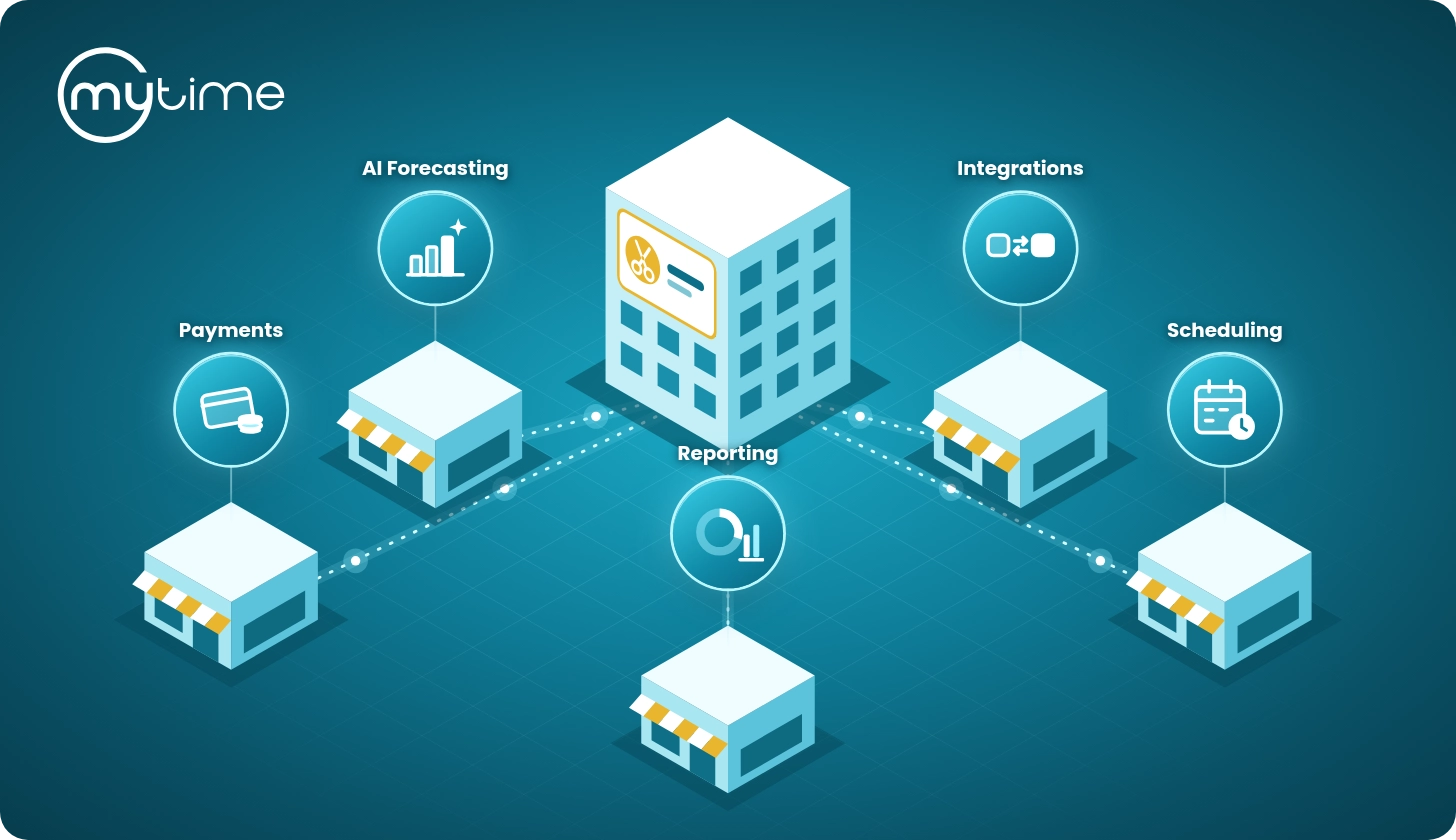
MyTime helps med spa brands connect staff scheduling with the broader operating model. That matters when a business needs one platform to support appointments, resources, service bundles, staff assignments, client records, reporting, and multi-location oversight.
For staff and resource scheduling, MyTime coordinates room bookings and specialist assignments (MyTime Wellness & Med Spa). It also aligns staff with needed resources and helps eliminate double-bookings and scheduling conflicts (MyTime Wellness & Med Spa).
Appointment setup supports configurable service bundles, timeframes, staff assignments, and staff matching based on availability and certification levels (MyTime Appointment Scheduling). Labor planning uses MyTime’s booking behavior, recent demand trends, and provider productivity signals to predict staffing needs by hour (MyTime Labor Forecasting).
Complex visits can use MyTime multi-staff appointments when different staff members work on different services within the same appointment (MyTime Help: Scheduling Multi-Staff Appointment on Scheduler App). Staff Productivity Report metrics give leaders visibility into utilization, sales per hour, ticket activity, booked hours, cancellations, pre-booking, and new versus repeat client percentages (MyTime Help: Staff Productivity Report).
Client readiness also stays connected. MyTime supports SOAP notes, preferences, treatment histories, waivers, forms, reminders, and global records across locations (MyTime Wellness & Med Spa).
Together, these capabilities help med spa brands move from reactive calendar management to structured staff scheduling. Leaders can plan coverage with better data. Managers can coordinate rooms and providers more easily. Staff can see the services they own. Clients can experience a smoother visit.
Med spa staff scheduling checklist
Use this checklist to evaluate whether your scheduling system can support a growing med spa brand:
- Define provider eligibility by service: Match injectors, aestheticians, specialists, and wellness providers to the services they can perform.
- Set service durations and buffer rules: Give teams enough time for prep, consultation, room turnover, and follow-up.
- Connect rooms, devices, and resources to appointment types: Prevent double-bookings and room conflicts before they reach the front desk.
- Plan coverage by demand: Use booking history, recent trends, provider productivity, and peak-time patterns instead of static schedules.
- Support multi-staff and bundled services: Let the schedule reflect the actual client journey.
- Track utilization and productivity by provider and location: Use reporting to improve staffing, not just review past performance.
- Standardize rules across locations: Keep brand standards consistent while allowing local managers to manage real schedules.
- Review schedule quality every week: Look for underused capacity, bottlenecks, cancellations, and missed pre-booking opportunities.
FAQs about med spa staff scheduling
What is med spa staff scheduling?
Med spa staff scheduling is the process of assigning injectors, aestheticians, specialists, rooms, equipment, and time blocks to services while protecting provider eligibility, client experience, and location-level demand. It goes beyond basic appointment booking because it must connect staff, rooms, devices, buffers, service rules, and client records.
Why is med spa scheduling harder than regular salon scheduling?
Med spa scheduling often involves specialized providers, treatment rooms, devices, consultation workflows, service bundles, intake forms, SOAP notes, and clinical-adjacent documentation. Those needs make provider and resource matching more complex.
What should med spa chains look for in staff scheduling software?
Med spa chains should look for staff eligibility controls, room and resource scheduling, configurable service durations, buffer times, multi-staff appointments, demand forecasting, productivity reporting, and centralized multi-location management.
How does labor forecasting help med spa scheduling?
Labor forecasting helps managers plan staffing around real demand patterns. MyTime’s Labor Forecasting uses historical booking patterns, recent demand trends, and provider productivity to predict staffing needs by hour (MyTime Labor Forecasting).
How do multi-staff appointments help med spas?
Multi-staff appointments help med spas coordinate visits where different team members perform different services. MyTime’s multi-staff appointment documentation says operators can assign specific staff members to each service or add-on within the appointment modal (MyTime Help: Scheduling Multi-Staff Appointment on Scheduler App).
Bring staff, rooms, demand, and reporting into one scheduling system
Med spa staff scheduling has become a growth system, not just a calendar function. Strong scheduling helps teams protect client experience, staff the right providers, use rooms and devices more effectively, and make better labor decisions across locations.
MyTime gives med spa brands a connected way to manage staff scheduling, resource coordination, multi-staff appointments, labor forecasting, client records, and staff productivity reporting. That connected model helps high-scale med spas move faster without losing operational control.
Want to see how MyTime helps med spa brands coordinate staff, rooms, resources, client records, labor forecasting, and reporting across locations? Book a demo.
Internal QA Check
- Source accuracy: Market growth, med spa location growth, multi-location operator size, and workforce claims are tied to Grand View Research, Mordor Intelligence, and BLS sources.
- MyTime capability accuracy: Staff and resource scheduling, appointment scheduling, labor forecasting, multi-staff appointments, multi-client workflows, Staff Productivity Report metrics, POS tip splitting, and client record capabilities are tied to MyTime product or help resources.
- Readability: Draft uses active voice where practical, short paragraphs, clear subheads, and mostly concise sentences.
- Sentence starts: Draft avoids three or more consecutive sentences starting with the same word outside intentional list formatting.
- CTA: Draft uses the established demo link: https://get.mytime.com/demo/.
- Guardrails: Draft uses “clients” as the default term, avoids unsupported superlatives, avoids unrelated case study proof points, and avoids competitor discussion.