



Royalty collection looks simple when a franchise brand has a few locations. Finance pulls sales numbers, applies the agreed royalty formula, checks payments, and moves on.
That process gets harder as the brand grows. Each new location adds more transactions, more prepaid value, more redemptions, more settlement timing questions, and more chances for spreadsheet errors.
Franchise royalty collection software helps multi-location brands reduce manual reconciliation by connecting POS data, royalty rules, settlement workflows, reporting, and brand-wide financial visibility in one system. For service-based franchises, that matters because royalties often connect to appointments, tickets, payments, memberships, packages, gift cards, and cross-location activity.
What franchise royalty collection software does
Franchise royalty collection software helps franchisors calculate, collect, track, and report recurring royalty fees due from franchisees. The system should connect transaction data to the royalty formula, then help finance teams collect and verify the right amount.
Royalty structures vary by brand, but they often depend on gross sales, fee percentages, due dates, and defined fee formulas. The FTC explains that franchisees may pay continuing royalties based on a percentage of weekly or monthly gross income, and those royalties usually support the right to use the franchisor’s name and system (FTC Consumer’s Guide to Buying a Franchise).
Franchise royalty software becomes especially useful when the system connects royalties to the operating data that creates the fee. Instead of exporting POS reports, applying formulas manually, and chasing down exceptions, finance teams can work from configured rules and centralized reporting.
Why manual royalty reconciliation gets harder as franchise brands scale
Franchise growth increases the need for clean financial processes. The International Franchise Association projects U.S. franchise establishments will grow from 832,521 to 845,000 units in 2026, adding more than 12,000 franchised businesses (International Franchise Association).
That growth creates more than a sales opportunity. It also creates more royalty records, location-level exceptions, payment timing questions, and reporting needs.
Royalty fees also carry formal disclosure and calculation requirements. The FTC’s Franchise Rule Compliance Guide says Item 6 of the Franchise Disclosure Document must disclose recurring or occasional fees, including royalties and advertising fees, along with the type of fee, amount, due date, and formula used to compute the fee (FTC Franchise Rule Compliance Guide).
The International Franchise Association describes royalty fees as a critical ongoing franchise cost, typically calculated as a percentage of gross sales, with common average ranges from 5% to 9% of gross sales (International Franchise Association). When a brand manages many locations, even a small mismatch in sales definitions, fee timing, or item eligibility can create avoidable reconciliation work.
Service-based franchises face added complexity. Services, products, memberships, packages, classes, and gift cards can all create different revenue and redemption scenarios. A client may buy value at one location, redeem it at another, or use prepaid credits over time.
Those workflows make royalty reconciliation more than a simple sales percentage. Finance needs a clear way to connect the royalty rule to the right transaction, item type, location, and settlement period.
The hidden cost of spreadsheet-based royalty collection
Spreadsheets can work in the earliest stage of franchise growth. They become fragile when teams use them to reconcile high-volume transaction data across locations.
Corporate Finance Institute defines reconciliation as matching internal transaction records against external records, such as bank statements, to identify differences and correct discrepancies (Corporate Finance Institute). In royalty collection, that often means finance teams compare POS exports, royalty calculations, bank transfers, and location-level reporting.
Deloitte describes reconciliation as one of the most critical controls in the financial close and reporting process because it helps substantiate balances with evidence and supports complete, accurate financial information (Deloitte). Manual reconciliation often forces teams to download data, manipulate files, match transactions, chase explanations, and investigate exceptions before close (Deloitte).
For franchise teams, that manual work shows up in familiar ways:
- Month-end close takes longer.
- Operators ask how fees were calculated.
- Finance has to explain location-level exceptions.
- Leadership waits for brand-wide reporting.
- Teams carry manual spreadsheet risk into a recurring process.
Deloitte warns that spreadsheet output errors can create risk when organizations rely on recurring spreadsheets for critical business processes without strong controls (Deloitte). Royalty collection fits that pattern because the same spreadsheet often gets reused each period, even as the brand adds more locations and transaction volume.
What the right royalty collection workflow should automate
The right royalty workflow should reduce the number of manual handoffs between POS data, fee calculation, settlement, and reporting. It should also make the process easier to review.
Deloitte says automated reconciliation can integrate reconciliation processes, automate activities, minimize manual work, and accelerate reporting (Deloitte). Deloitte also identifies useful automation capabilities such as data extraction, transaction matching, alerts on differences, status tracking, certification, analytics, and reporting (Deloitte).
For franchise royalty collection, the automation checklist should include:
- Central fee rule configuration at the franchisor or parent level.
- Percentage-based and flat-fee royalty logic.
- Item-level applicability for different sales categories.
- Closed-ticket-based calculations.
- Settlement cadence and timing controls.
- Bank account and transfer workflows.
- Location-level and brand-wide reporting.
- Exception visibility for finance teams.
This workflow gives finance a cleaner source of truth. It also helps operators understand how the brand calculates and collects fees.
How integrated POS data improves royalty accuracy
Royalty collection starts with trustworthy transaction data. When a brand separates POS activity from royalty calculation, finance teams have to bridge the gap manually.
Integrated POS data helps reduce that burden. Tickets, items, payments, and locations stay connected, so royalty logic can run closer to the source transaction.
This matters for service franchises because financial activity rarely lives in one simple sales category. A ticket may include services, retail products, membership credits, package redemptions, or gift card activity. A disconnected workflow can leave finance teams sorting through exported reports to decide what counts and when it counts.
When franchise royalty collection software connects to POS data, finance teams gain cleaner inputs for royalty reporting. Operations teams also gain more confidence because the fee logic starts from the same transaction record the location uses to run the business.
How MyTime supports franchise royalty collection
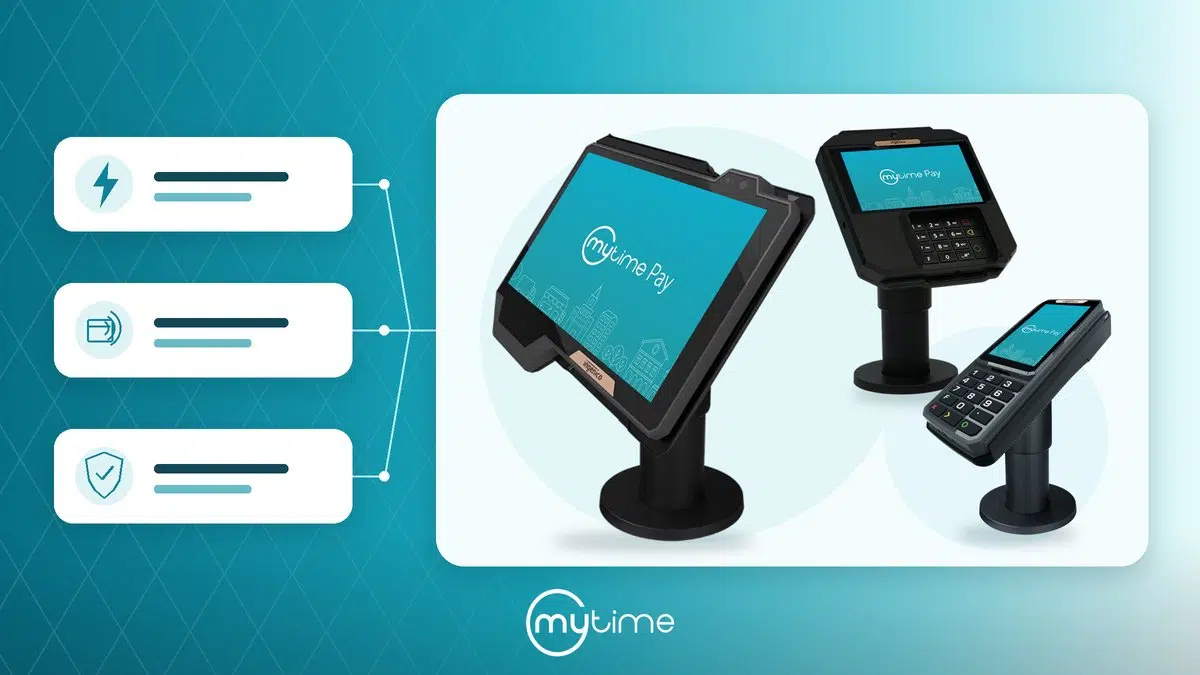
MyTime helps franchise brands connect royalty collection to the operating system that manages appointments, POS, payments, reporting, and multi-location controls (MyTime Franchise Solution). The franchise solution gives home office teams tools to track metrics, royalties, and subscription management while supporting franchisees with appointment scheduling, client management, email marketing, and integrated payments (MyTime Franchise Solution).
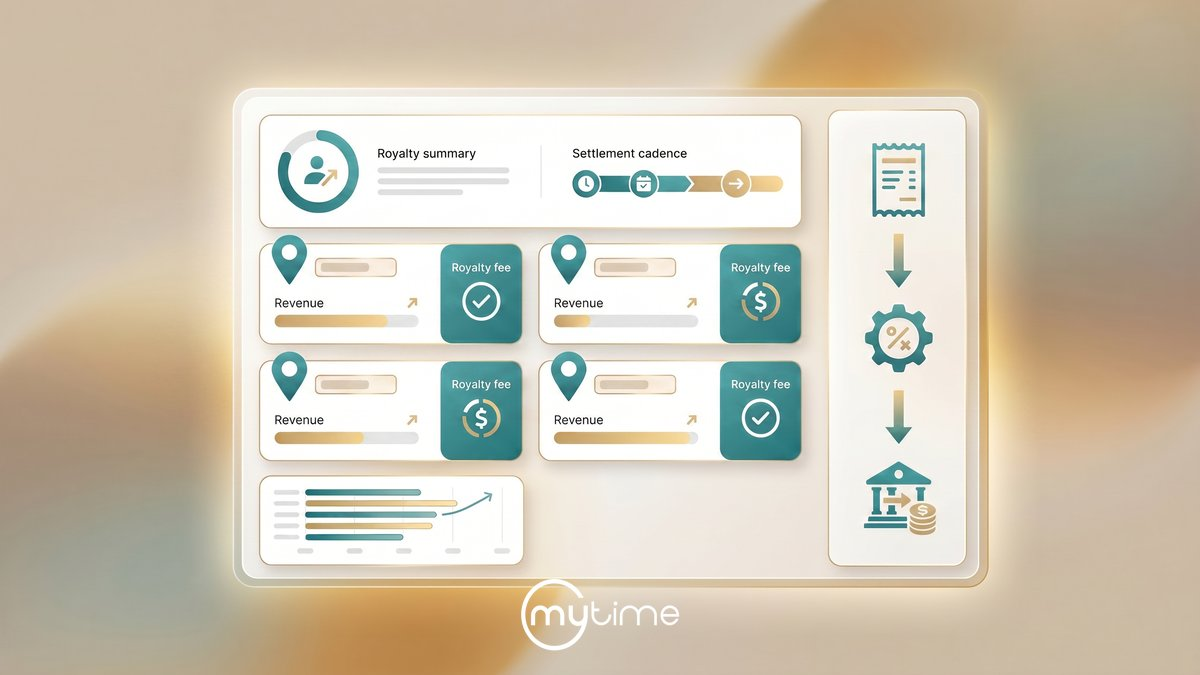
The royalty configuration workflow supports parent-level setup for franchise royalty rules. MyTime explains that franchisors can configure and automatically receive royalty payments from franchisees on a regular cadence (MyTime Help Center).
Franchisors configure the royalty fee structure at the parent level. Royalty fees can include sales percentages, monthly brand development fees, technology funds, and other royalty types (MyTime Help Center).
MyTime calculates royalty fees every time a ticket closes, and calculations begin from the configured start date (MyTime Help Center). This helps teams anchor royalty logic to completed sales activity instead of relying only on manual period-end exports.
Brands can also configure settlement timing. MyTime supports royalty settlement frequencies that repeat daily, weekly, or monthly, with interval controls that define how often fees repeat (MyTime Help Center).
MyTime supports per-item royalty logic or a flat fee collected for each transaction (MyTime Help Center). For per-item fees, MyTime can apply a flat dollar value or percentage to services, products, memberships, classes, packages, and gift cards (MyTime Help Center).
That flexibility matters for franchise operators. A simple percentage of total sales may not fit every brand, every category, or every prepaid item workflow.
How MyTime helps with prepaid items and cross-location redemptions
Prepaid value can make royalty reconciliation harder. Memberships, packages, gift cards, and item credits can separate the moment a client pays from the moment a client uses the value.
MyTime lets brands calculate revenue for prepaid items at Time of Purchase or Time of Use, and prepaid items include membership value, item credits, package redemptions, and gift card redemptions (MyTime Help Center). That gives franchise teams a structured way to align revenue timing with the brand’s operating model.
Cross-location redemptions add another layer. A client might buy a package, membership, or gift card at one location and redeem it elsewhere.
MyTime’s Automated Royalties & Redemptions capability helps brands automatically reconcile cross-location redemptions for memberships, packages, and gift cards, calculate franchisee royalties with precision, and maintain transparent brand-wide financials (MyTime). For franchise systems, that connection helps reduce the manual work that comes from tracking value across locations.
Reporting, controls, and franchise visibility
Royalty collection software should not stop after it calculates a fee. Franchise teams also need visibility into performance, payments, and controls across the network.
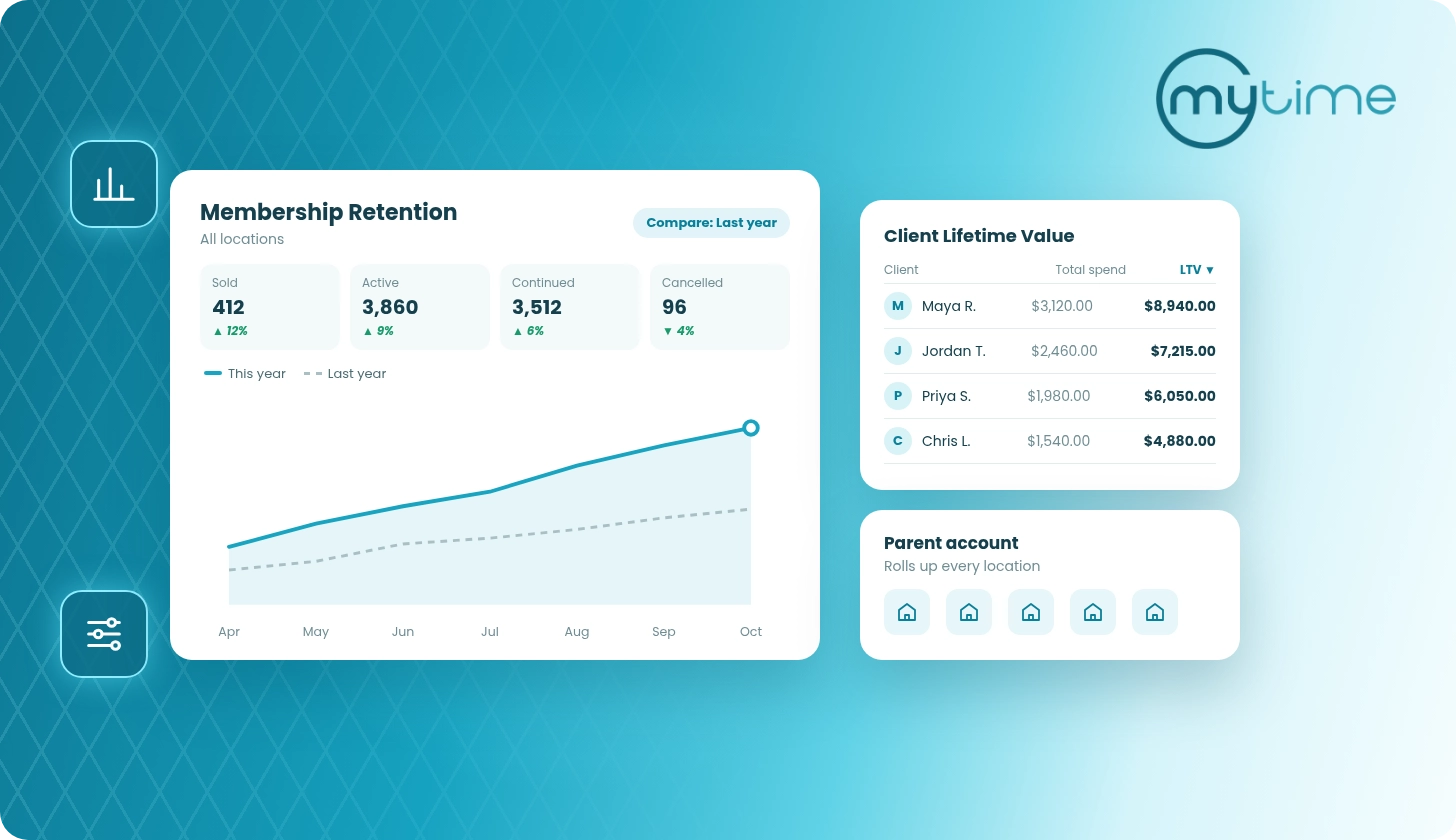
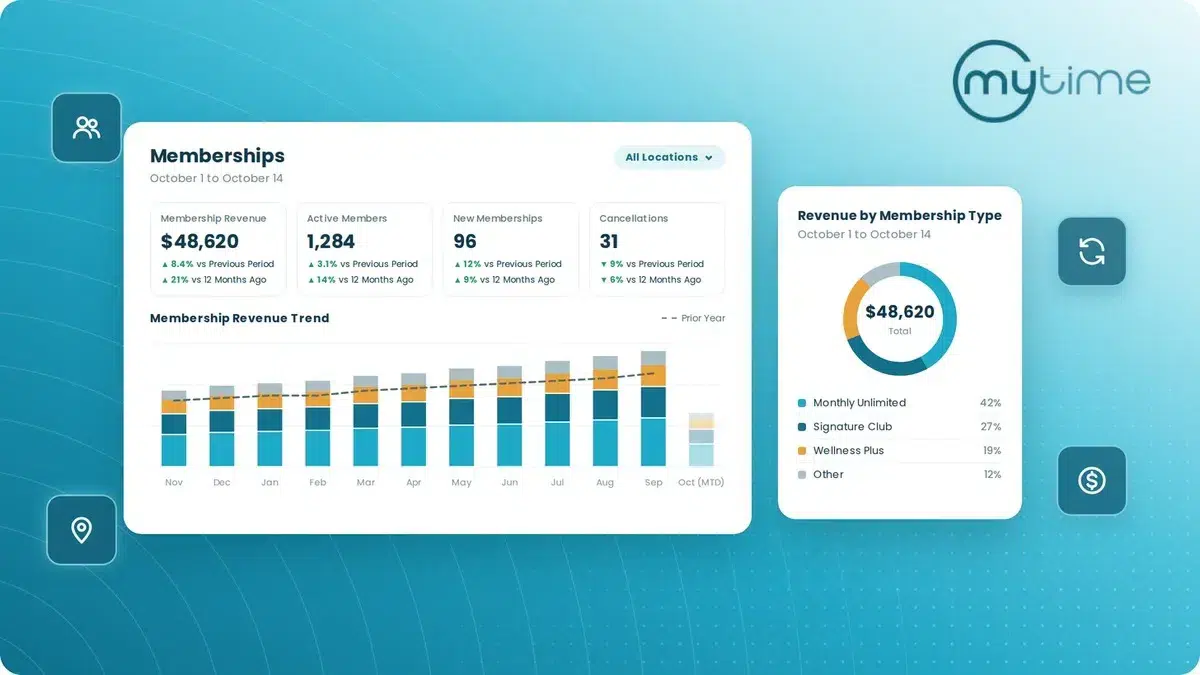
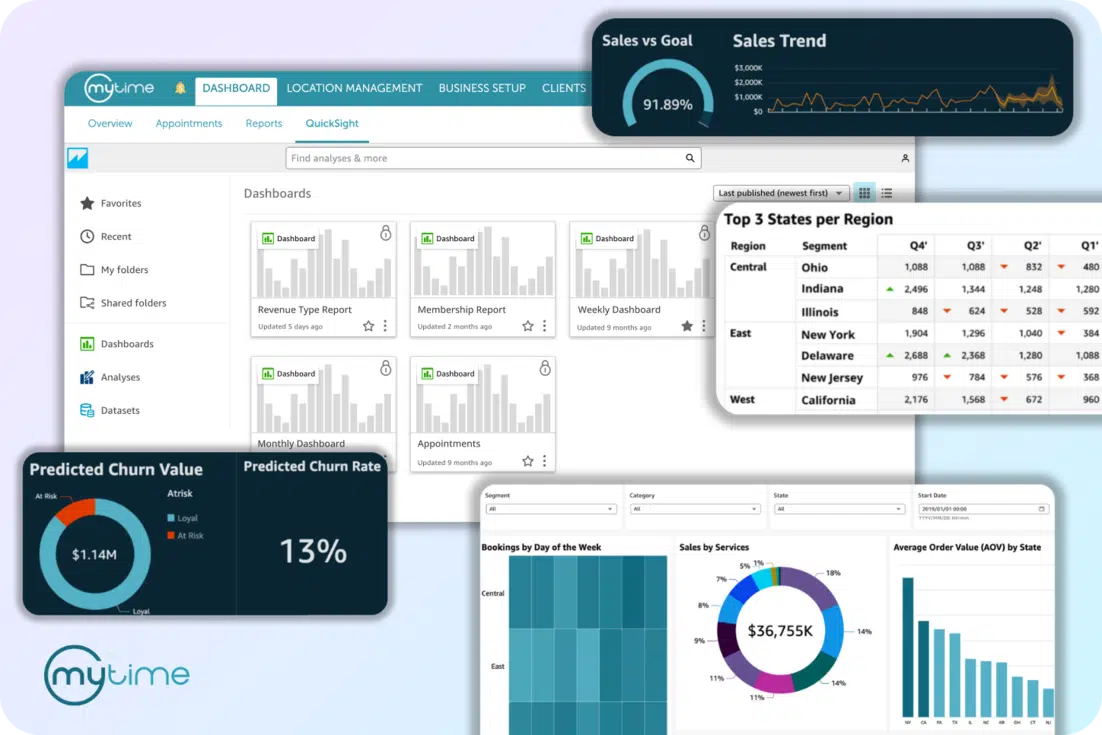
MyTime’s franchise solution includes real-time reporting, advanced reporting and analytics, and royalty reporting at the touch of a button (MyTime Franchise Solution). MyTime also says its dashboard includes more than 50 built-in reports that can break down revenue, productivity, and performance by location, service, or staff member (MyTime Franchise Solution).
Access controls also matter. MyTime’s franchise page describes custom access controls that let brands decide which teams can access different parts of the product and whether franchisors or franchisees manage specific functions (MyTime Franchise Solution).
Those controls support a cleaner franchise operating model. Corporate teams can standardize the rules that need consistency while giving franchisees the access they need to run daily operations.
MyTime’s homepage also notes that chain and franchise brands can manage all locations from one platform, use configurable permissions and access controls, and sync data with systems such as QuickBooks, Xero, ADP, and HubSpot (MyTime). That broader connectivity helps royalty collection fit inside the brand’s larger finance and operations stack.
Franchise royalty collection software evaluation checklist
Franchise brands should evaluate royalty collection software against the real workflows finance teams manage each month. The strongest systems connect fee logic, sales activity, payments, reporting, and multi-location controls.
Use these questions as a starting point:
- Can the system calculate royalties from closed tickets?
- Does the platform let franchisors configure fee logic centrally?
- Which item types can the fee logic cover?
- Does it support percentage-based and flat-fee models?
- Will settlement timing match the brand’s process?
- How does it support memberships, packages, gift cards, and cross-location redemptions?
- What reporting can finance teams see at the location and brand level?
- How do access controls separate franchisor and franchisee responsibilities?
- Where does the system connect with the broader franchise operating stack?
The goal is not just faster fee collection. The goal is a cleaner, more reliable royalty workflow that scales with the brand.
Why service franchises need a connected royalty workflow
Franchise royalty collection touches finance, operations, technology, and franchisee trust. When teams calculate royalties in one system, process payments in another, and reconcile redemptions in a spreadsheet, every period creates extra work.
A connected workflow reduces that drag. It helps finance teams spend less time proving numbers and more time analyzing performance.
For service-based franchises, the right system should account for how the business actually runs. Appointments, POS tickets, payments, memberships, packages, gift cards, reporting, and location controls all affect the royalty story.
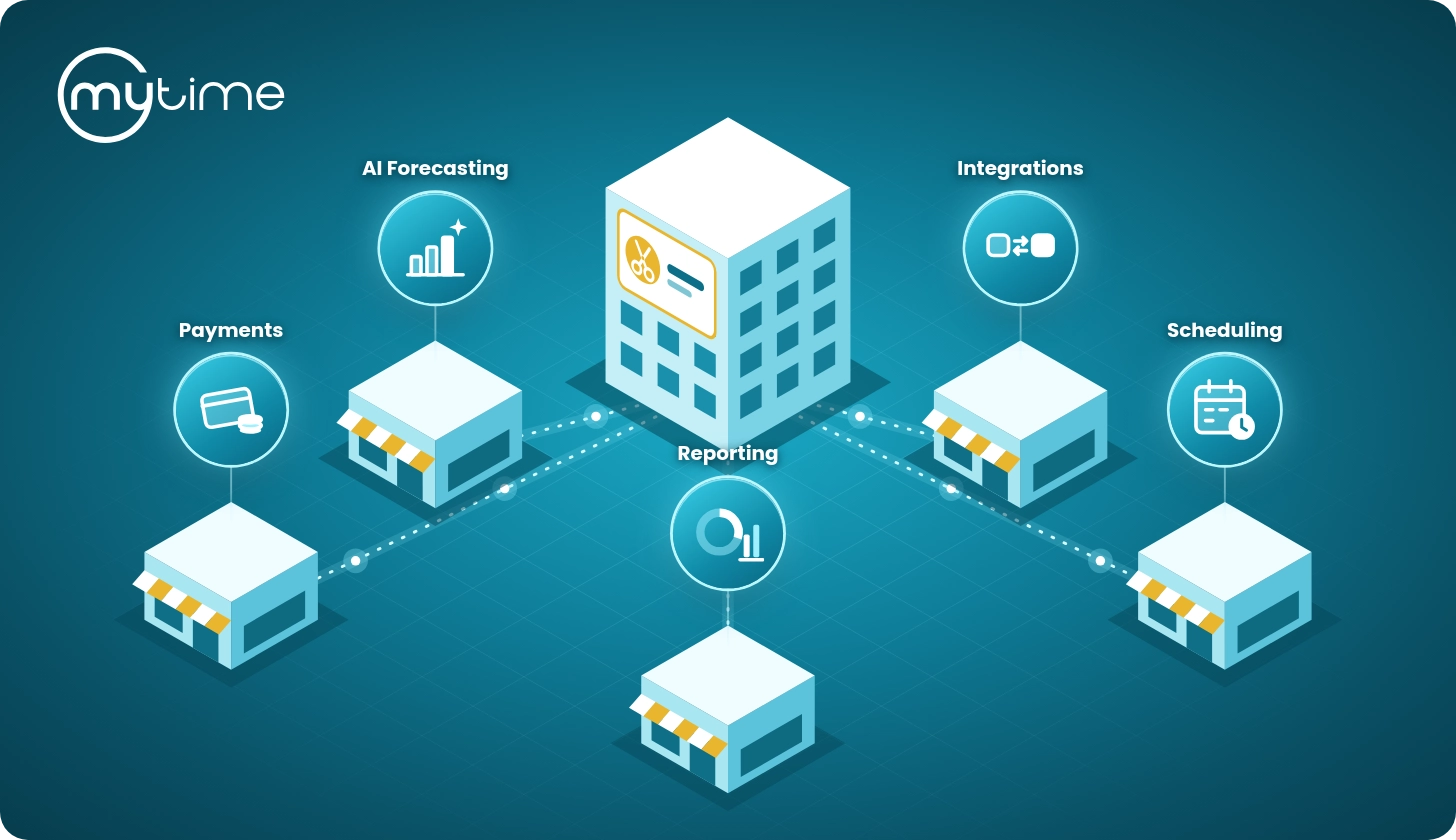
MyTime brings those workflows together for franchise and multi-location service brands. The platform helps teams connect scheduling, POS, payments, memberships, reporting, royalty configuration, and cross-location redemption workflows in one operating system built for chains and franchises (MyTime Franchise Solution).
Want to see how MyTime helps franchise brands simplify royalty collection, reporting, and multi-location operations? Book a demo.
FAQs
What is franchise royalty collection software?
Franchise royalty collection software helps franchisors calculate, collect, track, and report recurring fees due from franchisees. It connects transaction data, royalty rules, settlement timing, and reporting so finance teams can reduce manual reconciliation.
How does royalty collection software reduce manual reconciliation?
Royalty collection software reduces manual reconciliation by applying configured fee rules to operating data, such as POS tickets, item categories, locations, and settlement periods. This helps teams avoid repeated spreadsheet exports, manual formulas, and back-and-forth exception tracking.
Why does POS integration matter for franchise royalty collection?
POS integration matters because royalty fees often start with sales activity. When the system connects tickets, items, payments, and locations, finance teams can calculate royalties from cleaner source data.
Can royalty software support memberships, packages, and gift cards?
The right royalty workflow should support prepaid value because memberships, packages, and gift cards can affect revenue timing and redemptions. MyTime supports prepaid item revenue calculations at Time of Purchase or Time of Use and includes membership value, item credits, package redemptions, and gift card redemptions in that workflow (MyTime Help Center).
How does MyTime support franchise royalty collection?
MyTime lets franchisors configure and automatically receive royalty payments from franchisees on a regular cadence (MyTime Help Center). MyTime also supports parent-level royalty configuration, closed-ticket fee calculations, settlement frequency controls, per-item fee logic, flat-fee logic, and royalty reporting for franchise brands (MyTime Help Center).