



Med spa memberships can be one of the strongest ways to turn occasional visits into ongoing client relationships. But the most effective programs are not just monthly discounts. They are structured around treatment cadence, client goals, staff workflows, recurring billing, POS redemption, marketing automation, reporting, and clear operational controls.
For med spa chains and franchises, the stakes are even higher. A membership that works at one location can become confusing at five, inconsistent at 20, and difficult to measure across a larger network. To scale, brands need a membership model that is easy for clients to understand, easy for staff to sell and redeem, and easy for leadership to track across locations.
This guide explains how to structure, price, and retain clients with a med spa membership program, and how MyTime helps multi-location med spa brands connect memberships to the full client journey.
Why med spa memberships are becoming more important
Med spas are operating in a growing market. Grand View Research reports that the global medical spa market was valued at $21.21 billion in 2024 and projects it will reach $78.23 billion by 2033, growing at a 15.77% CAGR from 2025 to 2033 (Grand View Research).
That growth is being driven by broader wellness, self-care, anti-aging, and minimally invasive treatment demand. Grand View Research says demand is supported by growing awareness of self-care and anti-aging services, demand for minimally invasive treatments, and rising demand for laser hair removal and facial procedures (Grand View Research).
Wellness spending is also becoming more routine. McKinsey reports that U.S. wellness represents more than $500 billion in annual spend, growing 4% to 5% each year, and that 84% of U.S. consumers say wellness is a top or important priority (McKinsey).
For med spa brands, that creates an opportunity. Instead of treating every visit as a one-time transaction, memberships help turn ongoing wellness and aesthetic goals into a structured relationship. MyTime’s guide to predictable revenue explains that memberships shift the client relationship from transactional to ongoing and help establish a recurring revenue baseline (MyTime).
The key is to build a program that reflects how clients actually use med spa services. A membership should support real treatment plans, predictable follow-up, and consistent engagement, not just apply a discount at checkout.
Start with treatment cadence, not discounts
The biggest mistake med spas make with memberships is starting with the discount instead of the client journey. A stronger approach starts with treatment cadence.
Ask questions like:
- Which treatments naturally repeat monthly, quarterly, or seasonally?
- Which services help clients stay on track between larger treatment plans?
- Which add-ons, retail products, or maintenance treatments improve the overall experience?
- Which services need reminders, follow-up, or consultation before the next visit?
- Which benefits create value without eroding margin?
This is especially important for med spa, wellness spa, IV therapy, and aesthetics concepts because the client journey often spans multiple visits. Mordor Intelligence notes that consumers increasingly perceive aesthetic services as routine wellness maintenance, and it describes subscription wellness models that package services such as injections, chemical peels, and IV therapy for a fixed monthly price as a way to build predictable revenue streams and lower churn (Mordor Intelligence).
MyTime’s predictable revenue article makes the same operational point: service-based businesses are inherently recurring because clients already return regularly, and IV and wellness brands benefit from predictable treatment cadence (MyTime).
That means the membership should match the way clients already behave. If clients come in for facials, peels, IV therapy, laser treatments, skincare, body treatments, or maintenance appointments, the membership should help them stay consistent and make the next step obvious.
Common med spa membership structures
There is no single membership structure that works for every med spa brand. The right model depends on your service mix, margins, provider capacity, treatment cadence, and growth stage. Most programs fall into a few practical categories.
Credit-based memberships
Credit-based memberships give clients a monthly value credit or item credit that can be applied to eligible services, products, or treatment categories. This structure can work well when clients want flexibility and the brand wants to avoid over-committing to one specific treatment.
MyTime’s Help Center explains that membership value credits and item credits can be tracked on the client profile and in membership credit reports after tickets close (MyTime Help Center).
Service-included memberships
Service-included memberships give clients a defined service or treatment benefit each billing period. This can work well for services that have a natural monthly cadence, such as facials, wellness services, or other routine treatments.
This model is easiest to sell when the client clearly understands what is included, how often the benefit renews, and what happens if they do not use it before the next billing period.
Perk-based memberships
Perk-based memberships may include member-only pricing, retail discounts, birthday offers, priority booking, exclusive events, or early access to seasonal services. These benefits can help increase perceived value while giving operators more control over margin.
MyTime’s membership resources explain that memberships can include flexible tiers with custom perks, discounts, or credits (MyTime).
Package-plus-membership models
Packages and memberships are often strongest together. Packages can support higher-ticket treatment series, while memberships keep clients engaged between larger purchases.
MyTime’s ultimate guide to memberships, loyalty, and referrals explains that memberships can include value or item-based credits, exclusive discounts, members-only services, and members-only products (MyTime).
Loyalty and referral overlays
Memberships should not operate alone. Loyalty and referral programs can reinforce repeat engagement, reward advocacy, and give clients more reasons to return.
MyTime’s predictable revenue article explains that loyalty works best when it reinforces long-term behavior rather than one-time discounting (MyTime).
How to price a med spa membership program
Membership pricing should begin with unit economics, not competitor menus. A membership can look attractive on paper and still create operational problems if the benefits are too broad, too discounted, or too difficult for staff to manage.
Before setting a price, evaluate:
- Service cost
- Provider time
- Room or device capacity
- Product usage
- Retail margin
- Payment processing costs
- Expected redemption
- No-show or late-cancel risk
- Cross-location usage
- Staff training requirements
- Upgrade, downgrade, pause, and cancellation rules
The goal is not to give away margin in exchange for enrollment. The goal is to create a program that clients value and the business can sustain.
For example, a monthly credit can feel flexible to clients while helping operators control which services are eligible. A member-only price can support loyalty without turning every visit into a discount. A premium tier can create value through priority access, elevated perks, and tailored treatment support.
Clarity matters as much as the price itself. MyTime’s Help Center explains that online membership checkout displays the membership name, billing frequency, start date, end date, and price (MyTime Help Center).
That kind of visibility helps reduce confusion before the client buys. It also helps staff answer questions consistently across locations.
Make the membership easy to buy and use
A med spa membership program should be easy to join, easy to redeem, and easy to understand at checkout. If clients have to call, wait for a manual adjustment, or depend on a staff member remembering benefit rules, the experience will feel inconsistent.
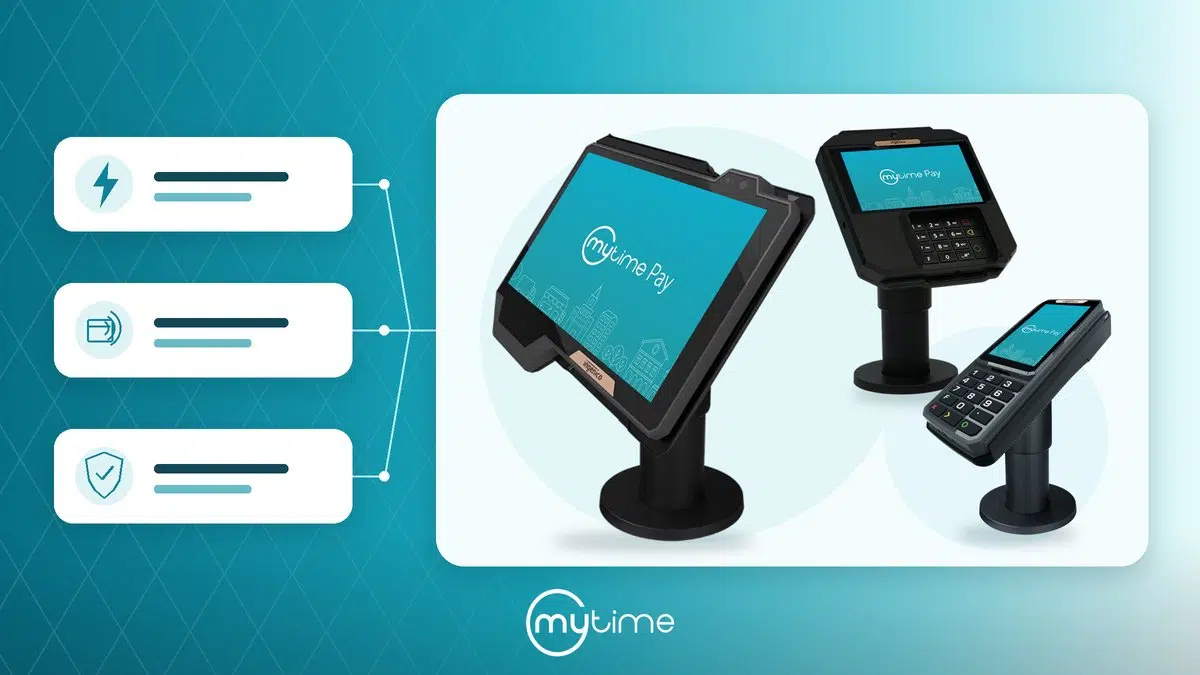
MyTime helps reduce that friction by connecting memberships to booking, client profiles, and POS workflows. MyTime’s Help Center explains that clients can purchase memberships online through the booking widget when memberships are configured, and that the purchase flow can include a Memberships tab, available credits, a Buy button, checkout, and card entry (MyTime Help Center).
On the staff side, benefits should apply without guesswork. MyTime’s Help Center explains that packages and memberships can offer benefits applicable to services, classes, or products, and when sold through POS, associated benefits can be applied to eligible items on the same ticket (MyTime Help Center).
The same Help Center article explains that “In Membership” labels appear on applicable items, membership discounts apply automatically, and membership value credits apply on the payment screen (MyTime Help Center).
That matters for med spa teams because front desk staff, providers, and managers should all be working from the same source of truth. When benefits are visible and automatically applied, the membership experience feels more polished and consistent.
Connect memberships to the full med spa client journey
A membership is not just a billing event. It touches the entire client journey.
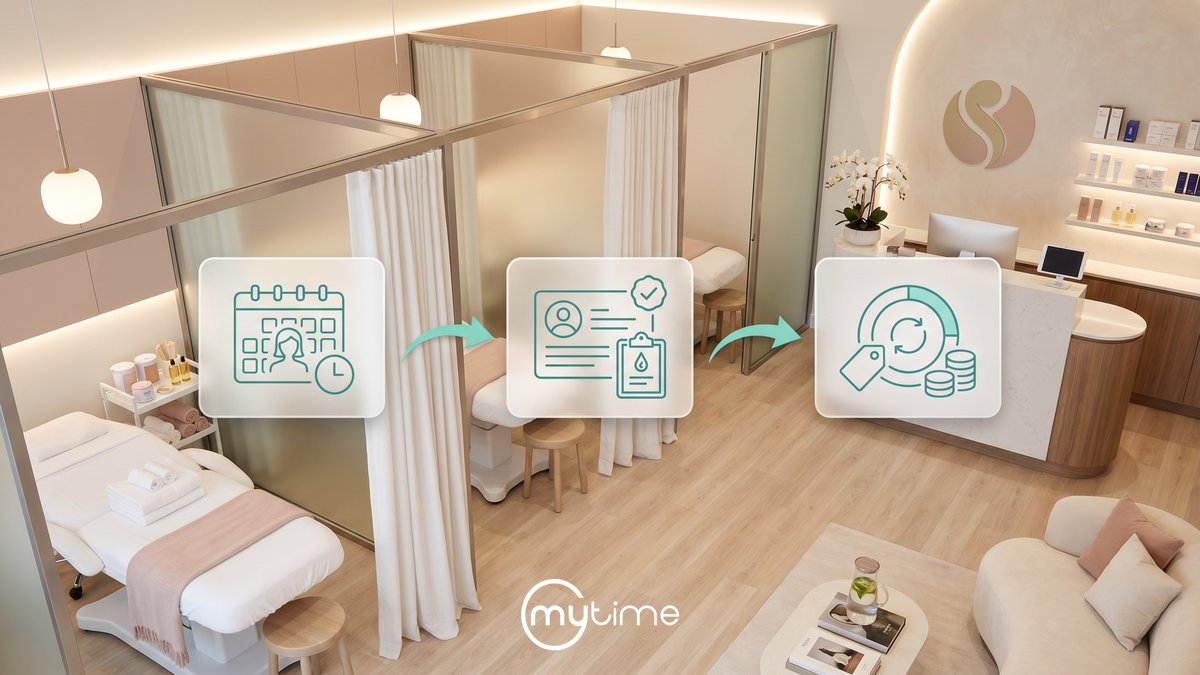
For a med spa, that journey may include:
- Discovery
- Online booking
- Consultation
- Intake forms
- Waivers
- Room and provider assignment
- Treatment history
- Checkout
- Product recommendations
- Follow-up
- Rebooking
- Marketing campaigns
- Membership renewal
- Loyalty and referrals
MyTime’s Wellness & Med Spa page explains that clients can book through a website, app, social media, or phone, and that booking can include customized intake forms and waivers (MyTime).
The same page explains that client records can include aesthetic preferences, SOAP notes, past procedures, contact details, digital waivers, intake forms, automated appointment reminders, complete visit records, and cross-location access (MyTime).
That matters because memberships become more powerful when they are connected to the client record. If staff can see preferences, past treatments, membership status, credits, and visit history, they can make better recommendations and create a more personalized experience.
MyTime also supports the client-facing experience. The Wellness & Med Spa page explains that the Branded Guest App lets clients book treatments, purchase packages, manage memberships, update preferences, track loyalty rewards, and receive real-time updates (MyTime).
For growing med spa brands, that connected journey is the difference between a membership program that runs on manual effort and one that can scale.
Retention depends on usage, not just enrollment
Membership sign-ups are only the beginning. A healthy program needs members to keep using benefits, booking appointments, renewing, and seeing value.
That means operators should watch for signals like:
- Unused credits
- No upcoming appointment
- Declining visit frequency
- Missed treatment cadence
- Failed billing
- Paused memberships
- Cancellations
- Downgrades
- Low retail or add-on engagement
- No response to campaigns
These signals create opportunities for proactive outreach. A client with unused credits might need a reminder. A member with no upcoming appointment might need a rebooking prompt. A client who recently completed one treatment series might be ready for a maintenance plan or package.
MyTime Marketing Hub supports email, text, and push notifications, along with targeted campaigns based on appointment history and client tags (MyTime Marketing Hub).
MyTime Marketing Hub also supports segmentation by service history, preferences, demographics, appointment history, and client tags, which helps teams personalize campaigns instead of sending every member the same message (MyTime Marketing Hub).
For med spa brands, this is where memberships become part of full journey orchestration. The program is not just about collecting monthly dues. It is about helping clients stay engaged with the treatments, products, and routines that brought them in.
What to measure in a med spa membership program
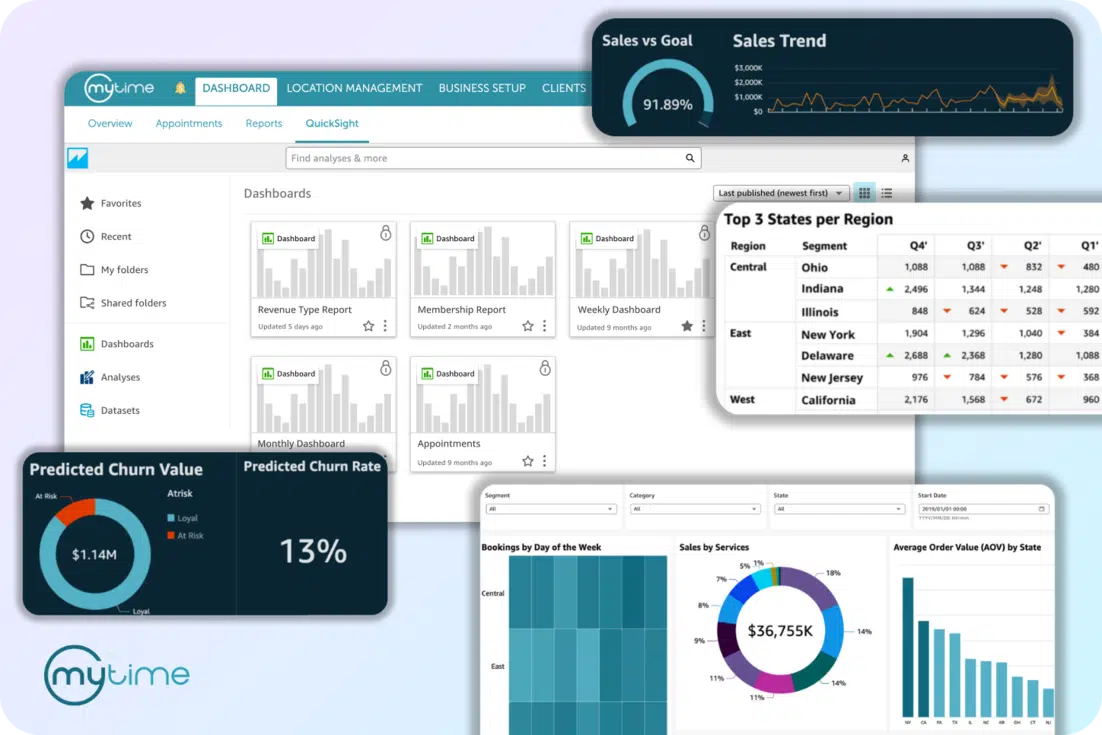
If you cannot measure a membership program, you cannot improve it. Multi-location med spa brands need reporting that shows how memberships perform by location, tier, service category, and client behavior.
Important metrics include:
- Membership adoption by location
- Active members by tier
- New member conversion by source
- Monthly recurring revenue
- Membership revenue as a percentage of total revenue
- Member visit frequency
- Member average order value
- Member retention and churn
- Credit utilization
- Unused value
- Redemption by service category
- Retail attach rate
- Package conversion among members
- Referral activity among members
- Upgrade, downgrade, pause, and cancellation reasons
- Cross-location usage
- Provider and room utilization tied to member demand
MyTime’s med spa software guide says operators should be able to evaluate membership and package attach rate, retention, redemption, unused value, cross-location usage, and revenue impact (MyTime).
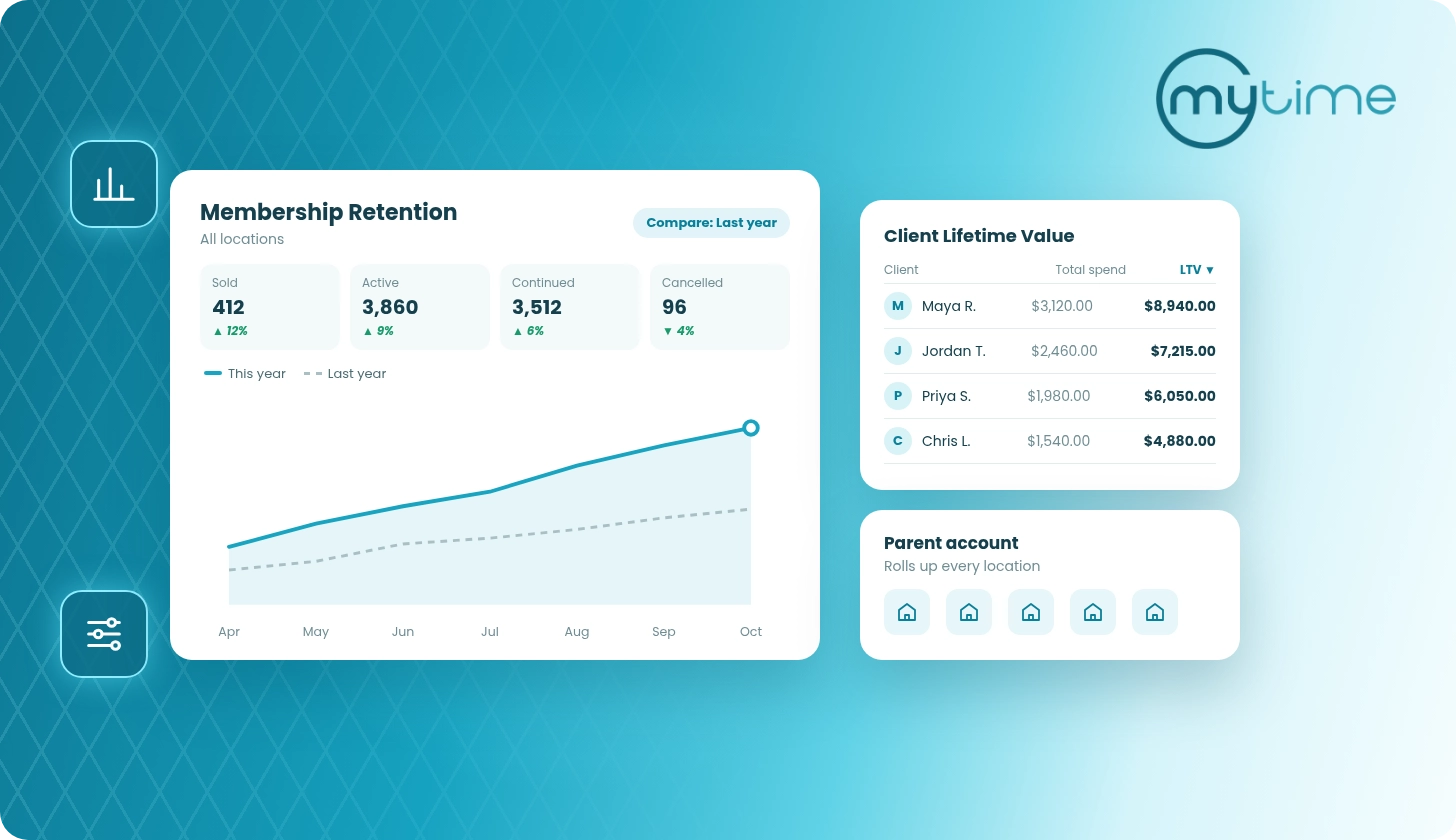
MyTime’s Help Center also explains that membership value and item credit balances can be seen on the client profile and in Membership Item Credit and Membership Value Credit reports (MyTime Help Center).
These reports help teams understand whether members are using benefits, where credits are being redeemed, and whether the program is supporting stronger retention.
Multi-location med spa memberships need brand controls
A single-location membership program can often survive with manual workarounds. A multi-location med spa program cannot.
Chains and franchises need to answer questions like:
- Can members redeem approved benefits across locations?
- Can corporate standardize membership rules while allowing local flexibility?
- Can staff see the same client profile at every location?
- Can membership credits, packages, gift cards, and loyalty balances reconcile correctly?
- Can leadership compare adoption, usage, revenue, and retention by location?
- Can new locations launch with the same membership structure and permissions?
MyTime’s Wellness & Med Spa page says operators can open new locations by cloning menus, permissions, and configurations, tailor POS, pricing, and taxes by site, keep data synced across the brand, auto-reconcile memberships, gift cards, and loyalty balances across locations, and launch global campaigns with local controls (MyTime).
MyTime’s Med & IV Spa Growth Readiness Guide also emphasizes that the same client should be able to move between locations with their record, membership, and balance following them (MyTime).
That is especially important for franchise and chain operators. A client should not feel like a new client every time they visit a different location. The membership should feel consistent across the brand, even when pricing, taxes, services, or local operations vary by market.
Clear terms and audit trails build trust
Membership programs work best when clients understand what they are buying and staff can explain what happened when questions arise.
Recurring programs should clearly explain:
- Billing frequency
- Price
- Start date
- End date, if applicable
- Included benefits
- Eligible services or products
- Credit rules
- Expiration or rollover rules
- Pause, cancellation, upgrade, and downgrade policies
- How stored payment information is used
This is not just a client experience issue. It is also a trust and operational accountability issue.
The FTC has taken enforcement action against companies it alleges obscured auto-renewing subscription terms, failed to clearly disclose material terms, made unauthorized charges, and made cancellation difficult (FTC).
Med spa brands should work with their own legal and compliance advisors, but operationally, clarity is always a better experience for clients and staff.
Audit visibility also matters. MyTime’s audit trails article explains that operators need a clear record of who did what and when when questions arise about credit adjustments, time entries, or membership changes (MyTime).
The same article explains that membership activity evolves through status changes, billing events, credit usage, and adjustments, and that strong membership tracking surfaces the full history rather than just the final outcome (MyTime).
For med spa memberships, that visibility can help teams explain benefit usage, answer billing questions, review adjustments, and maintain confidence across locations.
How MyTime supports med spa membership programs
MyTime helps med spa chains and franchises connect membership strategy to day-to-day execution. Instead of treating memberships as a separate add-on, MyTime connects them to the workflows that shape the client experience.
MyTime supports:
- Configurable membership plans
- Pricing, benefits, and duration
- Online membership purchase
- Recurring membership charges
- POS purchase and redemption
- Automatic benefit application
- Client profile visibility
- Membership item and value credit reporting
- Package, gift card, loyalty, and referral workflows
- Branded Guest App membership management
- Global client records
- Intake forms and waivers
- SOAP notes and treatment history
- Marketing campaigns and segmentation
- Cross-location reconciliation
- Franchise controls and local flexibility
- Audit visibility for membership activity
MyTime’s memberships, packages, and gift cards page says businesses can create and customize membership plans, including pricing, benefits, and duration (MyTime).
The same page says memberships can be managed directly from client profiles and tailored to franchise needs and individual preferences (MyTime).
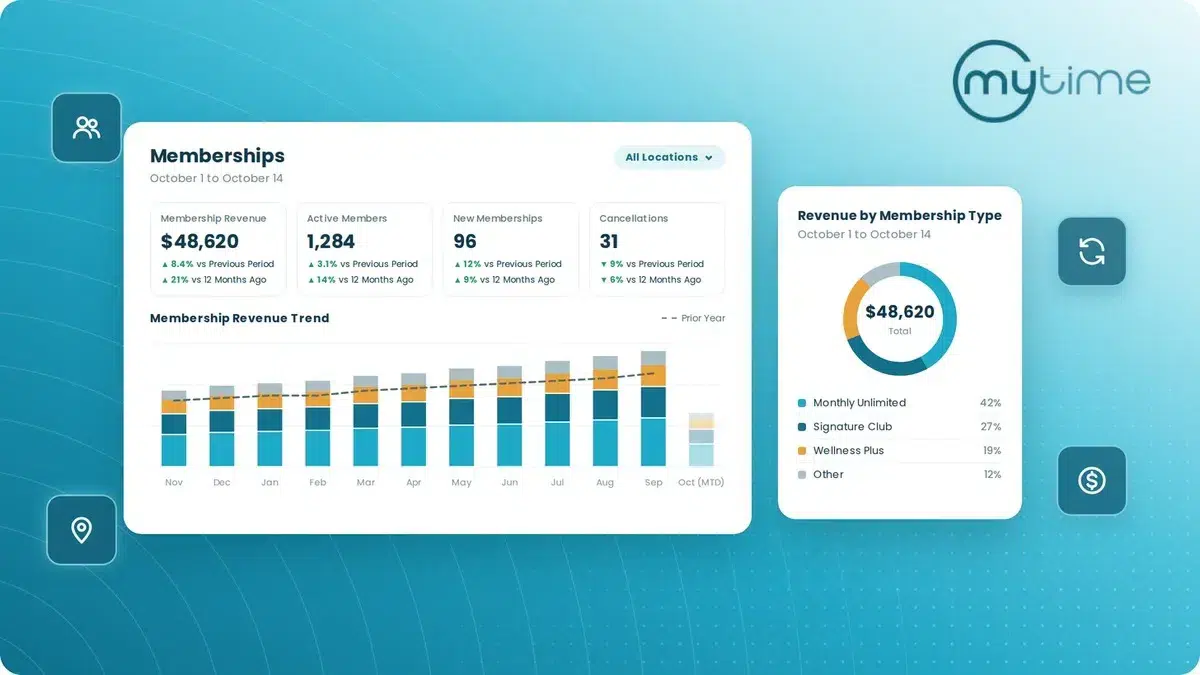
MyTime’s membership article explains that memberships can be purchased and redeemed directly in the booking flow, and that leaders can track adoption, retention, and membership-driven revenue in the MyTime dashboard (MyTime).
For growing med spa brands, that connected approach matters. The membership is not isolated from booking, treatment history, checkout, marketing, or reporting. It becomes part of the operating layer that helps the brand deliver a consistent client experience across locations.
Med spa membership readiness checklist
Use this checklist before launching or restructuring a med spa membership program:
- Do we know which services naturally repeat?
- Do we understand margin by service and benefit?
- Can we structure credits or benefits without over-discounting?
- Can clients buy memberships online?
- Can staff sell and redeem memberships through POS?
- Are membership benefits visible in the client profile?
- Do credits and discounts apply automatically?
- Can members use approved benefits across locations?
- Can we track credit usage, unused value, and redemption?
- Can campaigns segment by membership status, service history, and visit cadence?
- Do staff understand upgrade, downgrade, cancellation, pause, and expiration rules?
- Do we have audit trails for membership changes and credit adjustments?
- Can corporate compare adoption, retention, and revenue by location?
If the answer to several of these questions is no, the issue may not be the membership concept. The issue may be the operating system behind it.
FAQ
What is a med spa membership program?
A med spa membership program is a recurring program that gives clients ongoing benefits such as monthly credits, included services, member-only pricing, packages, loyalty perks, retail benefits, or priority access. The best programs connect billing, booking, POS, client profiles, marketing, reporting, and retention workflows.
How should a med spa structure membership tiers?
Med spas can structure tiers around entry-level benefits, core recurring treatment value, and premium access. Common models include credit-based plans, included-service plans, member-only discounts, package-plus-membership models, and loyalty or referral overlays.
How should med spas price memberships?
Med spas should price memberships based on unit economics, expected redemption, service margin, provider time, room and device capacity, product usage, retail margin, payment cost, and retention goals. Pricing should protect margin while giving clients clear value.
What retention metrics should med spa memberships track?
Med spa membership programs should track active members, revenue by tier, member visit frequency, credit usage, unused value, churn, failed charges, cancellations, upgrades, downgrades, retail attach rate, package conversion, rebooking rate, and cross-location redemption.
How does MyTime support med spa memberships?
MyTime supports configurable memberships, online purchase, recurring membership charges, POS purchase and redemption, automatic benefit application, client profile visibility, membership reports, marketing automation, loyalty, referrals, global client records, cross-location reconciliation, and franchise controls.
Build a med spa membership program that can scale
A strong med spa membership program does more than collect recurring revenue. It helps clients stay consistent, helps staff deliver a better experience, and helps leadership understand what is working across the brand.
The right structure makes benefits clear. The right pricing protects margin. The right retention strategy keeps members engaged. And the right operating platform connects memberships to booking, POS, client profiles, marketing, reporting, and multi-location controls.
Ready to structure, price, and scale a med spa membership program across locations? Book a MyTime demo.