

Two numbers do a lot to decide what each franchise location earns: how much clients spend per visit, and how much recurring revenue comes back from members at every renewal.
Both are easy to lose at the front desk. An add-on that suits the client never gets offered because the person at the register forgot or was busy. A membership is suspended because a bank payment bounced. A membership is sold without a signed agreement. At one location, these are training issues. Across dozens of locations with regular staff turnover, they add up to revenue that varies by location and by shift. And because a franchise system’s revenue is the sum of its locations, closing those gaps at every location grows the brand as a whole.
Recent updates to MyTime Payments and POS move these moments from staff memory into the system. This article covers how they grow revenue per visit and protect recurring revenue at every location, plus a few updates that save staff time at checkout.
Grow Revenue Per Visit
How Can Staff Suggest Add-Ons While Booking an Appointment?
With Staff Upsell Prompts, the rules you set suggest add-ons, memberships, packages, products, and fees at checkout. For how those rules work and what to suggest in different types of businesses, read How Franchise Brands Increase Average Ticket Value at Checkout.
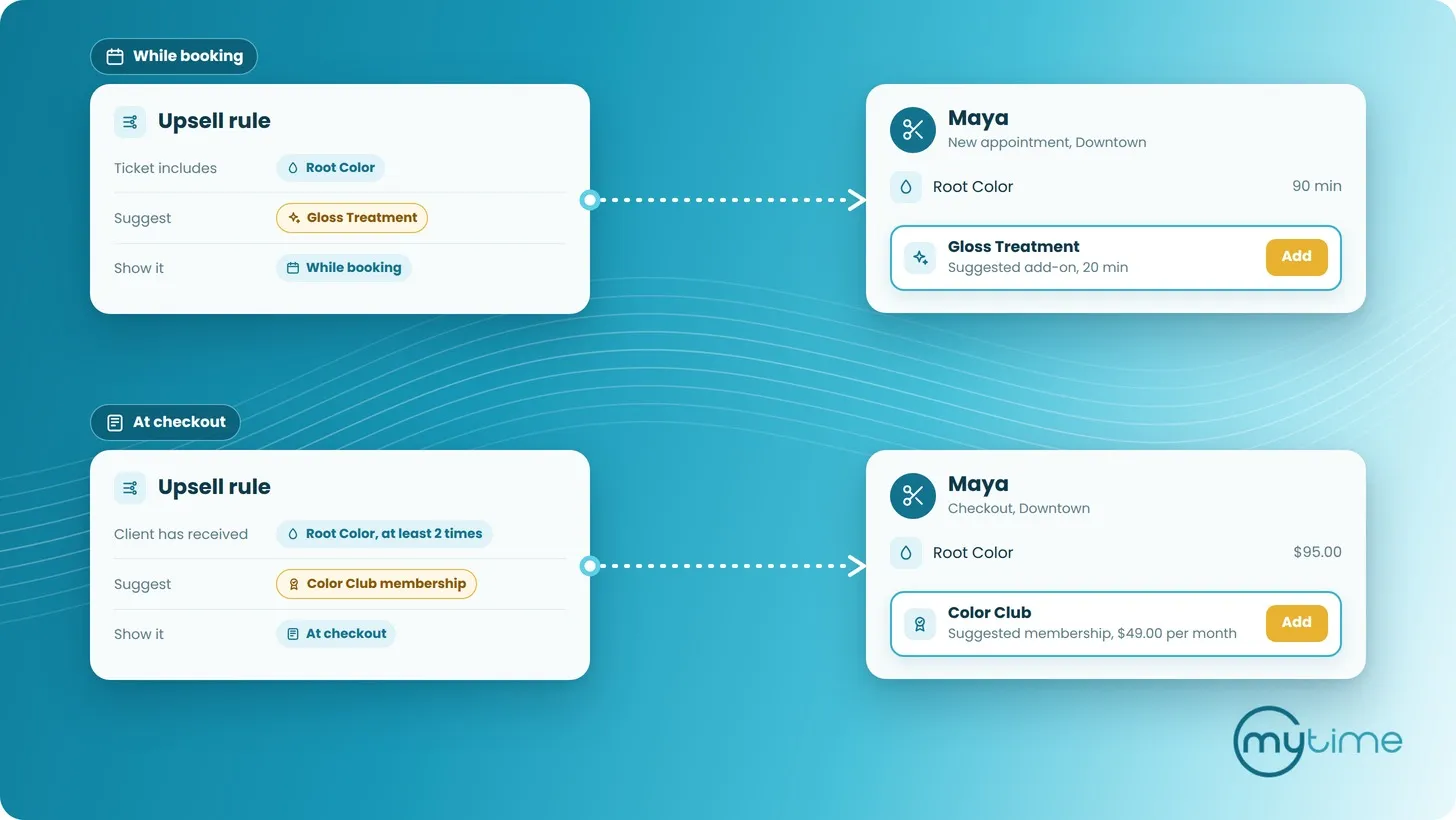
The same rules can also suggest add-on services while staff book an appointment. When staff add a service to a new appointment and it matches a rule, the suggested add-ons appear right there, and staff can add one with a click.
Timing matters. An add-on suggested at checkout has to fit into a visit that’s already over. Suggested while booking, it’s scheduled into the appointment from the start, with the time it needs. For each suggestion, you choose whether it appears while booking, at checkout, or both.
Can Upsell Suggestions Be Based on a Client’s History?
Yes. Along with the time of day, the day of the week, the ticket total, and what’s already on the ticket, a rule can look at the client’s own service history. It can trigger when a client has received a service at least, exactly, or at most a set number of times, or has never received it.
That lets you match the offer to where each client is in their relationship with your brand. A client on their second visit is a good candidate for a membership. A client trying a service for the first time may be ready for a package. Because the offer comes from a rule instead of memory, it’s made the same way by a staff member who has been there for years and one who started last week, at every location.
Protect Recurring Revenue
What Happens When a Membership Bank Payment Fails?
With Direct Debit (ACH) payments, clients can pay memberships from their bank account, at processing fees that are typically lower than cards. Direct Debit is available to businesses in the US and Australia. We cover how it works and how clients set it up in How Franchises Reduce Membership Churn With Smarter Billing and Renewal Communication.
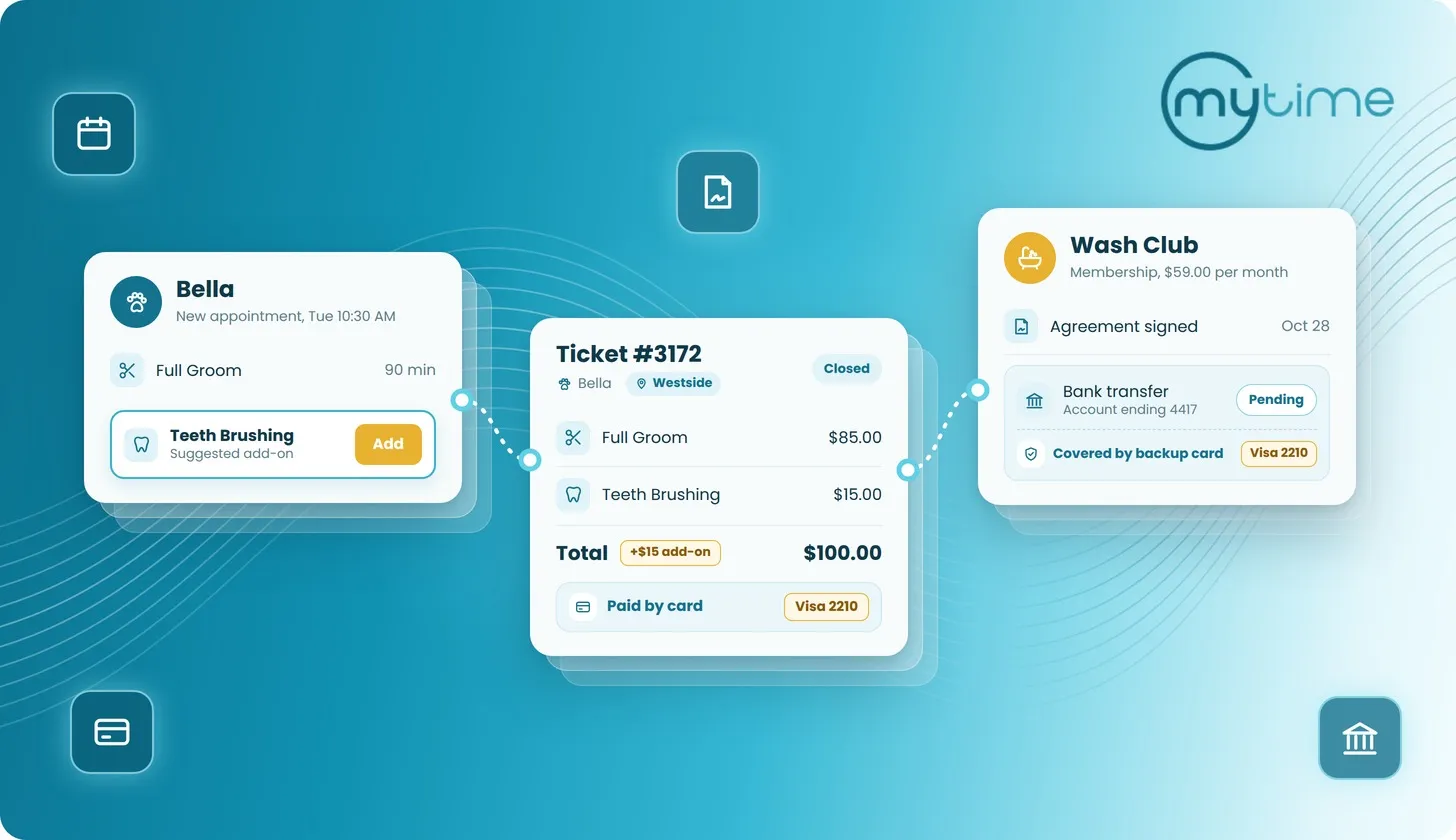
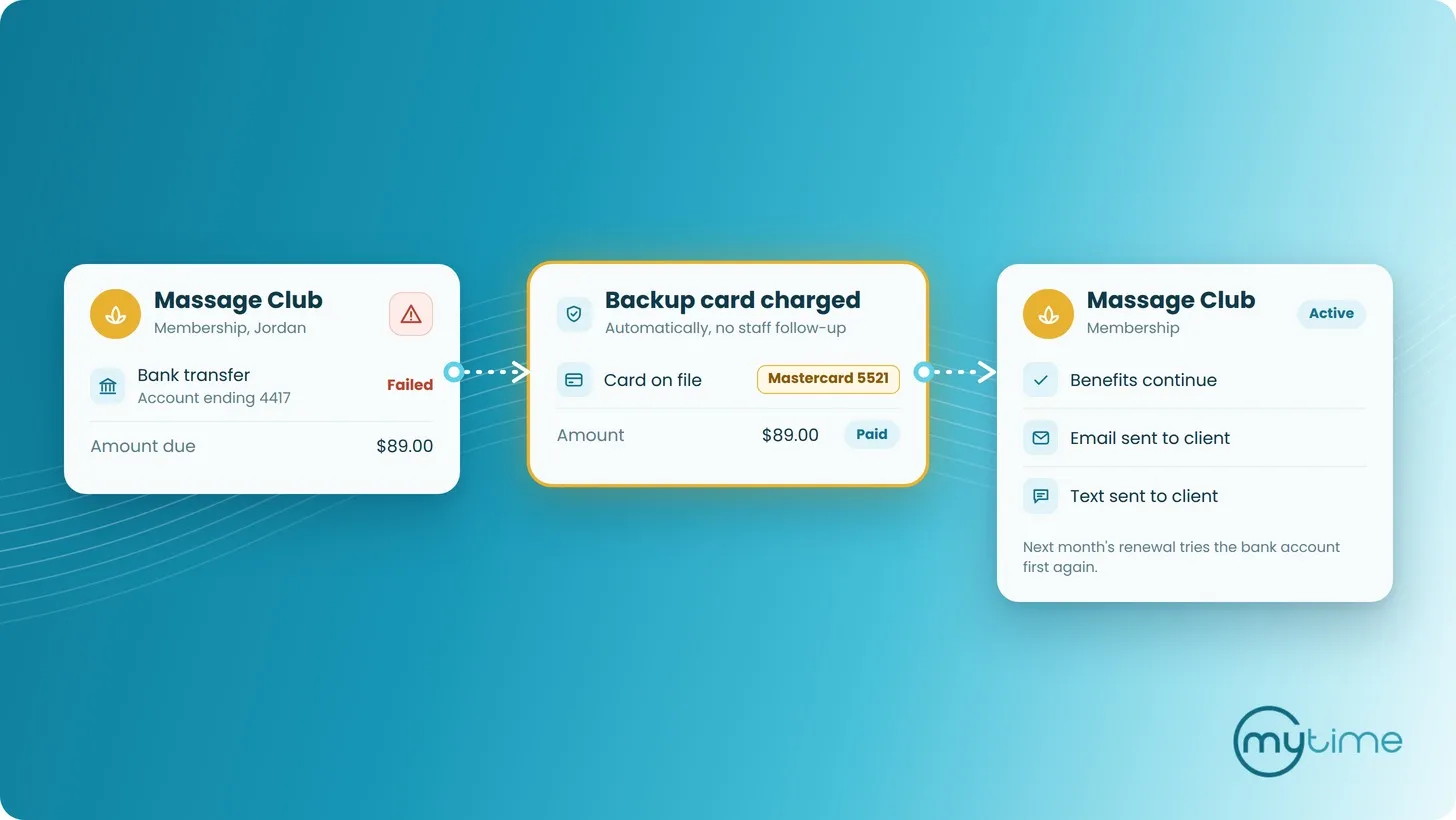
Bank accounts don’t expire the way cards do, but a bank payment can still fail, for example when an account doesn’t have enough funds. When a recurring membership payment from a bank account fails, MyTime can charge the client’s card on file instead of suspending the membership. The membership stays active, benefits stay intact, and the client gets an email and a text letting them know their card was used. A failed payment doesn’t cost you a member.
The next billing cycle tries the bank account first again, so the client’s preferred payment method doesn’t change. If a client has several memberships renewing on the same day, the backup charge is combined into a single card payment.
You can also limit how many times staff can retry a failed bank payment in a billing cycle. Every retry against an account without enough funds can cost the client an overdraft fee, so once the limit is reached, staff are prompted to update the payment method instead.
How Do You Make Sure Every Membership Has a Signed Agreement?
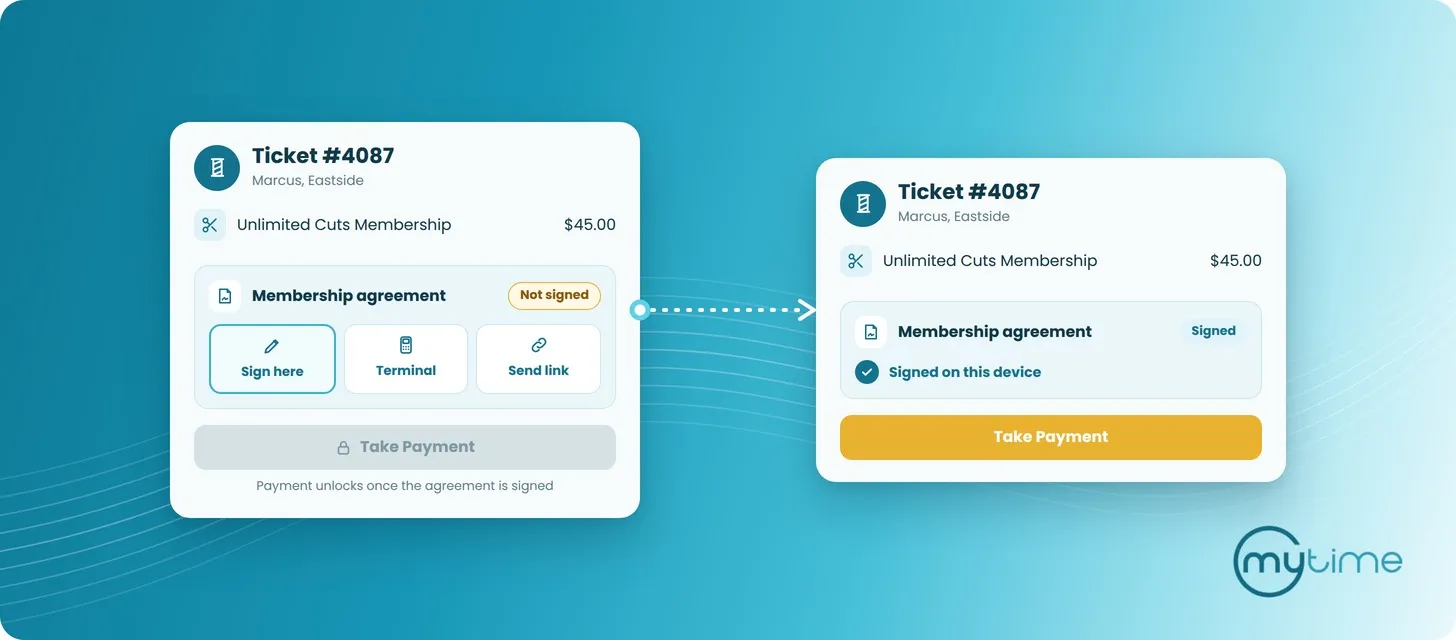
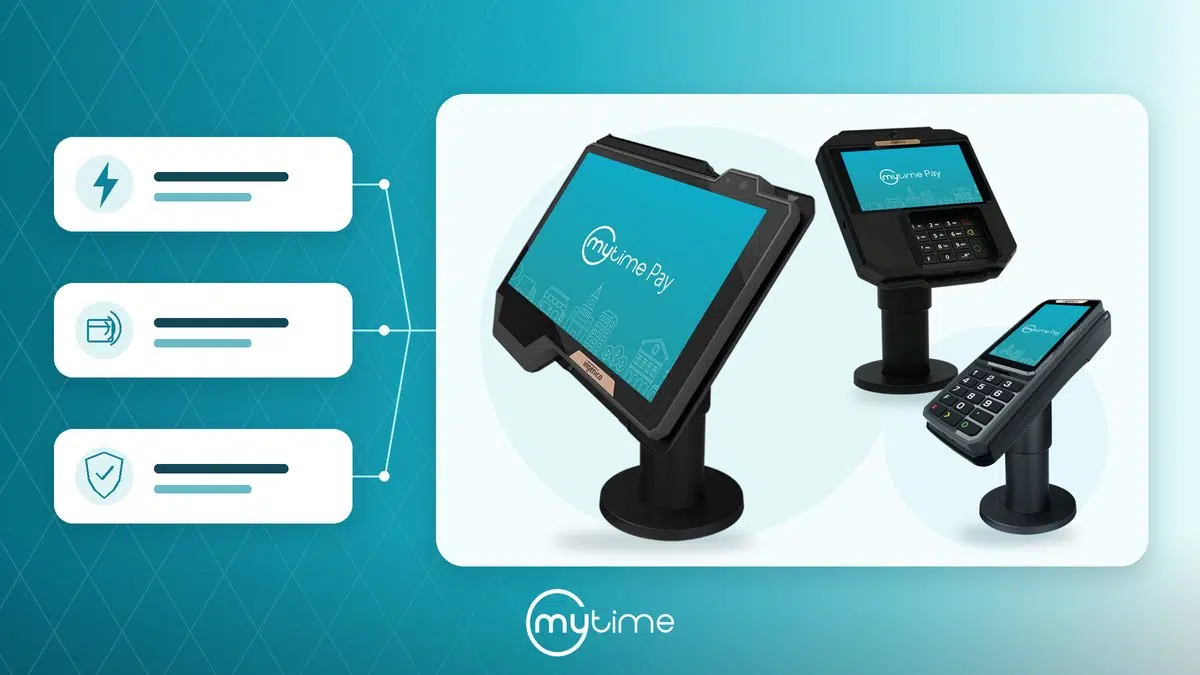
Require it before payment. With this in place, staff can’t take payment on a membership until the client’s membership agreement is signed. As soon as a membership is added to the ticket, MyTime prompts staff to collect the signature. Clients can sign on screen in the store or on an Ingenico payment terminal, or staff can send a link by email, Communicator, or shareable link. Payment unlocks as soon as it’s signed.
An expired agreement counts as unsigned, so the agreement on file is always current. For franchise brands, that means every membership sold at every location has a signed agreement behind it, which is what a location points to if a member later questions a charge.
Membership agreements are built with MyTime’s client intake forms and waivers, so you can use the same agreement for a membership at every location that sells it.
How Do Clients Add Their Bank Details at Checkout?
Staff send the client a secure link right from checkout, and the client enters their bank details on their own device. Nothing is keyed in at the front desk. Once the client adds the account, it’s ready to use on the ticket. When a client adds a bank account while buying a membership, it’s set as their membership payment method automatically.
If you’d rather keep bank account payments for memberships only, you can limit them to membership purchases, registration fees, cancellation fees, and renewals.
Save Staff Time at Checkout
Can You Close a Ticket Before a Bank Transfer Settles?
Yes. Bank transfers usually take three to five business days, but the ticket can be closed as soon as the transfer starts, the same as a card payment. The closed ticket shows the transfer as pending until it settles.
If the bank rejects the transfer, the ticket reopens with the bank’s reason so staff can collect another way, and the failed attempt stays on the ticket for your records. Refunds wait until the transfer has settled, since there’s nothing to refund until then.
How Do Staff Know Which Invoices Haven’t Been Paid?
When staff send a client an invoice from POS, the ticket is marked as having a pending invoice until it’s paid, and the client’s appointments on the schedule are marked too. Staff can see who still owes a balance without opening each ticket. The marker clears on its own once the invoice is paid. For a deposit or fixed-amount invoice, it clears as soon as that amount is paid, even if the rest of the ticket is still open.
Do Prepaid Online Bookings Need to Be Closed by Hand?
No. When an appointment or class booked online is paid in full upfront, through a 100% deposit or full prepayment, the ticket can close as soon as payment is collected. If you send automatic email receipts, the client gets their receipt right away instead of after the visit. Bookings with a partial deposit stay open until checkout, as usual.
What About Afterpay, Digital Wallets, and Card Surcharging?
MyTime also supports Afterpay, Apple Pay and Google Pay, and credit card surcharging. To learn how they help locations earn more on each transaction, read How Franchise Locations Earn More at Checkout.
Grow Revenue Per Visit and Protect Recurring Revenue at Every Location
With MyTime Payments and POS, the right offer is made at every location, every time. A failed bank payment doesn’t cost you a member, and no membership is sold without a signed agreement. The revenue your locations earn no longer depends on what each staff member remembers to do.
Book a Demo to see how MyTime grows and protects revenue across your locations.
Frequently Asked Questions
How can franchise brands grow revenue per visit?
By making the right offer on every visit instead of relying on staff to remember it. In MyTime, Staff Upsell Prompts suggest add-ons while booking and add-ons or memberships at checkout, based on rules that can include each client’s service history.
How can franchise brands protect recurring membership revenue?
By keeping failed payments from turning into lost members and making sure every membership is backed by a signed agreement. In MyTime, a failed membership bank payment can be charged to the client’s backup card, and payment on a membership can be locked until the agreement is signed.
What happens if a membership payment from a bank account fails?
MyTime can charge the client’s card on file instead of suspending the membership, and the client is notified by email and text.
What are Direct Debit (ACH) payments in MyTime?
Direct Debit (ACH) payments let clients pay for memberships and POS purchases from their bank account. Processing fees are typically lower than card fees, and Direct Debit is available to businesses in the US and Australia.
Can MyTime suggest upsells while booking an appointment?
Yes. Staff Upsell Prompts can suggest add-on services when staff book an appointment, as well as at checkout.
Can you require a signed membership agreement before taking payment?
Yes. Payment on a membership stays locked until the agreement is signed, and expired agreements count as unsigned.
Can you close a POS ticket while a bank transfer is pending?
Yes. The ticket can be closed as soon as the transfer starts and shows the transfer as pending until it settles. If the bank rejects it, the ticket reopens so staff can collect another way.