

Client lifetime value, often called customer lifetime value or CLV, is the total revenue a client generates over their relationship with your business. The standard formula estimates the value of an average client. Predictive client lifetime value goes further, adding what each client has already spent to what they’re likely to spend next, based on how recently they visited.
For service businesses that run on repeat visits, that difference matters. Client lifetime value has long been a core retention metric in MyTime, and the Client Lifetime Value Report is built to show it client by client. This article explains how predictive client lifetime value works, how to spot clients who are drifting, and how franchise brands can track client value at every location. For a closer look at the three inputs behind CLV, read How Franchise Service Brands Build Client Lifetime Value Across Every Location.
Why Doesn’t the Standard CLV Formula Work for Individual Clients?
The standard formula, average order value × visit frequency × expected lifespan, applies the same expected lifespan to every client. It works well for describing your client base as a whole. For individual clients it can mislead, because two clients with identical spending histories get nearly the same value, even if one visited last week and the other hasn’t returned in a year.
The client who visited last week is far more likely to book again. A client lifetime value you can act on needs to reflect that.
What Is the Difference Between Historical and Predictive Client Lifetime Value?
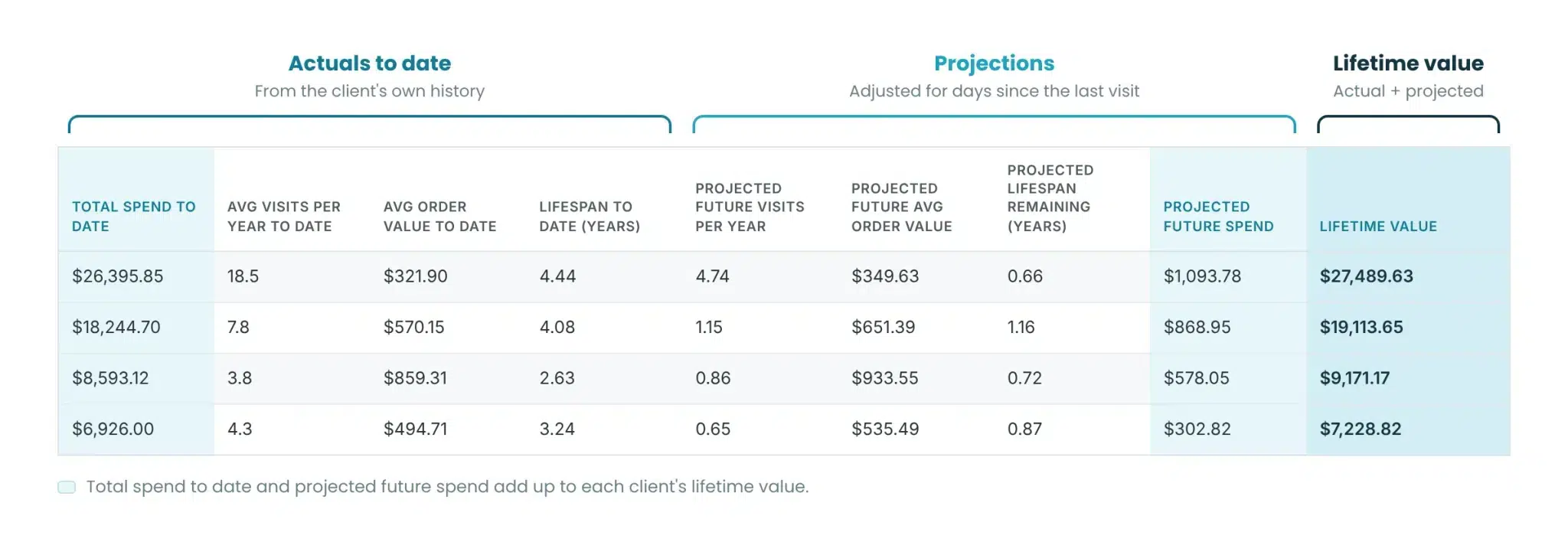
Historical client lifetime value is what a client has already spent with your business. Predictive client lifetime value adds an estimate of what they’re likely to spend in the future. In MyTime, Lifetime Value equals Total Spend to Date plus Projected Future Spend, and each part is shown in its own columns.
Total Spend to Date is the client’s actual net spending: gross sales less discounts, prepaid redemptions, and refunds. Projected Future Spend multiplies three estimates: how many times per year the client is expected to visit, how much they’re expected to spend per visit, and how many more years they’re expected to stay active. Because the actuals and the projections sit side by side, you can see exactly where each client’s number comes from. The Client Lifetime Value Report help article walks through each column.
How Does Visit Recency Affect a Client’s Lifetime Value?
Recency is one of the strongest signals of whether a client will return. Clients who visited recently tend to keep coming back at or above their usual pace, while clients who are overdue return less often and for less time. MyTime adjusts each client’s projected visits and remaining lifespan based on how long it has been since their last visit.
Here’s an illustration. Four clients at the same business have each made 20 visits and spent $700. The only difference is when they last visited.
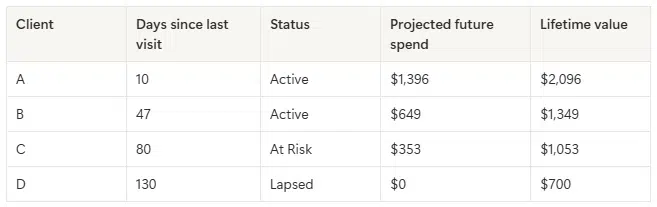
Same history, from $700 to more than $2,000 in lifetime value. Projections decrease gradually as time passes, rather than dropping suddenly at a fixed cutoff.
How Do You Know When a Client Is at Risk of Not Coming Back?
Compare the time since their last visit with how often your clients normally return. In MyTime, every client is labeled Active, At Risk, or Lapsed based on that comparison. At Risk clients are overdue for their usual return visit, which makes them the clearest place to focus win-back outreach.
What Do Active, At Risk, and Lapsed Mean for a Service Business?
Each status reflects where a client sits relative to your business’s lapse threshold, the point by which almost all returning clients have come back.
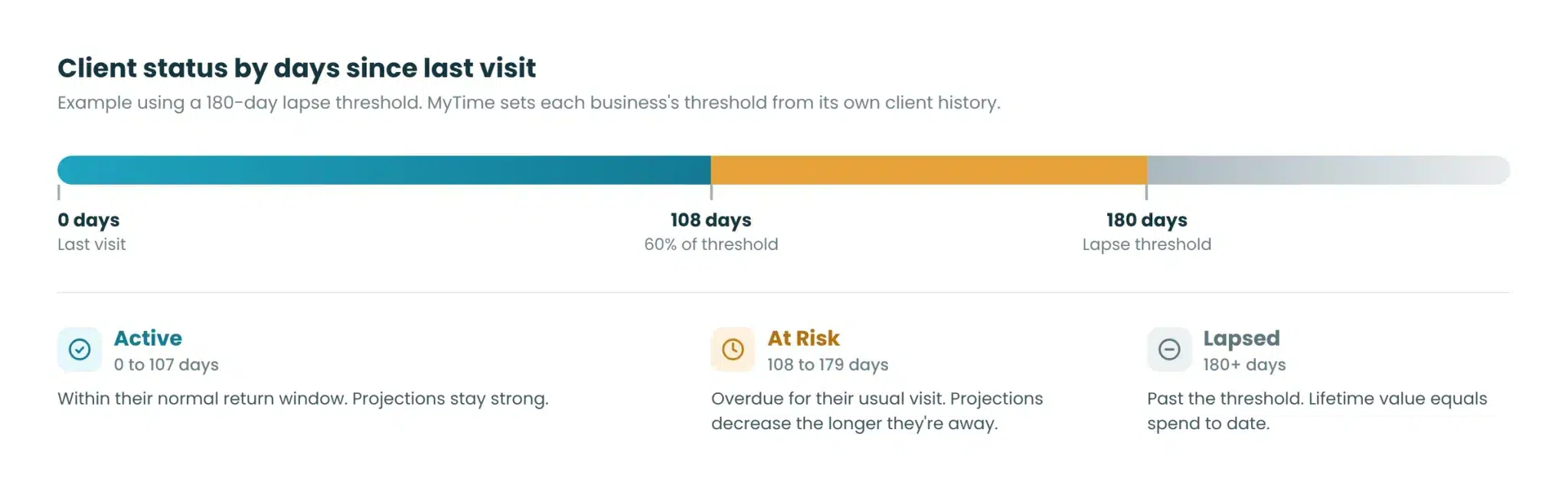
- Active: The time since the client’s last visit is less than 60% of the threshold. They’re within their normal return window, and their projections stay strong.
- At Risk: The time since their last visit is between 60% and 100% of the threshold. They’re overdue, so their projected visits and remaining lifespan decrease.
- Lapsed: The client has reached or passed the threshold. Their projected future spend becomes $0, and their lifetime value equals what they’ve already spent. If they return, their status changes back to Active and projections resume.
How Long Can a Client Go Between Visits Before They’re Considered Lapsed?
It depends on your business. MyTime sets a lapse threshold for each business at the point by which 95% of returning clients have come back. A pet grooming client who hasn’t visited in three months may have lapsed, while an IV therapy client who hasn’t visited in six months can still be Active.
For example, with a 180-day threshold, a client is Active from 0 to 107 days after their last visit, At Risk from 108 to 179 days, and Lapsed at 180 days or more. Because the threshold comes from your own client history, these statuses reflect how your clients actually behave, not a fixed rule like “inactive after six months.”
How Do You Estimate Lifetime Value for New Clients?
Compare them with clients who have been with your business for a similar amount of time. A client with only a few months of history hasn’t shown their true visit pattern yet, so MyTime bases their projected visits on clients at the same business with the same tenure. After 12 months, the client’s own history takes over.
Clients with fewer than 5 visits still receive an Active, At Risk, or Lapsed status, but their projections and lifetime value show N/A until there is enough data to project reliably.
How Can Franchise Brands Track Client Lifetime Value Across Every Location?
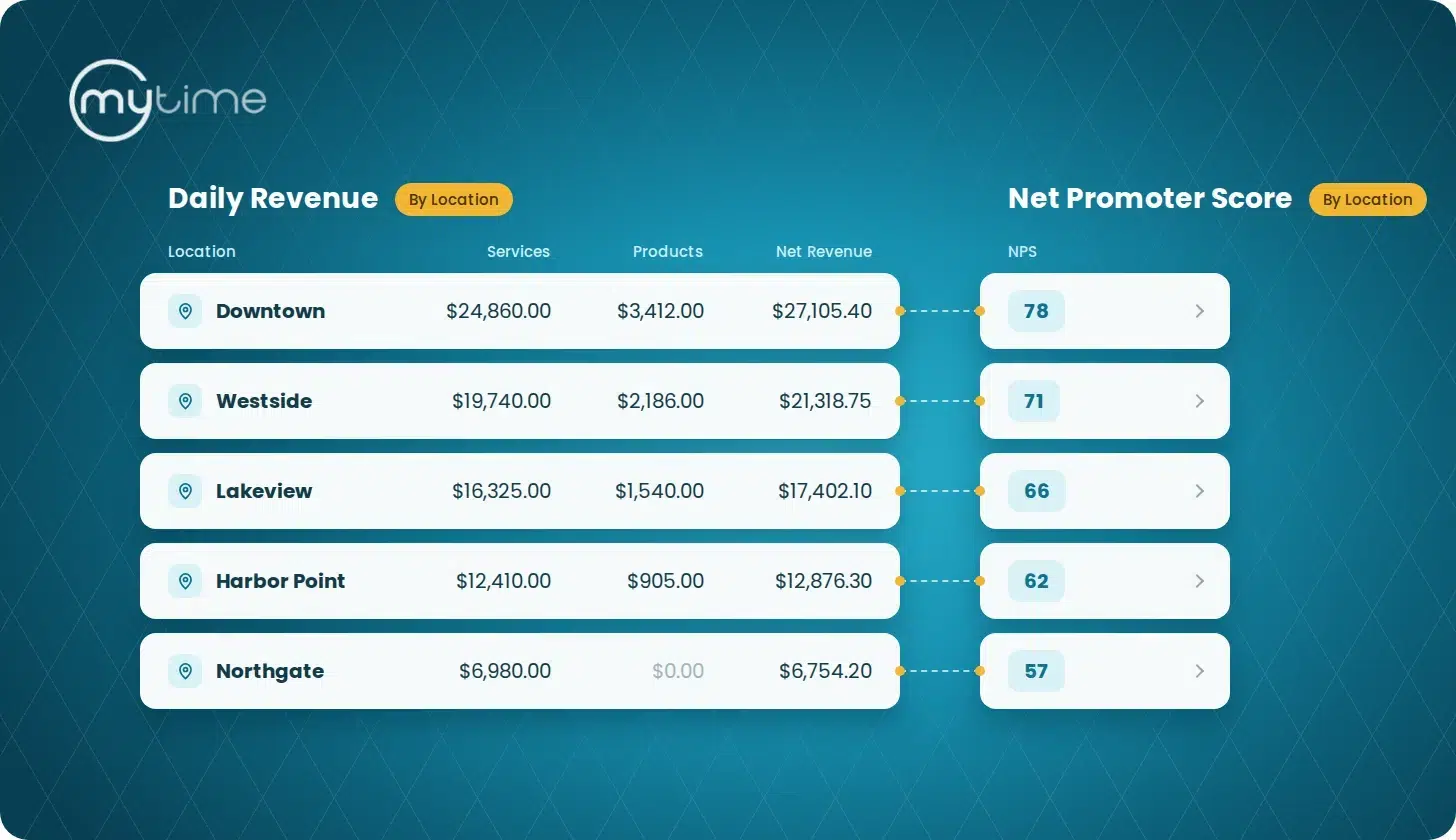
Use one report that covers every location. In MyTime, franchise owners can view client lifetime value across all of their locations at once or filter to a single location for a closer look, and the brand can see client value across the entire network. Each client appears as one row, with visits and spending from their pets or family members grouped together.
How Do New Franchise Locations Get Reliable Client Value Data?
They borrow from the brand. A location uses its own model once it has at least 100 active clients and 12 months of visit history. Until then, MyTime uses benchmark patterns from the location’s franchise brand, or from MyTime-wide data if needed, so newer locations get useful projections without waiting years to build their own history.
How Often Should Client Lifetime Value Be Recalculated?
Often enough to stay current, but not so often that your benchmarks shift under you. The Client Lifetime Value Report updates every 10 minutes, so each client’s status and spend reflect their latest visits. The model behind the projections recalibrates on the 1st of every month using your latest transaction and visit data, which keeps your benchmarks stable enough to plan around.
How Can You Use Client Lifetime Value to Improve Client Retention?
Use it to decide where retention effort goes first. Sort by Lifetime Value to see your most valuable clients, then look for the ones marked At Risk. Those are valuable relationships that are drifting but can still be recovered with a timely rebooking reminder, a targeted offer, or a personal call.
Filters help you go further. Filter by Service Category, such as Grooming or Daycare, to see the clients behind each part of your business. Filter by Membership Status to compare members with non-members, or by Client Source to see which channels bring in your most valuable clients. Filter by Location to see where each location’s most valuable clients stand.
See What Every Client Is Worth
Your most valuable clients deserve your attention before they drift away, not after. The Client Lifetime Value Report shows what every client is worth, which ones need outreach now, and how client value compares across every location you run.
Book a Demo to see client lifetime value for your business.
Frequently Asked Questions
Is client lifetime value the same as customer lifetime value or LTV?
Yes. Client lifetime value, customer lifetime value, CLV, and LTV all describe the total revenue a client generates over their relationship with a business. MyTime calls it client lifetime value, and the report is the Client Lifetime Value Report.
Does a lapsed client’s lifetime value drop to zero?
No. A Lapsed client’s projected future spend becomes $0, so their lifetime value equals their Total Spend to Date. If they return, their status changes to Active and projections resume.
How many visits does a client need before lifetime value can be projected?
Five. Clients with fewer than 5 visits show N/A for projections and lifetime value, but they still receive an Active, At Risk, or Lapsed status.
Can you see client lifetime value for a specific service category?
Yes. Filter the Client Lifetime Value Report by Service Category, such as Grooming or Daycare, to see the clients who have booked services in that category. Each client’s lifetime value still reflects their total spending with your business.
How does MyTime calculate client lifetime value?
MyTime adds each client’s Total Spend to Date to their Projected Future Spend. The projection multiplies projected visits per year, projected average spend per visit, and projected years remaining, each adjusted for how recently the client visited and based on your business’s own client history.