



Service businesses live on repeat visits. Most franchise brands understand this intuitively, but far fewer have a clear way to measure what a single client relationship is actually worth over time, or a system built around improving it.
Client lifetime value, or CLV, is the framework for solving that. It measures the total revenue a single client generates over their entire relationship with your business, across three inputs: spend per visit, how often they return, and how long they stay active. Each one amplifies the others, so even modest improvements across all three can change the economics of a franchise network significantly.
This article covers how MyTime approaches client lifetime value across a franchise network: each of the three inputs that determine it, where networks most commonly lose ground, and what it looks like when all three are working as a coordinated system.
Key Takeaways
- CLV is calculated from three inputs: spend per visit, visit frequency, and client lifespan. Because they multiply each other, improving any one raises the value of the other two.
- The performance gap between franchise networks rarely comes from service quality. It comes from whether the right systems are running consistently at every location.
- Memberships, automated client outreach, loyalty programs, and recurring appointments all move CLV, and the brands that see the biggest gains are running all of them together.
- When each location controls its own programs, results vary by operator. Brands that configure and run those programs at the network level turn individual wins into consistent outcomes everywhere.
What Is Client Lifetime Value for a Franchise Service Brand?
How is client lifetime value calculated?
The CLV Formula
CLV = Average Order Value × Annual Visit Frequency × Expected Client Lifespan
The three inputs that determine a client’s lifetime value:
- Average Order Value – what a client spends per visit. Small increases carry an outsized effect because they multiply across every future visit that client makes.
- Annual Visit Frequency – how many times they come in per year. The difference between a client who visits six times and one who visits four compounds into years of recoverable revenue over the life of the relationship.
- Expected Client Lifespan – how long they stay active, derived from your churn rate. This is the input that scales everything else, because every improvement to spend or frequency is only worth as much as the lifespan it runs across.
Because these three inputs multiply rather than add, improving any one of them raises the return on the other two across every client relationship in the network.
What Does a Strong Client Lifetime Value Look Like for a Franchise Service Brand?
Two franchise networks serving the same type of client can end up with CLV figures that are worlds apart. The difference is almost never who walks in the door. It is what happens operationally once they do.
In spa and wellness, solo practitioners without structured retention programs typically see CLV between $400 and $600. Operations running membership programs, automated client communication, and centralized reporting consistently reach $2,000 to $4,000 or more. That gap does not emerge from better service. It emerges from systems that keep clients spending more per visit, returning more often, and staying active longer.
Hydrate IV Bar, a wellness franchise, is a clear example of what closing that gap looks like. Memberships account for 40% of total net revenue, 66.1% of clients return within one month, and automated engagement has generated over $2 million in attributed revenue. Those are not separate wins. They are what happens when all three CLV inputs are running as a system across every location.
How Does Average Order Value Affect Client Lifetime Value?
Average order value is the revenue a client generates per visit. Small improvements carry an outsized effect on total lifetime value because they multiply across every future visit a client makes.
Why do memberships raise per-visit revenue more reliably than upselling?
Upselling requires something to go right in the moment: the right staff member, the right client mood, the right conversation. A membership establishes a spending commitment before the client walks in. The revenue is earned predictably without needing a successful upsell on every visit.
The results bear this out. We Whiten, a teeth whitening franchise with over 30 locations, grew membership revenue from 5% to 50% of total revenue within a year of implementing a structured membership program. At Hydrate IV Bar, 8.2% of new clients convert to memberships in their first year, creating a recurring revenue base that compounds as the network grows. Packages create the same structure across a fixed number of sessions, pre-selling future visits at a higher per-appointment value than a client booking individually would generate.
Research on paid loyalty programs bears out the revenue impact of that commitment structure. McKinsey found that members of paid programs are 60% more likely to spend more on the brand after subscribing, compared to 30% for clients enrolled in free loyalty programs.
Does the channel a client uses to book affect how much they spend per visit?
Yes, meaningfully. Clients who book through a branded guest app tend to spend more per visit than those who book through other channels. At Hydrate IV Bar, bookings made through the branded guest app outperformed the average order value by 24 to 27.75%, and overall AOV across the network increased by 9.83% after omnichannel booking was unified under a single platform.
The likely reason is friction. A client who books through an app has the full service menu in front of them at the moment of booking, making add-ons and upgrades easier to select before they arrive rather than depending on a conversation at the front desk.
Why does per-visit spend vary so much across franchise locations?
Uneven per-visit spend across a franchise network almost always traces back to inconsistent program presentation. When a membership program is actively offered at some locations and deprioritized at others because individual operators made different choices, the brand is averaging over an underperformance gap it may not have clearly identified.
Centralizing program configuration and presentation standards closes that gap by setting the default rather than leaving it to each location’s discretion. Scissors and Scotch, a men’s grooming and bar franchise, grew its Private Barrel membership community to over 20,000 members by building the program into the operational standard across the network rather than treating it as an optional local initiative.
Referral programs follow the same logic. Hydrate IV Bar’s fully automated referral program, requiring zero manual tracking, has generated $503,000 in lifetime revenue from referred clients, a result that depends entirely on the program running consistently everywhere rather than being managed location by location.
How Does Visit Frequency Affect Client Lifetime Value?
Annual visit frequency is how many times a client comes in per year. The challenge for franchise brands is that clients who intend to return regularly still drift without prompting, and that drift happens quietly across thousands of client relationships at once.
Why do clients visit less often than they actually intend to?
After a good appointment, most clients fully intend to return on schedule. They simply do not prioritize rebooking until they notice they are overdue, by which point weeks or months may have passed. The drift is gradual and unannounced. Across a franchise network with thousands of client relationships happening simultaneously, this represents a significant amount of recoverable revenue that never announces itself.
What kinds of automated outreach actually bring clients back?
The most reliable outreach reaches clients when a return visit is genuinely timely rather than arbitrarily scheduled. A rebooking reminder timed to a client’s typical service interval lands differently than a generic promotional message.
At Hydrate IV Bar, automated rebooking reminders generated $867,789 in attributed revenue. Automated birthday messages generated $165,588. Review request messages, timed after appointments to clients most likely to respond positively, generated $877,514. Combined, automated client engagement produced over $2 million in revenue across the network, driven entirely by messages reaching clients at moments when they were already primed to act.
Every client who leaves an appointment without scheduling the next one is a retention risk. Recurring appointments, set up once for clients with a regular service cadence, remove that risk by putting the next visit on the calendar automatically.
The frequency effect of paid membership extends beyond convenience. The same McKinsey research found that paid loyalty members are 43% more likely to make weekly purchases since joining, a behavioral shift that reflects a client whose relationship with the brand has moved from transactional to habitual.
How do loyalty rewards change when a client decides to rebook?
A loyalty program builds value over time, but that value only drives behavior if clients know when to act on it. When a client crosses a redemption threshold for the first time, a notification that their reward is ready to use carries weight a standard promotional message does not. The client earned that credit through their own visits, which makes the prompt feel personal rather than transactional, and gives them a concrete reason to book before they would otherwise have thought to.
What does strong visit frequency actually look like across a franchise network?
At Hydrate IV Bar, 66.1% of clients return within one month of their previous visit. For a wellness brand where the core service has a natural monthly cadence, that figure represents near-optimal frequency capture. It reflects recurring appointments, automated reminders, and membership structures working together, and it shows what becomes possible when those systems run consistently across every location rather than just the highest-performing ones.
How Does Client Lifespan Affect Lifetime Value?
Expected lifespan is the input that scales everything else. An improvement to spend per visit or return frequency that holds for five years is worth more than double the same improvement held for two. Churn erodes the return on every acquisition dollar spent, and it does so gradually and without announcement.
Why do most clients leave without ever telling you?
Most churn in service businesses is passive. A client has a mediocre experience, or a busy stretch disrupts their routine, and they drift without any particular grievance. Because they never express dissatisfaction directly, the business has no signal to act on. By the time a client’s departure shows up in a report, the window to recover the relationship has often already closed.
How do you surface dissatisfaction before it becomes churn?
Asking clients directly after appointments, through a structured and automated process, is the only reliable way to surface dissatisfaction before it becomes absence. An NPS survey sent automatically after a configurable number of appointments asks clients to rate their likelihood to recommend on a 0 to 10 scale. Clients who score 0 to 6 receive a direct prompt to contact the location team, opening a recovery conversation at exactly the right moment. The NPS report, filterable by location and staff member, shows operators which sites are generating dissatisfied clients and at what frequency, so the response can address causes rather than individual incidents.
The same infrastructure that catches dissatisfied clients also builds the review volume that attracts new ones. Cloud 9 Foot Spa used MyTime’s reputation management tools to generate over 200 five-star reviews at a single location in six months, a milestone that typically takes most businesses years to reach through ad hoc review requests.
How do you reach clients who have gone quiet before the relationship ends?
Segmenting lapsed clients by behavior rather than time alone produces meaningfully better re-engagement than a single generic outreach campaign. We Whiten runs three separate campaigns targeting different lapsed segments: clients with no appointment in the past 45 days and no future booking, clients who canceled without rebooking, and clients who have unused referral credits. Each segment receives a message with a reason specific to their situation rather than a generic re-engagement prompt.
MyTime’s Lapsed Client Report surfaces clients who have not visited in 1, 2, 3, 4, 5, 6, or 12 months, filterable by location and staff member. Used alongside automated lapsed client re-engagement flows, it gives operators two tools working together: the automation reaches the broadest group early, and the report identifies clients who may need a more personal approach.
What role do memberships play in keeping clients active longer?
A client on autopay with a monthly service has structurally removed the rebooking decision from their life. That structural commitment is what makes membership growth one of the most reliable drivers of client lifespan at scale.
We Whiten’s experience makes this concrete. Before implementing a structured membership program, memberships represented 5% of total revenue. Within a year of building the program properly, that figure reached 50%. Members by definition have longer active relationships than one-time or irregular visitors, and a franchise network where a growing share of clients are members is one where average expected lifespan is improving across the entire client base.
McKinsey’s research adds a brand affinity dimension to that retention argument: paid loyalty members are 59% more likely to choose the brand over competitors. For franchise service brands operating in markets where multiple comparable providers exist, that preference is what keeps expected lifespan from eroding under competitive pressure.
How Do Franchise Brands Measure Client Lifetime Value Across a Network?
Tracking CLV requires three inputs: average spend per transaction, visit frequency over time, and a churn-based lifespan estimate. The first two come from transaction and booking history. The third requires a company-wide view of how many clients who visited in one period returned in the next, a calculation most platforms do not surface automatically.
How do you put an actual number on what each client is worth?
Calculating LTV for individual clients requires combining transaction history with a churn-based lifespan estimate that updates as client behavior changes. Most operators have access to average spend and visit frequency from their booking data, but the lifespan figure is where most platforms fall short: it requires tracking what percentage of clients who were active in one period actually returned in the next, and converting that into a projected active lifespan.
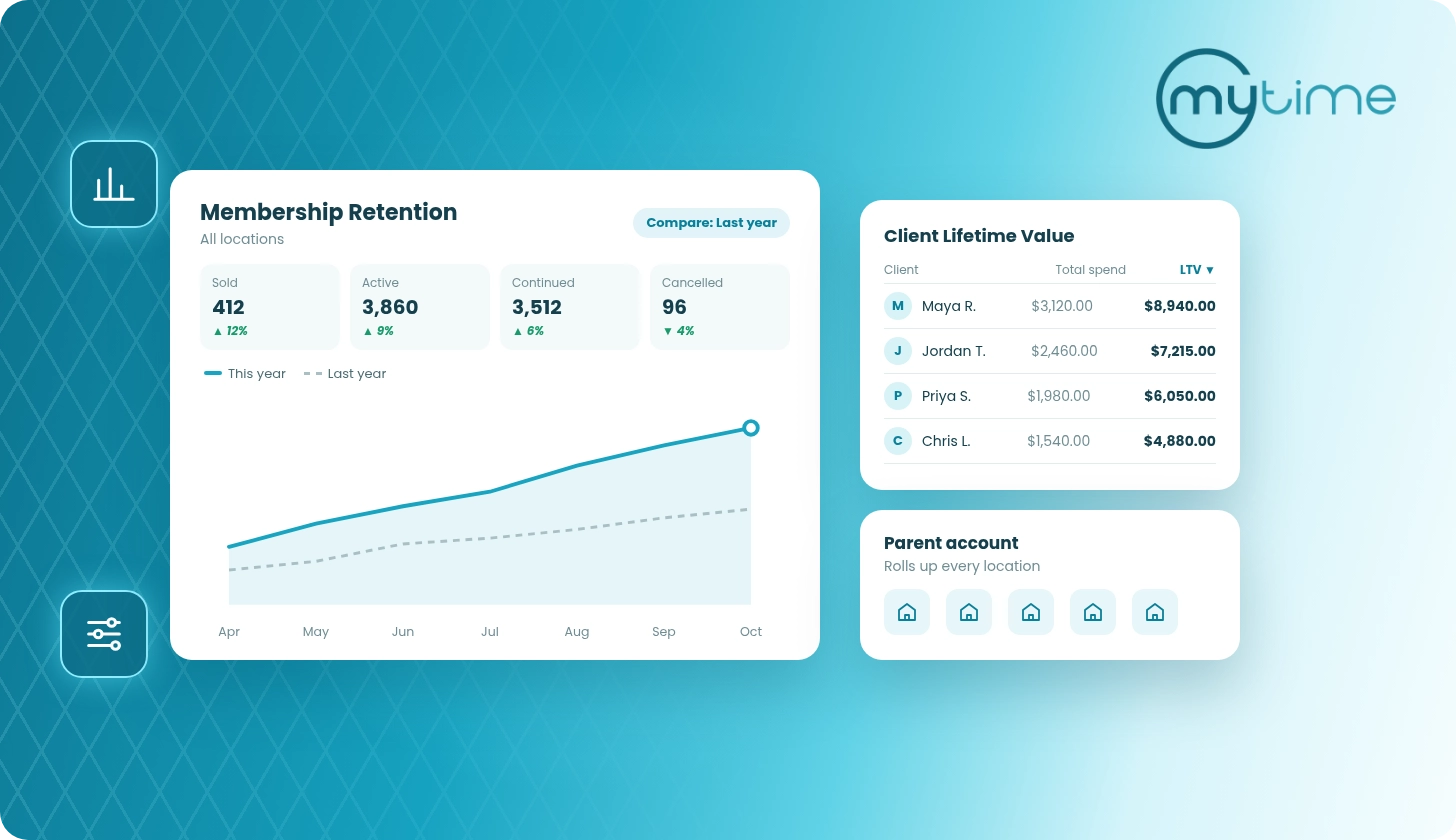
MyTime’s Client Lifetime Value Report does this automatically for every client, ranking them by projected lifetime value by default. Filters for location, membership status, client source, and first visit date let operators segment the data and identify which acquisition channels and client types are generating the most durable revenue.
How do you identify where in the network you are losing clients?
A declining CLV average tells you something is wrong. It does not tell you where. Retention problems in a franchise network can live at the location level, at the staff level, or in the gap between a client’s first and second visit, and each requires a different response.
Sean Peng, CEO of Cloud 9 Foot Spa, noted that beyond five or six locations, benchmarking tools become operationally critical. Without them, a central team is comparing performance from memory rather than data. MyTime’s Client Retention Report tracks the percentage of clients who return to the same staff member or the same location within 30, 45, 60, and 90 days. Viewed across locations, it surfaces which sites have a retention problem and at what stage in the client relationship the drop-off is occurring.
What does client satisfaction data tell you about where lifetime value is heading?
CLV calculations are backward-looking: they project forward based on what a client has already done. A client who was satisfied through their first twelve visits but has recently become a detractor will show a strong projected LTV that the actual relationship may not support.
NPS data adds a forward-looking layer. A location producing a high proportion of detractors is flagging a revenue problem before it appears in the LTV numbers, giving operators a window to address service or staffing issues before the churn those scores predict actually materializes.
What Does a Complete CLV Strategy Look Like for a Franchise Brand?
A CLV strategy for a multi-location service brand is an ongoing operational posture across all three inputs, with measurement that shows whether any of it is working and where to focus next.
Hydrate IV Bar illustrates what this looks like when it’s running. Memberships account for 40% of total net revenue. Automated engagement messages have generated over $2 million. 66.1% of clients return within one month. Those are not separate wins from separate initiatives. They are the same operational posture measured across different inputs, and they compound on each other.
As founder Katie Wafer Gillberg put it: “Every decision we make is about where we want to be five years from now. We needed a platform that could scale with us.”
The brands that execute this well share a common characteristic: the right things happen automatically at every location, without depending on individual operator judgment to make them happen. Clients receive follow-ups after visits. Lapsed relationships get outreach before they close. Membership and loyalty programs run consistently across the network. And operators at every level can see which clients are most valuable, which are drifting, and which locations are falling behind on retention.
Most of the infrastructure for this already exists in the platforms franchise brands are running today. The question is whether it is configured, running, and consistent across every location.
Book a demo to see how MyTime supports the full client lifetime value strategy across your franchise network.
Frequently Asked Questions
What is client lifetime value in a service business?
Client lifetime value is the total revenue a single client generates over their entire relationship with a business, calculated by multiplying average spend per visit by annual visit frequency by expected client lifespan. For service businesses, it’s the metric that makes the long-term cost of losing a client visible and the long-term return of retaining one concrete.
How do you calculate CLV for a salon, spa, or wellness brand?
The formula is LTV = Average Order Value x Annual Visit Frequency x Expected Lifespan. Average order value is net revenue divided by number of visits. Expected lifespan comes from churn rate: the share of clients who visited in one period and returned in the next, converted into projected active years. All three inputs multiply rather than add, so improving any one compounds the others.
What is the biggest driver of client lifetime value for service brands?
Churn rate has the greatest effect because it determines expected lifespan, which multiplies every other input. Reducing annual churn by a few percentage points increases the projected value of every client in the network, with compounding gains that build across years of future visits.
How can franchise brands improve CLV consistently across multiple locations?
The most reliable approach is centralizing the programs and communication flows that drive all three CLV inputs, so every location runs the same membership structure, the same follow-up cadence, and the same re-engagement outreach by default. Consistency at the network level is what makes individual improvements compound rather than stay isolated to high-performing locations.
How does MyTime help franchise brands track and improve client lifetime value?
MyTime calculates projected LTV for every client automatically and surfaces retention gaps at the location and staff level through dedicated reporting. NPS tracking flags satisfaction issues before they become churn. The platform’s membership, loyalty, automated messaging, and scheduling tools are built to move all three CLV inputs across every location in the network simultaneously.