





Membership programs have become a cornerstone of how service brands grow. Done well, they create predictable revenue, deepen client relationships, and build the kind of loyalty that compounds over time. But a strong membership offer is only part of the equation. How payments are collected, what they cost to process, and how clearly members are communicated with before a renewal all shape whether clients stay or quietly walk away.
MyTime continues to evolve its membership tools to help operators get those fundamentals right across every location in their network, from more reliable and cost-effective ACH billing to renewal communication that keeps clients engaged and confident in the brand.
What Is ACH Payment Processing and Why Does It Matter for Memberships?
ACH, or Automated Clearing House, is a payment method that processes transactions directly through a client’s bank account rather than a credit card network. For businesses running recurring billing, it has two meaningful advantages: lower processing fees and significantly fewer payment failures.
ACH processing is significantly cheaper than running payments through a credit card network. For a franchise processing hundreds of membership payments every month, that difference adds up fast, and because memberships tend to carry higher price points than one-time transactions, the potential savings across the network are substantial.
The failure rate gap matters even more operationally. Bank accounts don’t expire or get replaced after fraud the way credit cards do. A client whose card fails needs to be contacted, needs to update their payment information, and may churn simply because resolving the failure felt like more effort than it was worth. ACH removes that failure point almost entirely.
MyTime supports ACH for membership billing, and clients can now add and manage their bank account as a payment option directly from their own profile in the booking widget, making it simple for them to choose how they pay for their membership.
How Do Clients Update Their Payment Method for Membership Billing?
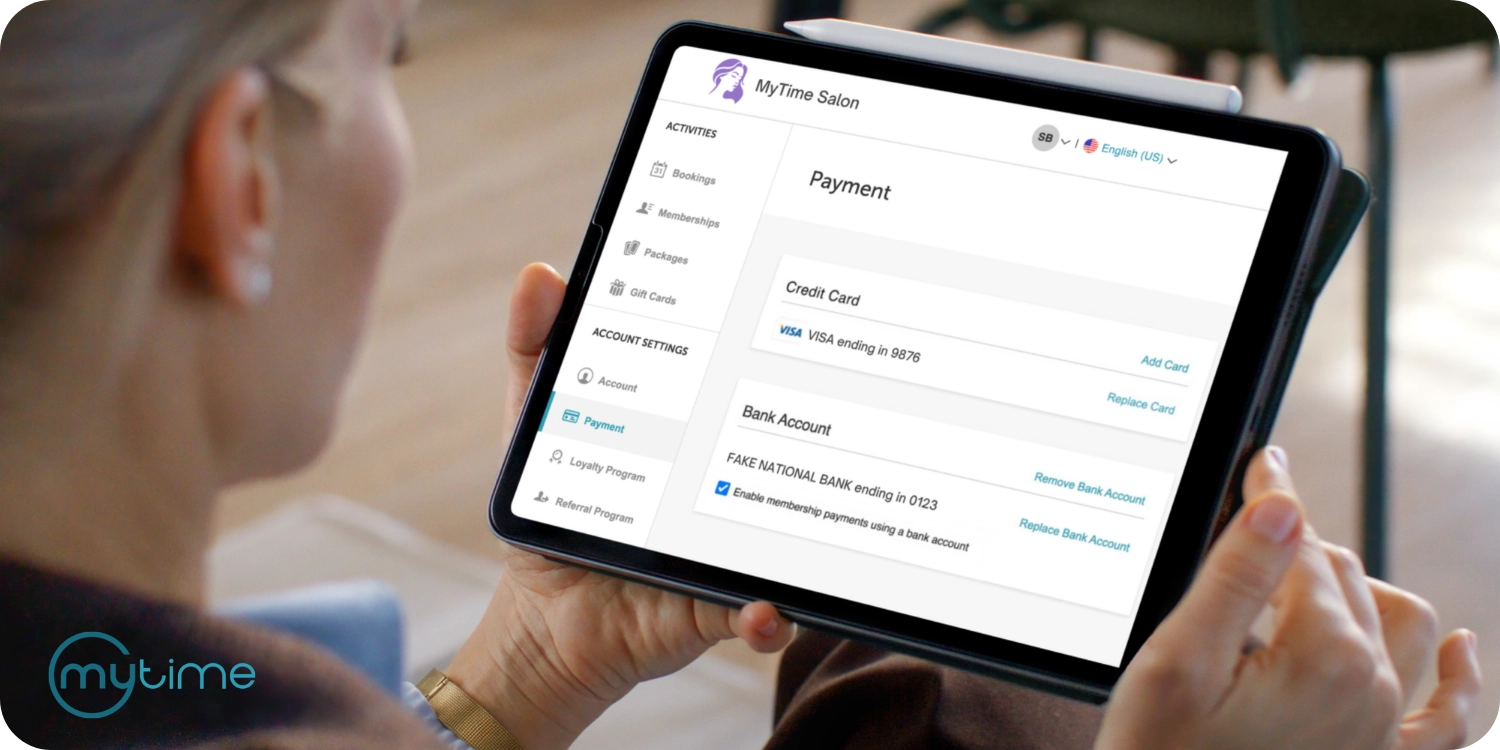
Clients can add their bank account directly from the My Account section of the booking widget. After signing in, they navigate to Payment, add their bank account details, and enable it for membership payments and recurring charges. Once saved, the bank account is reflected on their in-store profile automatically. No staff involvement required.
For merchants who prefer to initiate the setup, staff can add bank account details from the client profile by sending a link via Communicator or sharing a direct link for the client to complete on their own. Once a bank account is on file, it can be enabled specifically for membership and recurring billing from the client profile and managed from the Memberships section.
The result is an adoption path that works whether the client initiates it or the merchant does, with no manual workaround required in either case. Online checkout using a bank account is available when purchasing memberships through the booking widget, giving clients a seamless path to pay via ACH from the moment they sign up.
Should You Notify Clients Before Their Membership Renews?
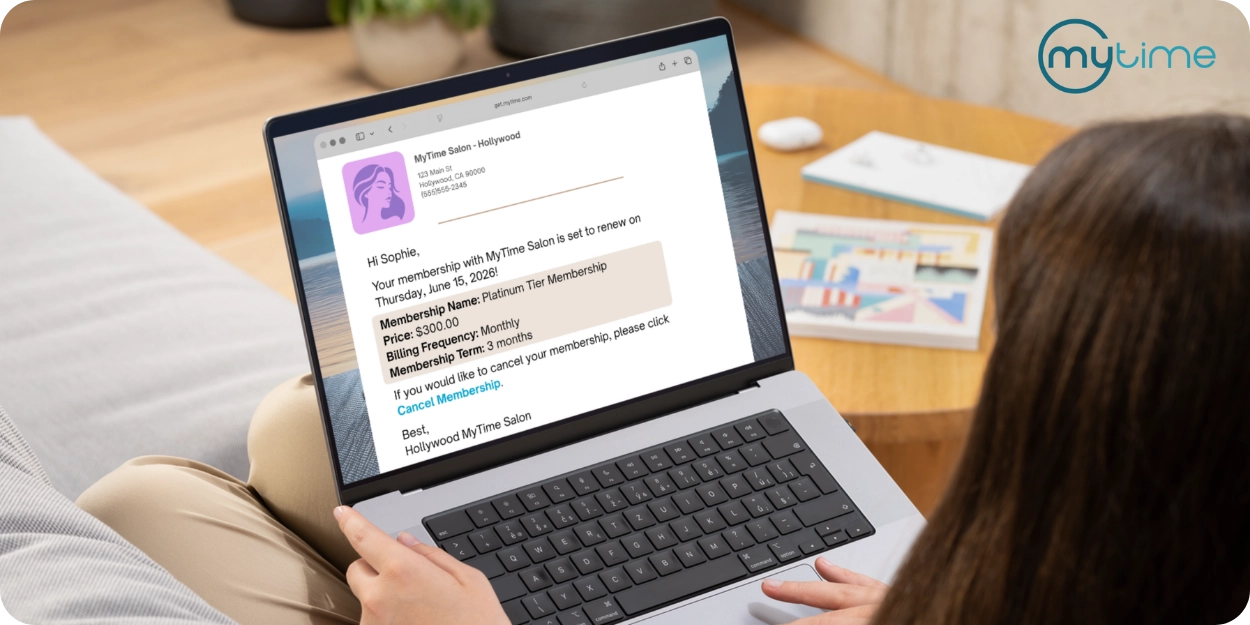
Membership churn driven by unexpected charges or a lack of communication before renewal is one of the more preventable problems a franchise can face. A Membership Renewal Consent notification is an automated email sent to clients ahead of their renewal, giving them the opportunity to cancel before the next charge processes if they choose.
A note on compliance: Certain states, countries, and regions require businesses to notify subscribers ahead of automatic renewals and provide a clear path to cancel. We recommend checking the specific requirements for the regions where you operate to ensure your membership program remains compliant. MyTime’s Renewal Consent notification is a practical way to meet those obligations while also strengthening the client relationship.
Most clients are going to renew regardless, and for them this notice is simply a signal that the brand is transparent and values the relationship. For those who have been sitting on the fence, a well-crafted reminder of what their membership includes, paired with a proactive path to cancel if they choose, is an opportunity to win them back before they were even lost. And for anyone who does decide to cancel, a graceful exit is always better than a disputed charge or a frustrated call.
Merchants can create separate templates for each membership type and configure the timing that makes sense for each one. A monthly membership might get a notice a few days out, while an annual membership warrants more lead time. The message itself is also an opportunity worth taking seriously. Rather than a generic renewal reminder, brands that include a brief recap of what the membership includes give clients a concrete reason to stay, which is particularly valuable for higher-tier memberships where the full range of benefits may not be top of mind.
How Do Automated Renewal Reminders Work?
MyTime sends Renewal Consent notifications by email, timed based on how each membership is configured. Merchants set the lead time that makes sense for each membership type and can create separate templates for each one. Each message includes a direct link for clients to manage their membership from their own account.
That per-membership configurability is where the real operational value sits. Different membership tiers carry different price points, different commitment levels, and different client expectations. Rather than applying one template across the board, operators can tailor the timing and messaging for each tier so that every member receives communication that feels considered and appropriate for the membership they hold.
Learn how one of MyTime’s merchants scaled their franchise with memberships here →
Membership Management Built for Scale
Failed payments and unexpected renewal charges are two of the most common and most avoidable drivers of membership churn. A franchise that addresses both is running a membership program that clients experience as reliable and transparent, which is precisely the kind of program people stay in.
MyTime’s membership tools are built to give operators the configuration options they need to run programs that work at scale, whether that means more reliable billing, lower processing costs, or communication that keeps members informed and engaged at every stage of their membership.
Read more on how memberships create a pathway to sustainable growth here →
Frequently Asked Questions
What is the difference between ACH and credit card payments for membership billing? ACH processes payments directly through a client’s bank account, which typically means lower processing fees and fewer failed transactions than credit cards, which expire and get replaced more frequently.
Can clients set up ACH payments on their own in MyTime? Yes. Clients can add their bank account from the My Account section of the booking widget and enable it for membership payments and recurring charges, without any staff involvement required.
How do membership renewal consent notifications reduce churn? By notifying clients before a charge processes, renewal reminders surface cancellation intent early, redirecting it away from post-charge disputes and toward a voluntary exit that preserves the client relationship.
Can renewal notifications be customized per membership type? Yes. MyTime allows merchants to create separate renewal consent templates for each membership type, with different timing and messaging that reflects the commitment level and expectations of each tier.
What is the biggest operational risk of running membership billing on credit cards? Payment failures. Credit cards expire, get flagged for fraud, and hit spending limits, all of which require staff follow-up and create client friction that ACH largely eliminates.
Ready to reduce membership churn across your locations? Book a demo!