



Managing one successful salon takes talent, discipline, and a strong team. Managing several locations takes something else: a clear operating system.
As a salon, barbershop, or beauty brand grows, the business changes fast. More locations mean more schedules, more staff, more service variations, more client records, more inventory, and more local marketing needs. The owner can no longer see everything by walking the floor.
To manage multi-location salon operations without losing control, leaders need standardized workflows, trained location managers, centralized scheduling, clean client data, connected POS and inventory, and reporting that shows what is happening across every location. The goal is not to make every salon feel identical. The goal is to protect the brand experience while giving each location enough flexibility to serve its local market.
That shift matters. The International Franchise Association notes that multi-location franchise brands need consistency across customer experience and daily operations, while fragmented technology can create operational complexity and inconsistent service experiences (International Franchise Association).
Why multi-location salon operations get harder as you grow
Growth creates opportunity, but it also exposes weak systems. A process that worked with one front desk, one manager, and one service menu can break when five locations start doing it five different ways.
The problem usually shows up in small ways first. One location handles cancellations differently. Another creates duplicate client profiles. A third sells memberships but does not surface the balance at checkout. Leadership sees revenue after the fact, but not the operational issues that caused the gap.
The International Franchise Association describes this broader challenge clearly: fragmented technology environments can increase administrative burden, reduce visibility, and pull teams into troubleshooting instead of growth work (International Franchise Association).
Multi-location salon leaders need systems that make the business visible. They also need standards that teams can follow without waiting for the owner to step in.
Define what must be standard and what can stay local
Control does not mean every location should operate like a copy-and-paste version of the first salon. Strong multi-location brands separate brand-critical standards from local flexibility.
Standardize the brand-critical workflows
Start with the workflows that shape the client experience and protect the business. These should not depend on the manager on duty.
Standardize the service menu structure, booking rules, cancellation policies, intake forms, waivers, membership handling, package balances, gift card rules, checkout flow, review requests, referral prompts, and reporting cadence.
Franchising.com notes that high-performing franchisees build intentional systems to create consistency across locations, including centralized hiring, standardized training, leadership meetings, performance metrics, and scalable platforms for scheduling and HR (Franchising.com).
The same principle applies to salon operations.
If the workflow affects the brand promise, it needs a standard.
Keep local flexibility where it helps the business
Local flexibility still matters. A downtown salon may run different promotions than a suburban salon. A barbershop in one market may see stronger demand for memberships, while another location may depend more on referrals or retail.
Give managers room to adjust local promotions, community partnerships, staff specialties, and service emphasis. Keep the core rules consistent, then let each location use local context to grow.
MyTime supports that balance with configurable workflows, location-level controls, centralized records, and flexible access permissions for multi-location and franchise brands (MyTime franchise software).
Build a leadership layer before the owner becomes the bottleneck
Owners lose control when every decision still depends on them. A scalable salon operation needs managers who can run locations, area leaders who can coach performance, and a clear operating cadence.
The American Franchise Academy frames this as “control from the distance.” Multi-unit operators cannot supervise every location all day, so they need management systems that help them duplicate operations across locations (American Franchise Academy).
For salon brands, that means clear roles. Location managers should own daily execution, staff communication, and client experience. Area managers should compare performance, spot gaps, and coach managers. Executive leaders should focus on growth, standards, and strategy.
Regular operating meetings also matter. Use them to review staffing, service quality, client feedback, utilization, rebooking, retail attachment, membership growth, and location-level performance.
When teams share what works, top-performing locations become a playbook for the rest of the brand.
Centralize scheduling without making the client experience feel corporate
Scheduling sits at the center of salon operations. It affects staff utilization, client experience, revenue, retention, and local demand.
Give clients one easy way to book across locations
Clients should be able to book from the channel they prefer. That might be the website, Google, Instagram, Facebook, a branded app, or the front desk.
Once the brand has multiple locations, booking needs to work across the network. Clients should be able to find the right service, the right staff member, the right time, and the right location without friction.
MyTime’s omnichannel booking helps multi-site brands accept bookings across key digital channels while keeping the experience branded and connected (MyTime omnichannel booking).
Give staff the context to serve clients anywhere
The client should not have to start over when they visit a different location. Staff need access to the right history, preferences, notes, memberships, packages, waivers, and appointment details.
Clean client data makes that possible. MyTime’s global client record gives authorized staff access to a unified profile across locations, including appointments, packages, memberships, waivers, payments, and communications (MyTime clean client data).
That level of visibility protects the client experience. It also protects reporting, because leaders can trust the data behind the decisions.
Connect POS, inventory, and client data
Disconnected systems create hidden work. Staff check one tool for the appointment, another for the payment, another for inventory, and another for the client record. Each handoff creates room for errors.
An integrated operating model connects the appointment, the transaction, the product, the staff member, and the client profile. That connection helps leaders understand what happened, not just what was sold.
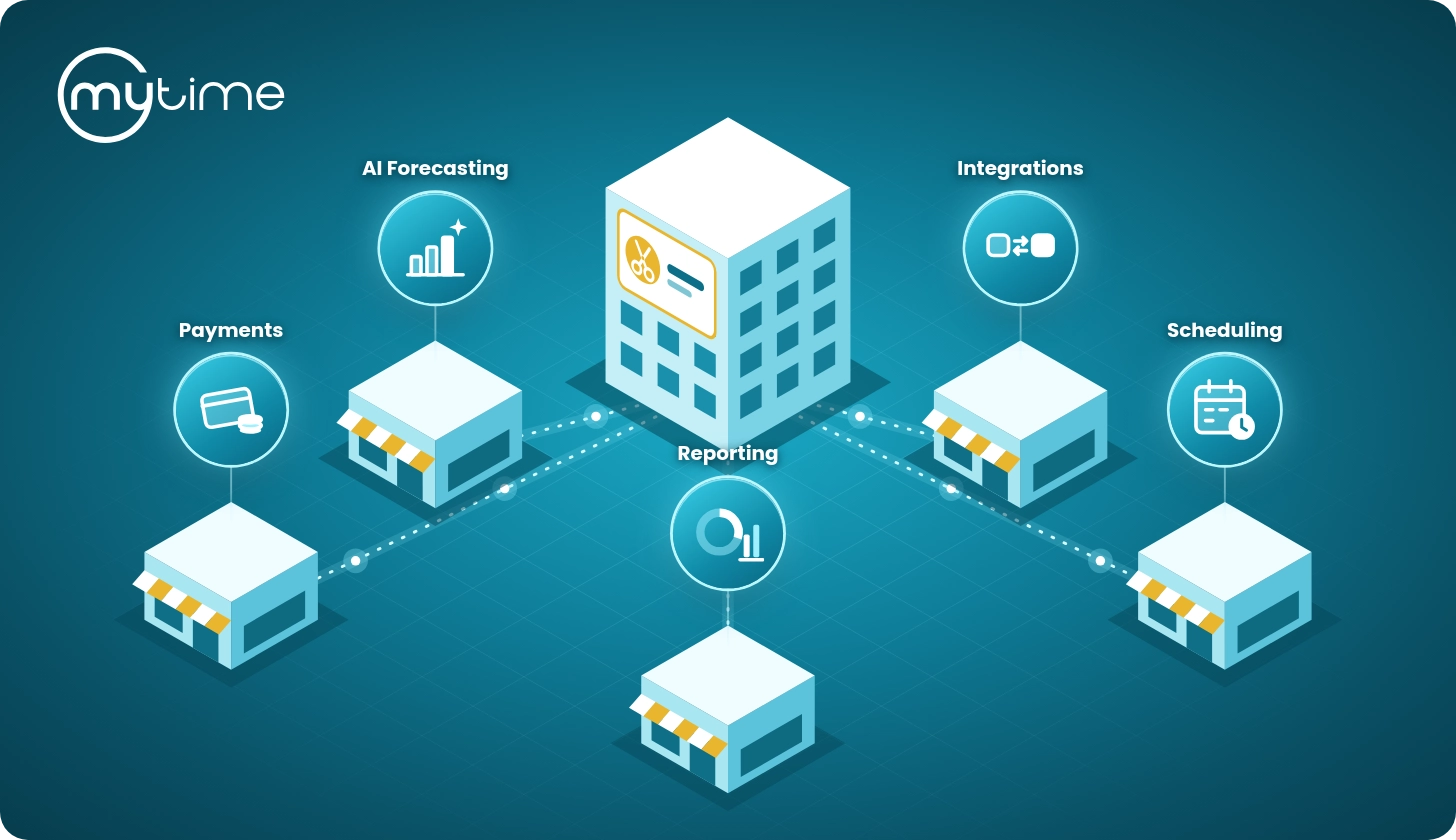
MyTime connects booking, scheduling, POS, inventory, customer management, staff management, marketing, memberships, loyalty, referrals, reporting, and franchise-level controls in one platform for multisite service brands (MyTime operational efficiency).
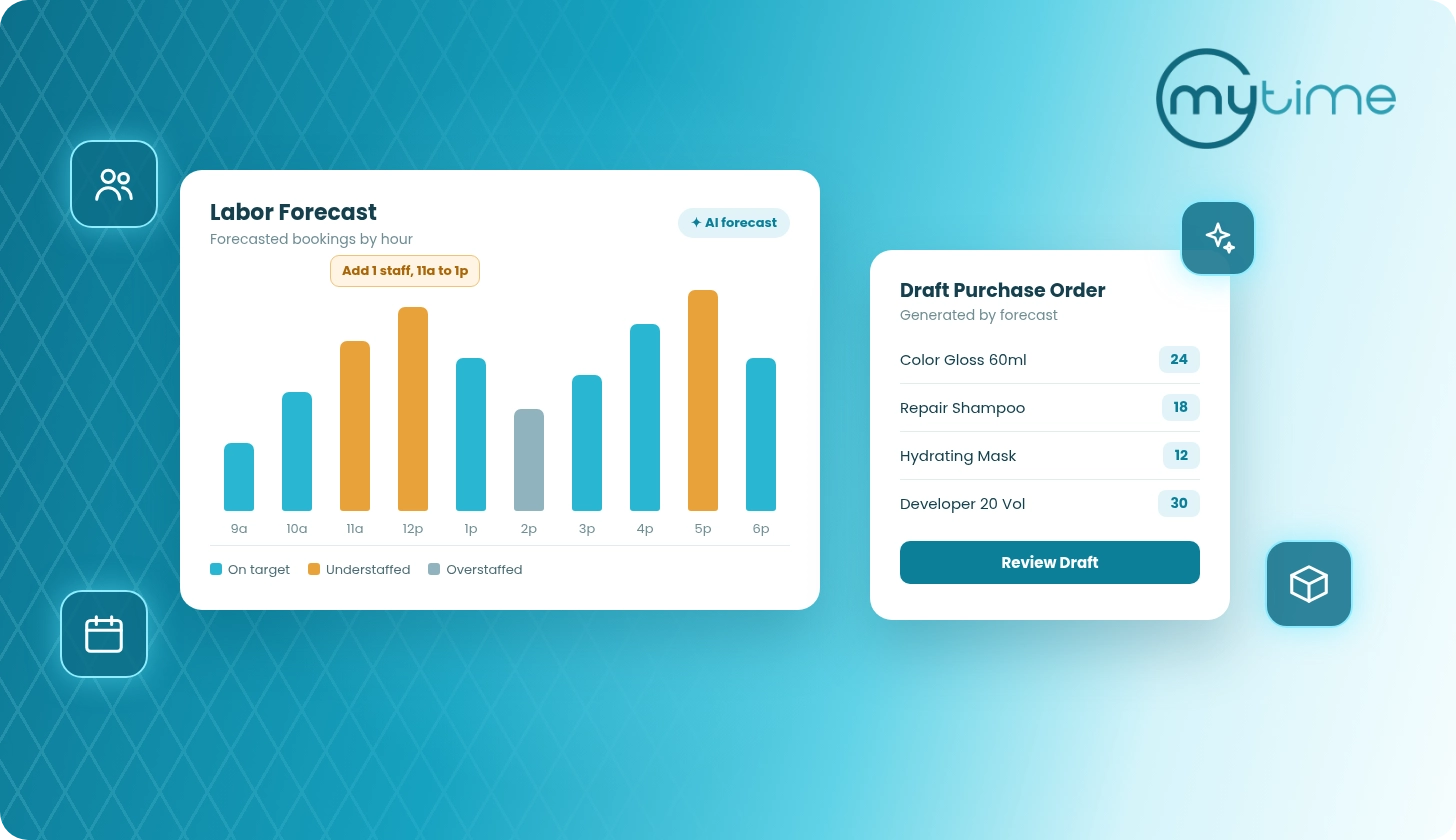
Inventory also becomes more important as the brand grows. A single location can often fix a stockout with a quick run or a vendor call. A multi-location brand needs better visibility into usage, stock levels, transfers, and purchasing.
When POS and inventory connect, operators can see what services and products drive demand. They can also reduce the manual work that drains manager time.
Use reporting to manage exceptions, not just review the past
Reports should not only explain last month. They should help leaders see what needs attention now.
Track the metrics that reveal operational control
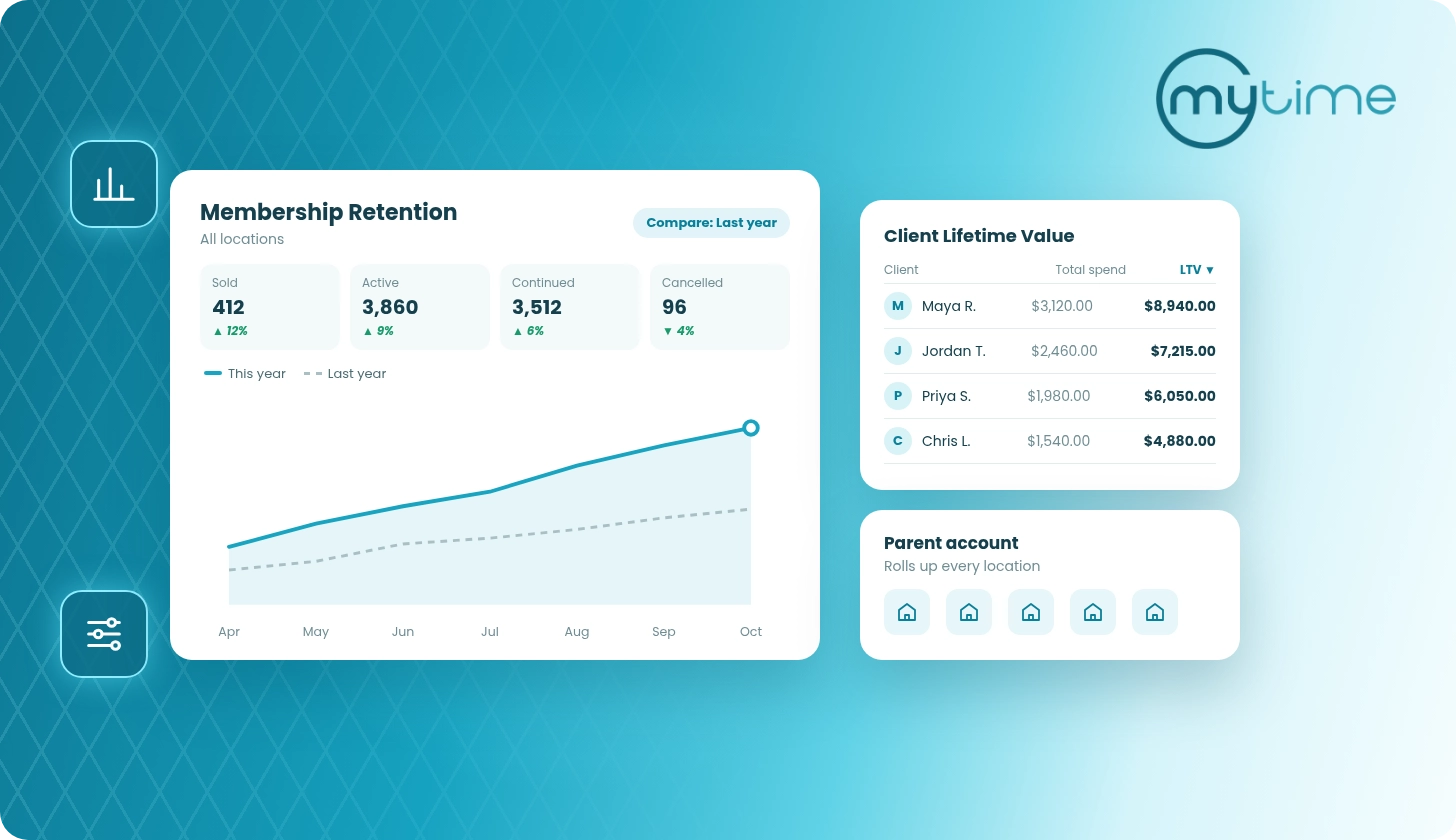
Multi-location salon leaders should track revenue by location, utilization, rebooking, membership sales, retail attachment, average ticket, staff productivity, client retention, review volume, and local campaign performance.
These metrics show where the brand runs smoothly and where it needs support. They also help leaders avoid managing by anecdote.
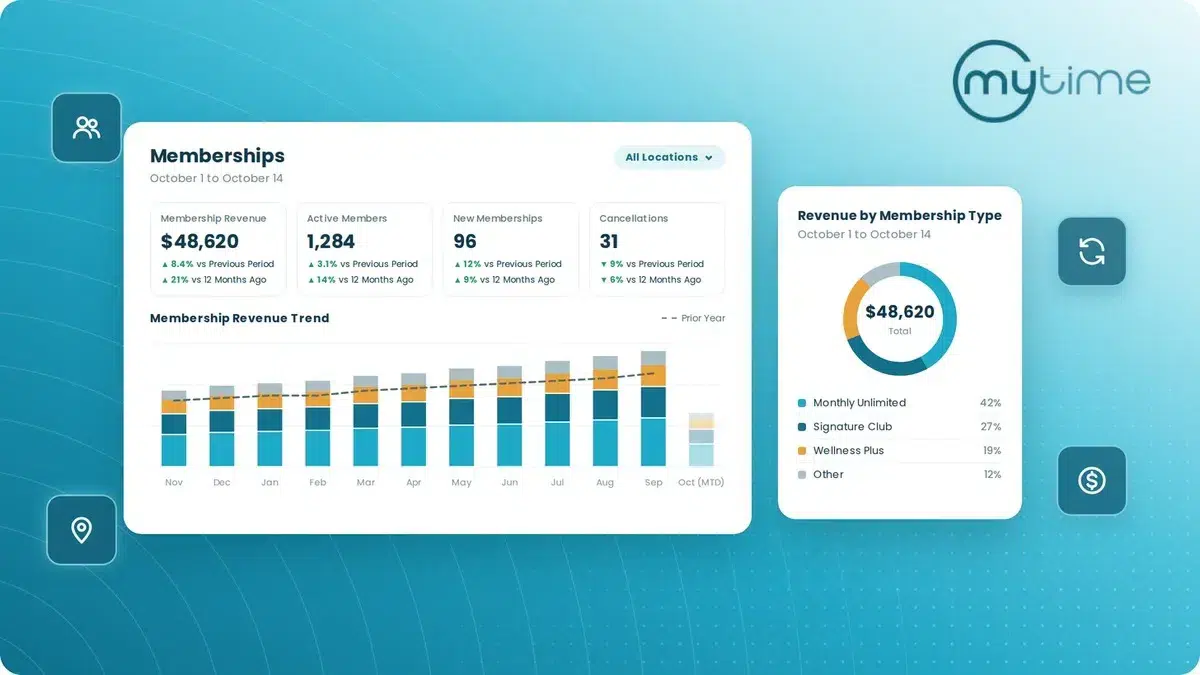
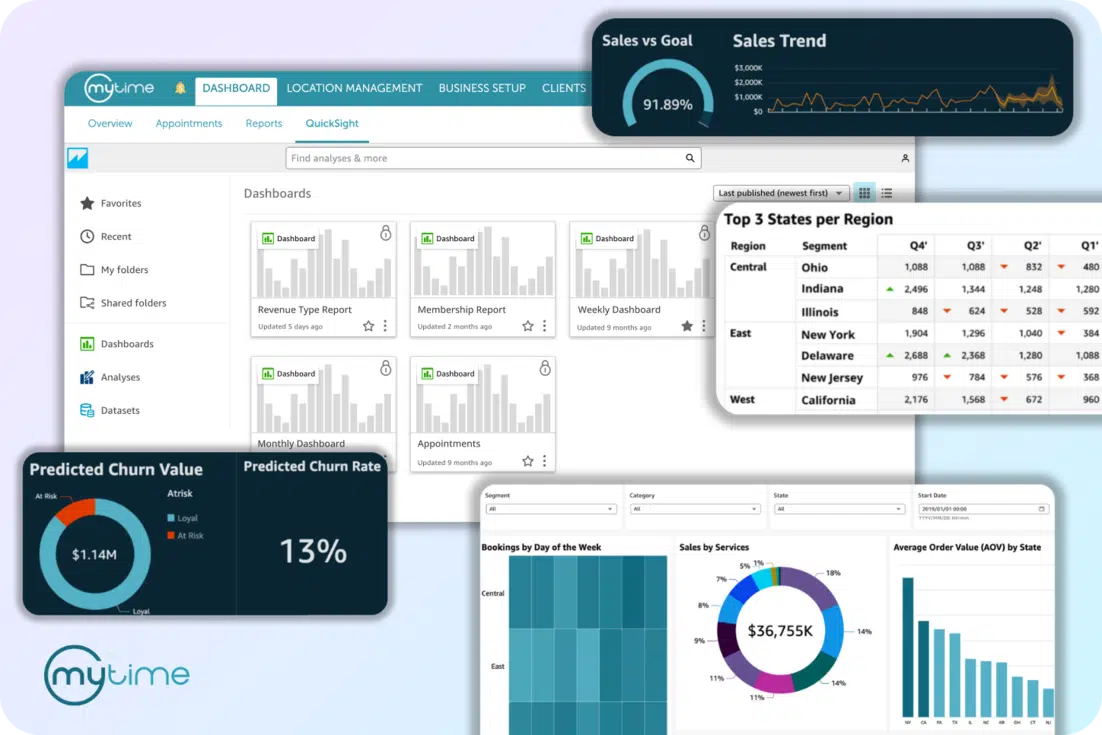
MyTime gives multi-location and franchise operators reporting across revenue, productivity, performance, location, service, and staff-level views, with access controls that support corporate and franchise structures (MyTime franchise software).
Compare top-performing and underperforming locations
The most useful reports help leaders find outliers. Why does one location rebook more clients? What helps another sell more memberships? Which local habits explain stronger review volume or better utilization?
Those answers often reveal training gaps, service mix differences, schedule constraints, manager habits, or local marketing opportunities.
Operational control does not mean micromanaging every location. It means knowing where to look and acting before small gaps become larger problems.
Orchestrate the full customer journey
Multi-location control is not only an internal operations issue. It shapes the full customer journey.
A client may discover the brand on Google, book through Instagram, receive a text reminder, visit one location, buy a membership, rebook at checkout, leave a review, refer a friend, and later visit another location. Each step should feel connected.
MyTime brings scheduling, payments, customer engagement, reporting, and analytics together on a single platform. AI helps connect those workflows and orchestrate what should happen next across the customer journey (MyTime company).
That is where operations and growth meet. The system should not only manage today’s appointment. It should help turn first visits into repeat visits, repeat visits into memberships, and memberships into long-term customer value.
MyTime’s SMS and AI Chatbot capabilities support two-way messaging, smart text-based scheduling, automated rebooking reminders, 24/7 inquiry handling, personalized recommendations, and complex appointment coordination (MyTime SMS and AI Chatbot).
For a growing salon brand, that means the customer journey does not depend on one person remembering the next step. The operating system helps move the relationship forward.
Choose software that fits how your salon brand operates
Growing salon brands should avoid rigid software that forces every location into a generic workflow. The platform needs to match how the business actually runs.
Look for configurable service rules, booking logic, access controls, templates, reporting views, customer data rules, local permissions, and corporate oversight. Ease of use also matters. If the system feels too hard for frontline teams, adoption will suffer.
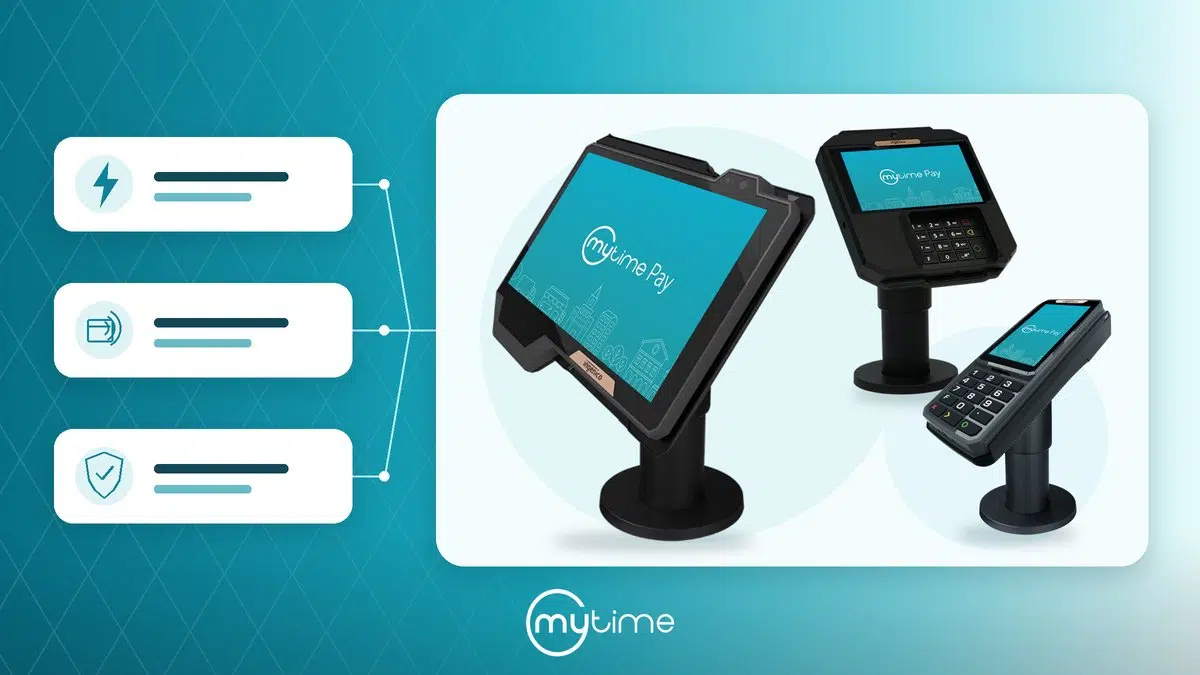
MyTime is built for appointment-based, multi-location service brands that need flexibility, control, and usability. The platform is cloud-based, easy to provision, easy to learn, and accessible from a web browser or mobile device (MyTime franchise software).
The partnership model also matters. MyTime assigns a dedicated onboarder, account manager, and engineer who learn the customer’s operation and build around how the brand runs (MyTime company).
The software should support the operating model, not force the operating model to bend around the software.
What this looks like in practice
You’re not evaluating features. You’re evaluating whether the platform can actually run your business at scale.
Here’s what that looks like in practice:
Hydrate IV Bar generated more than $2M from automated client engagement, with 40% of total revenue driven by memberships (MyTime customer stories).
→ Recurring revenue and retention are not side strategies. They become core to how the business grows.
Hounds Town runs 95+ locations with integrated POS and real-time reporting, giving franchisees centralized data and operational control (MyTime customer stories).
→ Scheduling, payments, and reporting stay connected as the network expands.
Cloud 9 Foot Spa reduced staff training time by 40% and generated 200 five-star reviews in six months at one location with reputation management (MyTime customer stories).
→ High-volume operations depend on speed, simplicity, and consistency.
V’s Barbershop uses MyTime’s omnichannel booking and daily tip payouts to support guest booking and provider cash flow (MyTime customer stories).
→ Client convenience and staff experience both matter when the brand scales.
Hair Saloon improved the experience for staff and guests, made onboarding more intuitive, and used a customizable app to maintain brand integrity (MyTime customer stories).
→ Growth works better when the system is easy for teams to learn and aligned to the brand.
Multi-location salon operations checklist
Use this checklist to assess whether the business can scale without losing control.
- Document brand-critical workflows.
- Define what corporate controls and what locations can localize.
- Build a location-manager and area-manager operating cadence.
- Centralize booking and scheduling.
- Keep client records clean and accessible.
- Connect POS, memberships, packages, and inventory.
- Track location, staff, client, and marketing performance.
- Use dashboards to manage exceptions early.
- Automate reminders, rebooking, reviews, referrals, and win-back campaigns.
- Review the customer journey from discovery to lifetime value.
- Choose software that can be configured around the brand’s operating model.
FAQ
What is multi-location salon management?
Multi-location salon management is the process of running multiple salon locations with consistent standards, connected systems, shared data, local accountability, and centralized visibility.
It includes scheduling, staff management, client records, POS, inventory, marketing, reporting, training, and customer experience. The strongest operating models protect the brand while still giving each location enough room to serve its local market.
How do you keep salon locations consistent?
Keep salon locations consistent by standardizing the workflows that shape the client experience. That includes booking rules, service menus, client intake, cancellation policies, checkout, memberships, packages, reviews, referrals, and reporting.
Then give local managers enough flexibility to adjust promotions, staffing, and community engagement for their market.
What software features matter most for multi-location salons?
Multi-location salons need online booking, staff scheduling, POS, client records, memberships, packages, inventory, marketing automation, reputation management, reporting, permissions, and AI-enhanced journey orchestration.
The right platform should connect these workflows so teams do not have to manage the business from disconnected tools.
How can salon owners manage multiple locations without being onsite every day?
Salon owners can manage multiple locations without being onsite every day by building a leadership layer, setting clear KPIs, centralizing systems, and using dashboards to manage exceptions.
That structure helps the owner move from daily supervision to strategic leadership.
Why does client data matter for multi-location salons?
Client data matters because the experience depends on what the team knows. Staff need access to appointment history, preferences, notes, waivers, memberships, packages, payments, and communication history.
Clean client data helps the brand deliver consistent service across locations. It also makes reporting more accurate.
Take control before growth gets messy
Multi-location salon operations do not fall apart all at once. Control usually slips through small gaps: inconsistent workflows, duplicate records, disconnected reports, unclear manager ownership, and customer journeys that rely on manual follow-up.
The fix is a stronger operating layer. Standardize what matters. Give local teams room to execute. Centralize the data. Connect the customer journey. Use reporting to manage exceptions before they become larger problems.
MyTime helps multi-location salon brands standardize operations, centralize data, and orchestrate the full customer journey from first touch to lifetime value.
Book a call to see how MyTime can support your multi-location salon operation.