




The technology stack your brand needs to scale beyond 5 locations.
Past five locations, growth stops being a marketing problem and starts being an operating one. This guide walks through the eleven essentials — the booking, clinical, payments, inventory, marketing, and multi-location infrastructure your brand needs in place to scale without operational variance eating your margin.

Why growth stalls between five and twenty locations.
Demand isn’t the problem. By the time a med or IV spa brand crosses five locations, the operating layer underneath every studio — booking, intake, clinical notes, payments, inventory, marketing, and reporting — starts to compound errors. Every new opening adds variance instead of leverage. The brands that scale cleanly past that wall built the foundation early.
Stitched stack. Manual workarounds. Variance everywhere.
- Each location runs a slightly different booking flow, intake form, and waiver process.
- Client records live in one system, payments in another, marketing in a third — nothing reconciles.
- Membership conversion swings 30–40% across locations and nobody can explain why.
- Marketing ROI is a quarterly reconciliation exercise, not a real-time view.
- Inventory stockouts hit on a Saturday and no one sees it until Monday.
- Every new location takes weeks of tech-stack configuration before it can open the doors.
One operating layer. One client record. One source of revenue truth.
- Booking, intake, waivers, and SOAP notes are configured once at the brand level and inherited by every studio.
- The same client moves between locations and their record, membership, and balance follow.
- Membership, retail attach, and rebooking become properties of the system — not properties of memory.
- Marketing spend ties directly to booked revenue at the campaign and location level.
- POS, payments, retail, and back-bar inventory update the moment a service or sale completes.
- New locations go live as a configuration push, not a project — built off the brand template you’ve already proven.
What every med, IV, and aesthetic studio brand needs in place to scale past 5 locations.
A practical, vendor-agnostic checklist of the technology essentials — framed exactly the way operators evaluate them. Each step covers what it is, why it matters at scale, and what to look for when you build or replace it.
Reputation & Listing Management
Every search result, map pin, and review across every location is an extension of your brand. At scale, “mostly accurate” is the difference between a fully booked Saturday and an empty room.
- Accurate, consistent profiles maintained automatically across Google, Yelp, Facebook, and the major directories — for every location.
- Real-time listing updates the moment hours, services, or staff change — without lifting a finger.
- Automated review generation tied to actual visits, with two-way response from one inbox.
- Brand-level visibility into which locations are earning rave reviews — and which need attention.
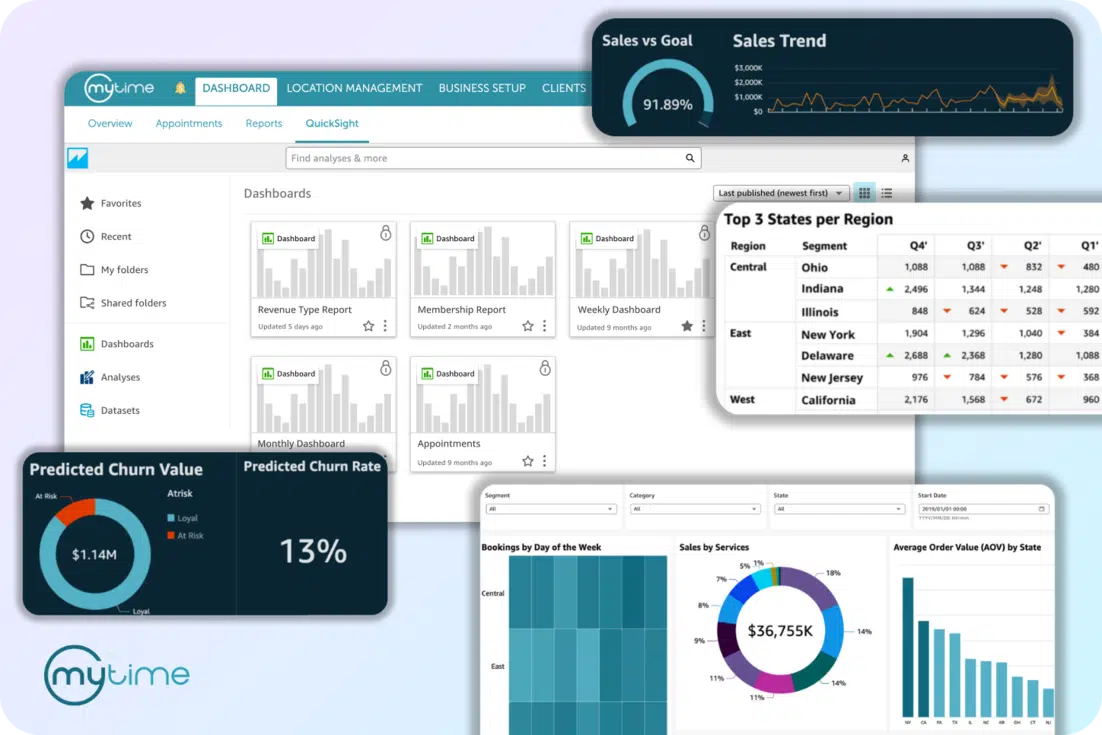
Built-in Listing & Reputation Management automatically syncs every location’s presence across Google, Yelp, Facebook, and TripAdvisor, generates reviews from real visits, and gives corporate a single dashboard to see how every studio is being perceived in its market.
True Omnichannel Booking
Clients book on the channel they’re already using — Google, Instagram, your branded app, your website, or the phone. Every channel has to drop into the same system, with the same rules.
- Booking widgets on your website, social, Google Search, and Reserve with Google — all powered by one schedule.
- Multi-service and multi-day booking for complex flows like a peel followed by IV therapy or a full rejuvenation day.
- Group bookings for couples treatments and small wellness cohorts, with individual confirmations to each guest.
- Automated confirmations, reminders, and waitlist capture — so every empty slot fills itself.
MyTime’s Omnichannel Online Booking sits on every channel your client is already on — with packages, intake forms, and waivers attached to the right service the moment they book. One schedule. Every location. Every channel.
Intelligent Staff & Resource Scheduling — with Credentialing
Med and IV spa scheduling isn’t just about who’s on shift. It’s about who is certified, licensed, and credentialed to perform a specific procedure in a specific room with the right equipment. The booking engine has to enforce that automatically.
- Service-level certifications — only credentialed providers appear as bookable for the procedures they’re cleared to perform.
- Resource-aware scheduling for treatment rooms, devices, and equipment — no double-booking the laser.
- Smart utilization across providers, rooms, and chairs to keep the schedule fully productive.
- Automatic enforcement when a credential lapses, expires, or hasn’t been renewed.
Staff & Resource Scheduling is configured to your brand’s credentialing rules, so providers only appear bookable for procedures they’re certified to perform — with rooms, devices, and back-bar resources coordinated in the same view.
Global Client Profiles, Records & History
A client who books at your Scottsdale location and then books in Austin should be the same client — with the same record, the same membership, and the same package balance. That’s table stakes for a brand of any size.
- One client profile, accessible across every location, with full visit history, photos, and SOAP notes.
- Aesthetic preferences, past procedures, contraindications, and notes available the moment a client checks in.
- Membership balances, package usage, gift card values, and loyalty points that travel with the client between studios.
- Complete client history at the provider’s fingertips — so the next session continues exactly where the last one left off.
Global Client Records & Intake Forms maintain meticulously detailed profiles, SOAP notes, and treatment histories — all centralized, all accessible across locations, all configurable to your brand’s clinical workflow.
Global Intake, SOAP Notes & Waiver Management
For IV and clinical services, the intake form is the protocol. The waiver is the liability shield. The SOAP note is the record of care. At scale, every one of those has to be set, controlled, and standardized from the parent level — not rebuilt location by location every time a service changes.
- Global intake forms & SOAP templates — configured once at the brand level, inherited automatically by every location, updated everywhere when the protocol changes.
- Service-specific intake routing — a NAD+ drip pulls a different form than a Myers’ cocktail, an IM B12 shot, or a chemical peel. Every booking surfaces the right one.
- Liability waiver management with expiration tracking — for clinical services like IV therapy, an expired waiver is an unsigned waiver. Auto re-collection before the next visit is non-negotiable.
- Pre-appointment automation: prep instructions, hydration guidance, contraindication flags, photo uploads, and consent flows triggered by appointment type.
- Reminders, confirmations, and rescheduling logic that protect your schedule and reduce no-shows.
Intake Forms, SOAP templates, and waiver management are configured at the brand level and inherited by every location — so when your medical director updates the IV protocol, every studio is using the new form by tomorrow morning. Waiver expiration is enforced automatically, and every form is tied to the right service from the moment a client books.
Audit Trails & Compliance Infrastructure
Med and IV spas handle Protected Health Information (PHI). At scale, with hundreds of staff across dozens of locations, compliance can’t live in policy documents — it has to live in the platform itself.
- Role-based access controls so the right people see the right records — and only those.
- Detailed audit trails on every action: who viewed, edited, or modified a client record, when, and from where.
- Bank-grade encryption in transit and at rest, SSO, MFA, and IP-locking for sensitive workflows.
- Business Associate Agreements (BAAs) with vendors who actually understand med spa compliance obligations.
Custom Roles & Access Permissions, audit trails with timestamps, SAML-based SSO, and IP-locking are built into the enterprise platform — with HIPAA-aware workflows and BAAs for the customers who need them.
Fully Integrated POS & Payment Flexibility
The POS isn’t a checkout tool — it’s the spine of your financial operations. It has to accept any payment, anywhere, and tie every transaction back to the client, the service, the provider, and the campaign that drove it. At scale, the right payment mix isn’t a nice-to-have — it’s margin.
- One POS for in-store, online, in-app, on-device — tap, dip, swipe, ACH, recurring billing, and Tap to Pay on a staff phone.
- ACH for memberships — bank-debit recurring billing dramatically reduces processing fees vs. credit card and cuts involuntary churn from expired and declined cards. On a high-volume membership base, the savings compound monthly.
- Configurable card surcharging — built-in, compliance-aware surcharge rules pass card processing costs to the customer where state law allows, protecting your margin without re-pricing your services.
- Real-time view of revenue, profitability, refunds, and discounts across every location.
- Marketing ROI you can actually measure — campaign-level revenue attribution from the same system that takes the payment.
- Subscription and membership billing automated, recurring, and reconciled — with no missed charges and no manual invoicing.
- PCI scope minimized, with tokenized credit card storage and integrated processing.
A fully integrated POS handles every payment method on every channel — tap, dip, swipe, ACH, subscription, in-app, online — with native ACH for memberships, configurable surcharging where allowed, real-time performance and profitability dashboards, and direct attribution from marketing campaign to booked revenue.
Marketing Automation & Campaign Attribution
Marketing isn’t a department for a multi-location brand — it’s a system function. The same operating layer that owns the schedule, the client record, and the POS is the only one that can actually trigger the right campaign at the right moment, to the right client, and prove what it generated in revenue.
- Global campaign management — brand-wide campaigns built once at corporate, deployed across every location with local guardrails for franchisees.
- Automated flash sales when the schedule needs to fill — the platform sees the open Tuesday afternoon, surfaces it to the right segment, and books it before it goes empty.
- Hyper-personalized drip campaigns triggered by last visit, last service, package usage, lifecycle stage, or membership status — reactivation, win-back, anniversary, post-treatment follow-up, all running in the background.
- BOGOs, package promos, gift card pushes, referral incentives, and seasonal offers — all configurable, all trackable, all tied back to the client record.
- Direct revenue attribution — every campaign rolls up to dollars booked and dollars collected in the same system, so you can see exactly what each marketing dollar produced.
- Two-way SMS, email, and in-app messaging unified into one client conversation — not three disconnected tools.
The Marketing Hub runs hyper-personalized, segment-aware campaigns triggered by client behavior and schedule signals — flash promos when capacity opens, win-back when retention slips, anniversary and post-visit drips that bring clients back — with revenue attribution back to every dollar generated, all in the same platform that holds the booking, the client record, and the payment.
Connected Inventory — Retail, Back-Bar & AI Forecasting
Botox vials, IV bags, fillers, retail skincare, hydration kits — inventory is one of your largest line items and one of your easiest leakage points. It has to update the moment a service is performed or a product is sold.
- POS-connected inventory: front-of-house retail and back-bar consumables update automatically with every transaction.
- Brand-wide standardized SKUs with the flexibility for location-specific variants where needed.
- AI-driven forecasting that learns demand patterns and pre-builds purchase orders against your max-quantity thresholds.
- Low-stock alerts and reorder triggers that fire automatically — before a Saturday morning becomes a stockout.
- Vendor-aware ordering rules tied to brand-approved suppliers, so franchisees order on-brand without thinking about it.
Inventory Management is fully connected to scheduling and POS — so every IV drip, every Botox unit, every retail bottle is decremented in real time, with AI-driven reordering keeping every location perfectly stocked.
Memberships, Loyalty & Referrals
The most profitable client is the one you’ve already earned. Predictable monthly revenue from memberships smooths cash flow, deepens loyalty, and turns a transactional service into a long-term relationship. Eighty-five percent of U.S. med spas already offer memberships — the brands scaling cleanly are the ones whose programs are built into the platform, not bolted on.
- Configurable membership programs that bill, renew, and expire automatically — with package and credit balances visible to the client and the provider.
- ACH bank-debit billing for memberships — lower per-transaction processing fees vs. credit card, fewer involuntary cancellations from expired or declined cards, and a more stable monthly revenue base. On a multi-location membership program, those basis points add up to real margin.
- Loyalty points and tiered rewards earned across every location and redeemable on any service or retail product.
- Automated referral programs with credits, codes, and rewards tracked end-to-end.
- Personalized marketing campaigns triggered by visit history, past services, package usage, and lifecycle stage — reactivation, win-back, anniversary, post-treatment follow-up.
- Cross-location membership and gift card balances that travel with the client — reconciled centrally.
Memberships, Loyalty & Referrals are built directly into client and POS workflows, with native ACH billing for membership dues, marketing automation that segments on visit history, services, and lifecycle stage — so every renewal, every campaign, every win-back is hyper-personalized to the client, on-brand for your studio, and run on the most cost-effective payment rail available.
Multi-Location Management, Reconciliation & Royalty Automation
When you’re running 10, 50, or 200 locations — corporate-owned or franchised — the operating layer has to give corporate full visibility, give franchisees clean local controls, close the books cleanly every month, and make new openings repeatable.
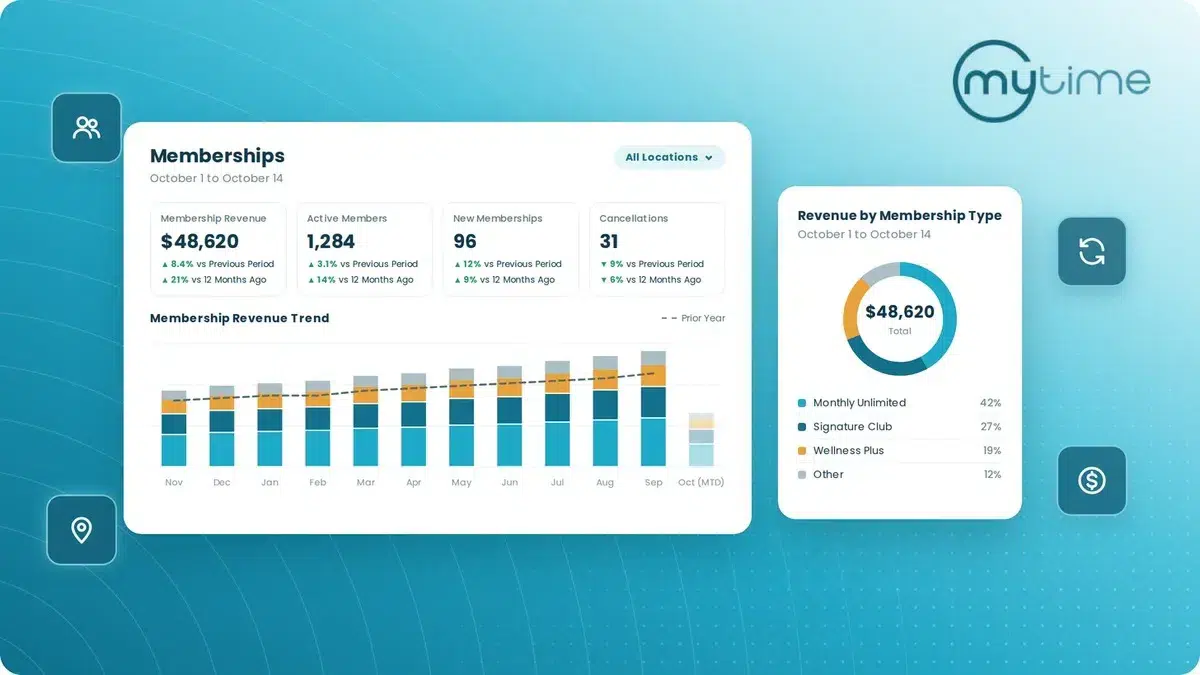
- Real-time multi-location reporting on revenue, utilization, productivity, retention, and marketing performance — corporate, regional, and location-level.
- Cross-location reconciliation — memberships used at any location, gift card balances drawn at any location, and packages redeemed across the system all reconcile back to the location that earned the revenue.
- Automated bank & financial reconciliation — daily batch settlement, deposits, processor fees, refunds, and chargebacks tied back to the transactions that generated them, location by location.
- Month-end close support — pre-built reports for revenue recognition, deferred revenue on packages and memberships, tip distribution, and inter-location transfers, so finance closes in days, not weeks.
- Automated royalty calculation and collection for franchise systems — royalty fees calculated on the right base, on the right cadence, debited automatically.
- Division of control: corporate sets brand-wide standards (services, pricing logic, marketing templates, intake forms); franchisees keep the local controls they need (hours, staff, local promotions).
- New-location go-live as a configuration push: clone menus, permissions, and templates; tailor what needs to be tailored; open the doors with the operating layer already in place from day one.
- Role-based access for corporate, regional managers, owners, and staff — provisioned the moment a new location is added.
Multi-Location Management, automated daily reconciliation, royalty reporting, financial close support, and the Franchisor Dashboard are built into the same platform — so opening location number 12, or number 120, becomes a configuration decision, not a tech project, and finance closes the month against one source of truth instead of stitching reports across systems.
Your brand belongs on their home screen.
To make sure your brand never misses an opportunity — and is the first thing your client thinks of the next time they want to book — you need more than a website. You need a branded experience your clients carry with them. Booking, packages, memberships, loyalty, in-app messaging, and self check-in — all under your name and your colors, on the device that’s already in their hand.
- Branded mobile app under your name and colors — available on iOS and Android.
- One-tap rebooking, package and membership balance visibility, and digital gift cards.
- Self check-in, in-app messaging, and push notifications for confirmations, prep, and promos.
- Loyalty points, referral codes, and rewards visible — and earnable — in the app.
- Multi-location aware: your client can book at any of your studios from the same app.
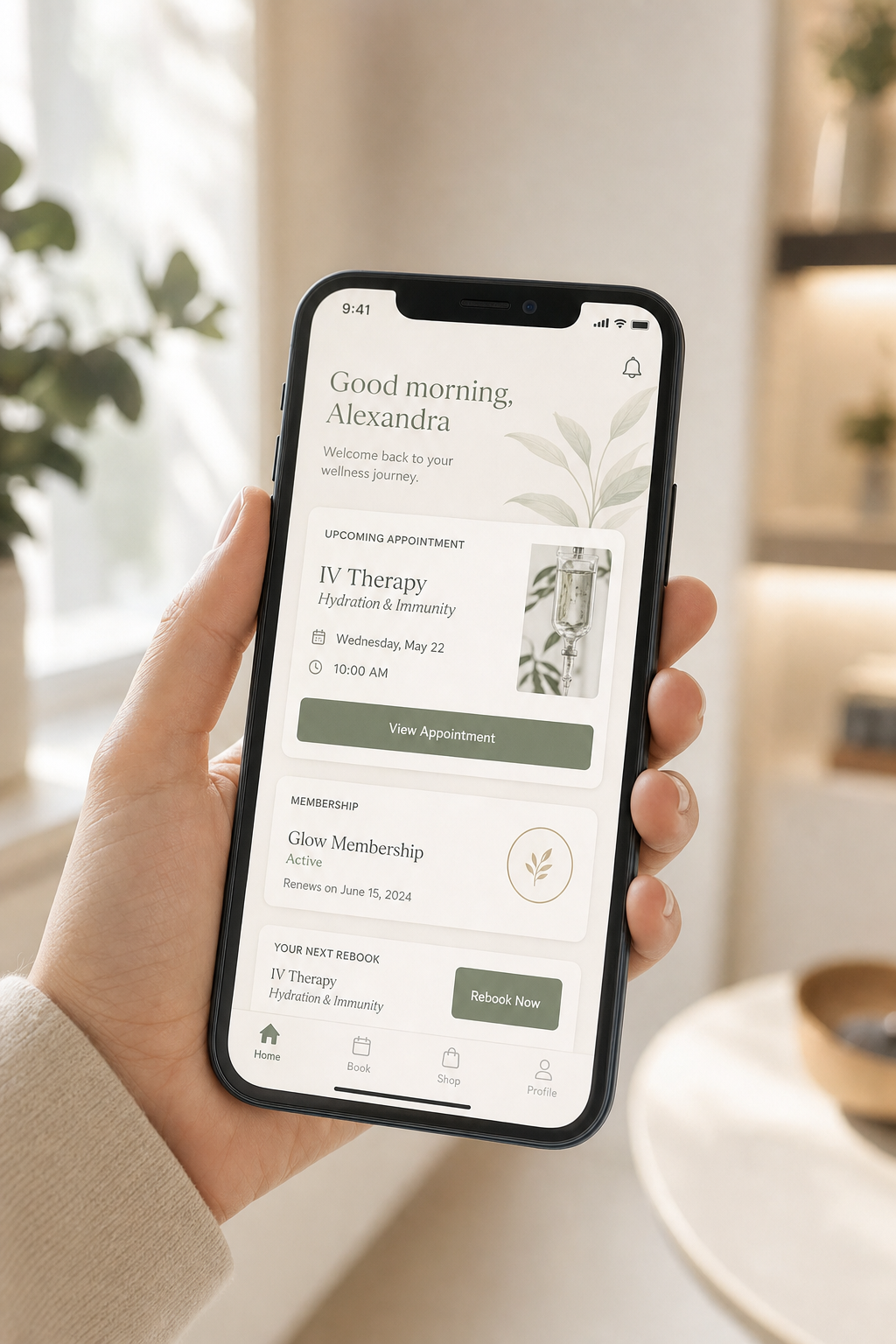
A re-bookable client is a return client.
When your brand lives on the home screen next to their banking app, the next visit is one tap away — not a Google search away.
From System of Record to AI-Driven System of Action.
AI doesn’t replace your operating layer — it amplifies it. The brands pulling away from the pack are the ones whose AI is embedded directly in the platform where their data, permissions, and clinical workflows already live. Below: the four roles AI plays inside MyTime, every day, across every location.
Copilots
Work alongside your team- Reporting assistant — ask business questions in plain English, get instant analysis across every location.
- POS coaching agent — real-time upsell, membership, and retail-attach recommendations at checkout.
- Booking widget configurator — set up complex booking rules conversationally.
Wedges
Replace repetitive manual tasks- Virtual receptionist — handles calls and texts, books appointments 24/7, reduces staffing costs.
- AI inventory forecasting — smart ordering with configurable rules and alerts.
- Widget creation agent — builds custom booking experiences from a description.
Sentinels
Monitor and protect your business- Bad-actor detection — wrong loyalty points, unauthorized discounts, suspicious refunds.
- KPI monitoring — alerts when key metrics decline below your thresholds.
- ML anomaly detection — surfaces patterns humans miss across dozens of locations.
Orchestrators
Automate complex workflows- Employee onboarding — automated provisioning across scheduling, POS, and access controls.
- New service setup — configure across all locations: pricing, marketing, intake, in one flow.
- Multi-system coordination for brand-wide rollouts and configuration changes.
“The brands that scale cleanly past the variance wall almost always built around one operating infrastructure earlier than felt necessary. Past five locations, the cost of a stitched stack compounds every quarter you wait. The brands ready to grow are the ones who decided to solve it once.”Marcus Slater CGO, MyTime
Choose a technology partner. Not a tech vendor.
The line between a vendor and a partner becomes obvious the moment something goes wrong — or the moment you ask for something the platform doesn’t do out of the box. As you evaluate platforms, here are the qualities that separate a partner who scales with you from a tool you’ll outgrow at twelve locations.
The partner standard
-
Bespoke to your brand and processes — not the other way around.
The platform configures to your booking flow, your clinical protocols, your membership tiers, your brand voice, your franchise structure. Your operations don’t bend to fit the software; the software bends to fit them.
-
A single, unified codebase — not a one-off fork.
Bespoke configuration on top of one product means you’re always on the latest release, never orphaned, and benefit from every new capability the platform ships.
-
A dedicated team that understands your operating reality.
Forward-deployed engineers, account managers, onboarding specialists, and solution engineers who know your business — not a ticket queue and a help center.
-
Built for multi-location complexity from day one.
Centralized governance with local flexibility. Division of control between corporate and franchisees. Automated reconciliation and royalty collection. Real-time reporting at every level. None of this should be a roadmap conversation.
-
Real implementation commitment.
Data migration support. Parallel staging. Phased rollout. Train-the-trainer materials. Zero-downtime go-live. The platform should treat your launch as their launch.
-
An open API and an integration ecosystem.
The right partner connects cleanly to the marketing, accounting, payroll, and analytics tools you already use — with centralized or local integration control across every location.
The vendor pattern — what to walk away from
-
Software that was adapted from a single-location tool.
Multi-location, franchise, and clinical complexity were not in the original blueprint. You’ll feel it the first time you try to enforce a brand-wide pricing rule.
-
Configuration framed as “customization” with a quote attached.
Every change to suit your brand becomes a paid project, a custom build, or a feature request that ships next year. That’s a vendor relationship, not a partnership.
-
A different product for every business size.
You buy the franchise edition, then the enterprise edition, then a different module for memberships. You’re really stitching together their internal product silos — on your own time.
-
“Support” that’s a ticket queue.
No named team. No operator-to-operator conversation. No one who knows the difference between an IV therapy clinic and a salon when you call.
-
Pieces that don’t talk to each other.
Booking lives here. POS over there. Inventory in a third system. Marketing in a fourth. You’ve built the same stitched stack you started with — just in their colors.
-
Compliance and security as an afterthought.
No clear answer on PHI handling, BAAs, audit trails, role-based access, or SSO. At scale, this becomes a board-level risk — not a footnote.

A structured transition. A zero-downtime go-live. A team that scales with you.
A growth-ready platform isn’t just what you buy — it’s how you launch it and how it grows with the brand. MyTime’s 8-step deployment process is built for multi-location operators: process design, build, data migration, UAT, go/no-go, training, communications, and a phased go-live across waves of 10–15 locations at a time.
Weeks of guided onboarding. Parallel staging. Dedicated team. Zero-downtime go-live.
- Process design — mapping every workflow, membership rule, and configuration to your brand template.
- Data migration support from your current systems with parallel staging until you’re ready.
- Train-the-trainer materials and on-site support during your phased rollout.
- Forward-deployed engineers and a named team built for multi-unit operators.
Permanent fragmentation: years of manual reconciliation, margin leakage, and expansion bottlenecks.
- Every quarter you wait, the stitched stack compounds another layer of variance.
- Membership conversion drift, marketing-ROI fog, and inventory leakage become baseline reality.
- Every new location takes weeks of setup — and inherits the same operating debt.
- The cost of switching keeps climbing the longer you stay.
Build the operating layer your next 50 locations will run on.
A 30-minute, operator-to-operator conversation. We’ll walk through the 11 steps against your current stack, surface what’s in place and what’s gating expansion, and show you what scaling on one operating layer looks like — configured to your brand.
For CEOs · COOs · VPs · Franchise Development · Built for med, IV, and aesthetic studio brands