


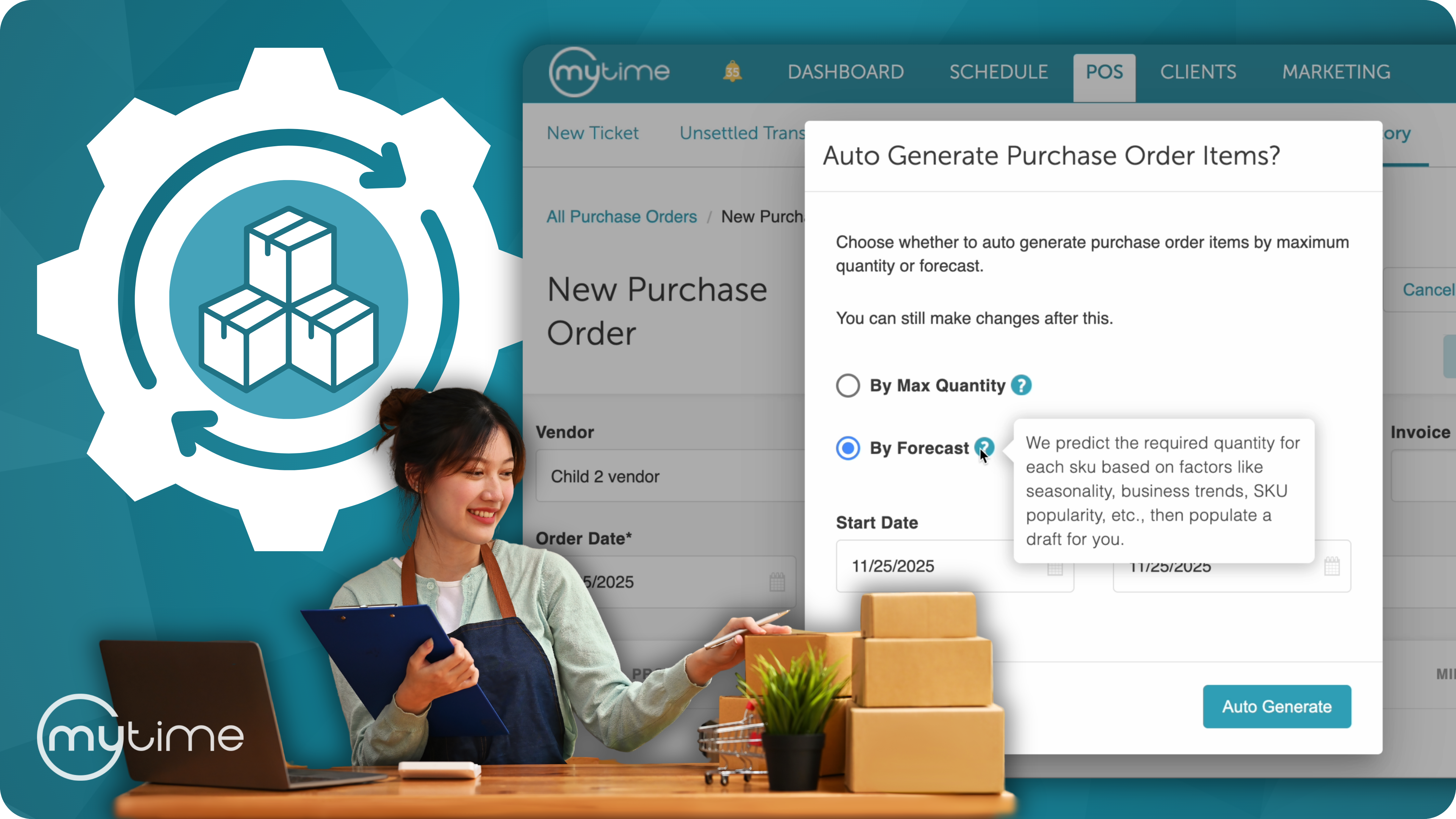
For multi-location service brands, inventory is one of the most important—and most expensive—parts of running a smooth operation. Yet most teams still rely on the same manual habits: eyeballing shelves, reordering everything when it “looks low,” or refilling SKUs back to a static max level.
The result? Too much of what isn’t selling, and not enough of what actually drives revenue.
Inventory forecasting changes that. By using real consumption patterns to predict not just what products your locations will need but when to order them, multi-location brands can stay ahead of demand—accounting for vendor lead times and delivery gaps before they become a problem. The result is smarter, more consistent purchasing that doesn’t depend on any one person remembering to check.
Below, we break down why forecasting matters, how it works in MyTime, and what it means for franchise operators aiming to run lean, profitable, and predictable operations.
What Is Inventory Forecasting?
Inventory forecasting is MyTime’s AI-driven solution leveraging historical usage patterns to predict what products your locations will need in the future. Instead of relying on guesswork or last month’s numbers, forecasting ensures your teams order the right amount of product at the right time.
For multi-location brands, this helps prevent two expensive problems:
(1) excess inventory that ties up cash, and (2) stockouts that interrupt services and reduce revenue.
Why Inventory Forecasting Matters
- Predicts how much to order and when—accounting for vendor lead times to prevent stockouts before they happen
- Aligns purchasing with real consumption, not guesswork or manual checks
- Automates daily reorder recommendations, reducing the time and effort spent on manual ordering
- Standardizes purchasing across every location
- Improves profitability, accuracy, and operational predictability
If your brand has more than a handful of locations, forecasting becomes essential—not optional.
.png?width=2000&height=900&name=$%20(1).png)
Why Inventory Planning Breaks Down at Scale
As brands grow, inventory challenges get more complex—not less. Three operational pain points show up again and again:
1. Overstock Drains Cash
Overbuying feels safe in the moment, but it’s expensive over time.
- Shelves fill with slow-moving SKUs
- Shrink, expiration, and storage costs increase
- Capital that could support marketing, hiring, or expansion becomes trapped in product
Across a large footprint, even small miscalculations add up quickly.
2. Stockouts Limit Revenue and Hurt Trust
Stockouts are equally costly—but in the opposite direction.
- Required products run out, delaying or cancelling services
- Retail shelves sit empty, reducing per-visit revenue
- Members lose trust if their preferred products are frequently unavailable
- Manual ordering reacts to what’s already low—by the time a reorder is triggered, there may not be enough time to receive stock before it runs out
Reputation damage is hard to quantify, but operators feel it.
3. Manual Ordering Doesn’t Scale
What works for one location breaks down across 10, 50, or 200.
- Teams rely on gut feel or visual checks
- Decision-making varies wildly between locations
- No shared logic or systemwide view into broader consumption trends
- No visibility into vendor lead times, making it impossible to know whether a reorder placed today will arrive before stock runs out
Manual ordering becomes a patchwork—one that gets more costly every time the brand grows.
Why Forecasting Works Better Than Traditional Ordering
Forecasting solves the weaknesses of static min/max rules and manager intuition.
Here’s why:
- Static rules can’t keep up. They treat every SKU the same—even if demand is rising, falling, or seasonal.
- Consumption patterns reveal the real story. Forecasting identifies trends you’d never see from a shelf check.
- Automation removes bias. Human judgment tends to favor recent usage; forecasting uses a full history of data.
- Forecasting accounts for the full supply chain. Lead times and delivery gaps are factored in automatically, so reorders happen at the right time—not just when stock looks low.
Together, these advantages compound across every location—making forecasting not just a smarter way to order, but a more resilient way to operate.
How MyTime Inventory Forecasting Works
MyTime applies AI-driven forecasting specifically for multi-location service brands, using real consumption data linked to both services and retail sales.
Here’s how it works:
1. Forecasting Built on Real Consumption Trends
MyTime evaluates usage across multiple windows—30, 60, 90 days, and up to one year when possible. This helps surface:
- Seasonal spikes
- Consistent trends
- Changing demand (rising or falling)
- Regional differences
Forecasts are built on real activity, not assumptions.
2. Eligibility Rules Ensure Reliable, Data-Backed Predictions
Not every product has enough data to produce a reliable forecast.
To keep predictions accurate at scale, MyTime evaluates each SKU’s activity against configurable criteria to determine eligibility for forecasting.
MyTime uses the following eligibility rules to determine which SKUs qualify:
- Lookback window (90/180/365 days): how far back MyTime reviews usage for each SKU
- Minimum number of days with sales or consumption: ensures the SKU has enough real activity to model upcoming needs (e.g., a product sold only twice in 90 days isn’t forecasted and instead follows Max logic).
These rules decide which SKUs qualify for forecasting based on available data, protecting teams from inaccurate predictions and keeping forecasts focused on products with meaningful activity.
3. A Built-In Safeguard for SKUs With Limited Data
If a product doesn’t qualify for forecasting, MyTime automatically replenishes it using Max logic—ensuring nothing slips through the cracks.
Max logic:
- Replenishes products up to the franchise-set maximum stock levels
- Respects vendor requirements such as minimum order quantities (MOQs)
- Rounds forecasted quantities up to the nearest MOQ multiple, ensuring order requirements are always met without exceeding set stock limits
4. Optimized Ordering in One Streamlined Purchase Order
For brands that want the most precise approach to restocking, MyTime’s forecasted replenishment ordering goes beyond predicting demand—it factors in the entire supply chain picture.
The system accounts for vendor lead times and target stock periods, then automatically calculates how much needs to be ordered right now. Specifically, it weighs:
- Forecasted reorder point: the predicted quantity needed to cover the vendor lead time
- Forecasted consumption: the predicted quantity needed for your target stock period
- Offset by quantity already on hand or on order
The result runs daily across all locations, surfacing a ready-to-act replenishment list without requiring anyone to initiate the process.
5. Full Visibility Into the Data Behind Every Recommendation
MyTime consolidates all recommended quantities into a single draft PO:
- Forecast quantities for SKUs that met the eligibility threshold
- Max quantities for SKUs that did not qualify
No duplicate workflows. No missed items. No switching between modes. Each line item is tagged to show how its quantity was determined—whether entered manually, generated by Max, or driven by forecast—so your team always knows the reasoning behind every recommendation.
6. Full Visibility Into the Data Behind Every Recommendation
SKU-level charts are surfaced exactly where your team needs them during ordering. Two views are available for each product:
- Historical consumption alongside predicted demand, giving a clear picture of how past usage informs the forecast
- Consumption history broken down across the past 30, 60, and 90 days, including periods of zero usage
Together they give your team clear visibility into not just what to order, but why.
-1.png?width=2000&height=900&name=Untitled%20design%20(62)-1.png)
What This Means for Franchise Operators
1. A More Profitable Inventory Mix
You keep the products that move and reduce the ones that don’t. Margins improve almost immediately.
2. Less Cash Trapped on Shelves
Lean, data-backed replenishment frees up capital for growth initiatives.
3. Fewer Stockouts and Emergency Orders
Because the system accounts for vendor lead times and delivery gaps—not just current stock levels—locations stay prepared for demand before shortages have a chance to develop.
4. Predictable Service Delivery
Clients get the same consistent experience across every location.
5. Your Team Reclaims Time
No more spreadsheets, double-checking shelves, or manually deciding when and what to reorder. The system surfaces daily recommendations automatically, so your team reviews and approves rather than builds from scratch.
6. Brand-Wide Consistency
Every location follows the same logic, improving financial performance and trust in the system
Using Forecasting to Optimize Both Staffing and Inventory at Scale
Inventory Forecasting becomes even more powerful when paired with MyTime’s Labor Forecasting. Together, they give franchises a forward-looking view into both product needs and staffing requirements—two of the biggest drivers of operational efficiency.
Combined, they help operators:
- Predict upcoming service volume
- Align staffing and product needs based on real demand
- Plan weeks ahead with greater accuracy
- Strengthen unit economics across every location
This is the foundation of predictive operations—a smarter way to run a multi-location business.
FAQs: Common Questions About Inventory Forecasting
How accurate is inventory forecasting?
MyTime generates highly reliable forecasts for SKUs with sufficient activity. Only products that meet the eligibility rules are forecasted.
What data does MyTime use?
Historical consumption, service volume, seasonality, SKU popularity, and recent velocity—analyzed through AI-driven forecasting models.
What if a SKU doesn’t have enough history?
It automatically uses Max logic for replenishment.
Can managers override recommendations?
Yes. Operators can review and adjust any quantity before submitting the purchase order.
How do Forecast and Max quantities work together?
Both flow into a single, consolidated purchase order.
Does MyTime account for vendor lead times when generating order recommendations?
Yes. MyTime’s forecasted replenishment ordering factors in vendor lead times and target stock periods to calculate precise order quantities automatically—so locations stay stocked ahead of demand, not just reacting to it.
Upgrade to Predictive Inventory Planning
If your teams are still relying on spreadsheets, min/max rules, or gut feel, you’re leaving margin, cash flow, and consistency on the table. Inventory Forecasting changes that.
MyTime gives multi-location brands a smarter, demand-driven way to order the right products at the right time—reducing cost, protecting revenue, and creating a unified, predictable operational model across every location.
→ Schedule a personalized demo and see inventory forecasting in action.


